CM Uttarakhand Pays Tribute to Explorer Nain Singh Rawat
Synopsis
The Chief Minister's Office of Uttarakhand paid homage to legendary 19th-century explorer and cartographer Nain Singh Rawat on his birth anniversary, honouring his secret surveys of Tibet and his Royal Geographical Society gold medal of 1877.
Key Takeaways
Nain Singh Rawat was a 19th-century explorer and cartographer from the Kumaon region of present-day Uttarakhand.
He conducted secret surveys of Tibet for the British Survey of India , travelling in disguise as a Tibetan pilgrim.
He received the Royal Geographical Society's gold medal in 1877 , one of geography's highest honours.
The Chief Minister's Office of Uttarakhand posted the tribute on October 21, 2026 , marking his birth anniversary.
Uttarakhand regularly honours Himalayan explorers and historical figures through official communications to reinforce regional identity.
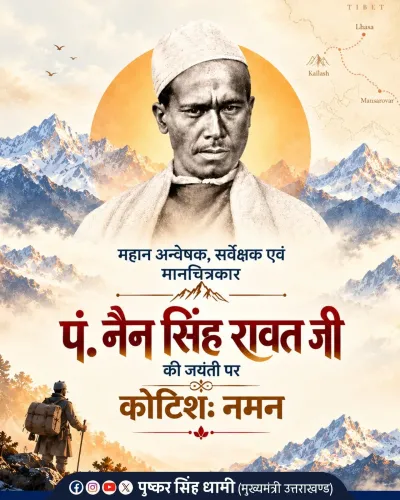
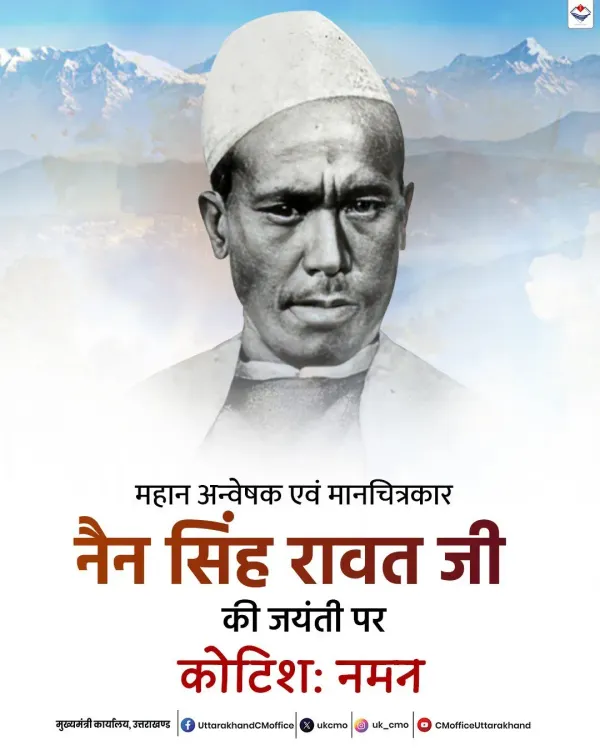
A cartographer who mapped the roof of the world in secret — braving Tibet's forbidden terrain disguised as a pilgrim — receives his annual salute from the state he called home. The Chief Minister's Office of Uttarakhand on Wednesday, October 21, 2026, posted a tribute on X marking the birth anniversary of Nain Singh Rawat, honouring him as a 'great explorer and cartographer.'
The post, written in Hindi, reads: 'Mahan anveshak evam manchitrakaar Nain Singh Rawat ji ki jayanti par unhe kotishaha naman' — ('Countless salutations to the great explorer and cartographer Nain Singh Rawat on his birth anniversary.')
The Man Who Walked Forbidden Tibet with a Rosary and a Compass
Nain Singh Rawat was born in the Kumaon region of what is today Uttarakhand, and he went on to become one of the most consequential surveyors of the 19th century. Recruited and trained by the British Survey of India, he was deployed to map the largely uncharted and heavily guarded territories of Tibet — a mission that European explorers simply could not undertake openly. Rawat travelled in disguise, often posing as a Tibetan Buddhist pilgrim, counting his paces with a modified prayer rosary and recording altitude with a thermometer hidden inside a walking staff. Each step was a data point. Each prayer bead a measurement. The results were extraordinary. His surveys produced the first reliable cartographic data on vast stretches of the Tibetan plateau, the course of the Tsangpo river, and the altitude of Lhasa. The Royal Geographical Society in London recognised his contributions with its prestigious gold medal in 1877 — a rare and remarkable honour for an Indian surveyor working under colonial constraints.Uttarakhand's Tradition of Honouring Its Himalayan Sons
The tribute fits a consistent pattern in Uttarakhand's official communications. The state government regularly invokes the legacy of its explorers, mountaineers, and warriors from the high Himalayan districts — figures whose stories anchor local identity and pride. Rawat is among the most globally recognised of these, with his contributions acknowledged in the history of geography worldwide. For residents of Kumaon and the broader state, his story is a reminder that some of the world's most consequential geographic knowledge was gathered not by well-funded European expeditions, but by a man on foot, counting steps through the snow. The explorer who turned every footfall into a fact deserves more than a footnote — and Uttarakhand, at least on his birth anniversary, makes sure he gets it.Point of View
A state whose identity is deeply tied to the Himalayas, Rawat's story of individual courage and scientific contribution is particularly potent political symbolism. Elevating such figures also quietly asserts the intellectual and exploratory legacy of India's hill communities at a time when their contemporary contributions — from defence to disaster response — dominate the national narrative. Whether the tribute translates into lasting institutional recognition, such as museum programmes or school curricula, is the real test of the state's commitment to his legacy.
NationPress
21 Oct 2026
Frequently Asked Questions
Who was Nain Singh Rawat?
Nain Singh Rawat was a 19th-century explorer and cartographer from the Kumaon region of present-day Uttarakhand, who conducted secret surveys of Tibet for the British Survey of India while disguised as a Tibetan pilgrim.
What award did Nain Singh Rawat receive?
Nain Singh Rawat received the Royal Geographical Society's prestigious gold medal in 1877 in recognition of his extraordinary surveying work in Tibet.
Why is Nain Singh Rawat's birth anniversary celebrated?
His birth anniversary is observed to honour his pioneering contributions to geography and cartography, particularly his dangerous and covert mapping of the Tibetan plateau at a time when Tibet was closed to outsiders.
Which state in India claims Nain Singh Rawat as its own?
Uttarakhand, specifically the Kumaon region, is the home state of Nain Singh Rawat, and the state government regularly pays tribute to him on his birth anniversary.
How did Nain Singh Rawat secretly survey Tibet?
He travelled disguised as a Tibetan Buddhist pilgrim, using a modified prayer rosary to count his paces and a thermometer hidden in a walking staff to record altitude, feeding precise geographic data back to the Survey of India.