CM Joseph Vijay Orders Fast-Track Justice for Serious Crimes
Synopsis
Chief Minister C. Joseph Vijay has directed Tamil Nadu's law-enforcement and prosecution machinery to promptly register serious criminal cases, investigate them swiftly, and secure stringent punishments through expedited trials, signalling a firm law-and-order stance from the new administration.
Key Takeaways
Joseph Vijay issued the directive on 25 May 2026 via the official Chief Minister's Office account.
The order covers all three stages of criminal justice: case registration, investigation, and trial .
The stated goal is to ensure severe punishments are secured for those who commit serious offences.
The directive implicates both the Tamil Nadu Police and the state's public prosecution offices.
No specific offence categories or timelines were enumerated in the post; operational definition is left to implementing agencies.
Follow-up government orders on special courts or case-disposal benchmarks will determine the directive's practical impact.
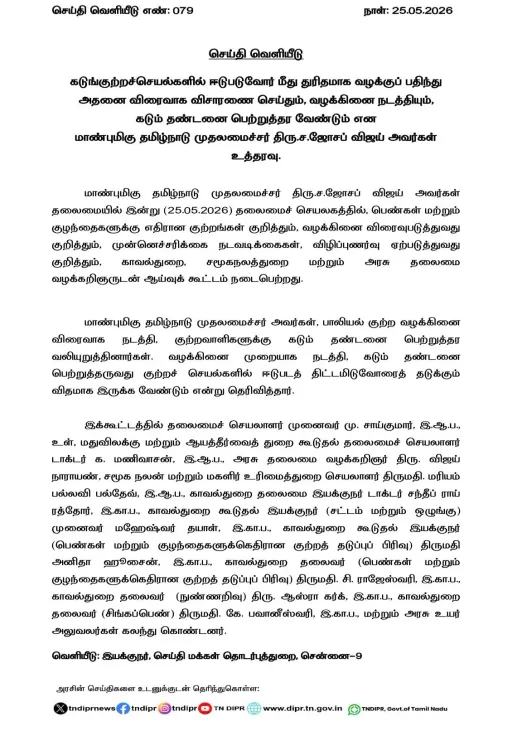
The Chief Minister's Office of Tamil Nadu announced on Monday, 25 May 2026, that Chief Minister C. Joseph Vijay has directed law-enforcement and prosecution agencies to swiftly register cases involving serious offences, conduct investigations without delay, and ensure that stringent punishments are secured through expedited trials.
Context
The directive, posted in Tamil on the official CMO account, states: 'கடுங்குற்றச்செயல்களில் ஈடுபடுவோர் மீது துரிதமாக வழக்குப் பதிந்து அதனை விரைவாக விசாரணை செய்தும், வழக்கினை நடத்தியும், கடும் தண்டனை பெற்றுத்தர வேண்டும்' — meaning, 'Those who engage in serious crimes must have cases registered against them promptly, investigations conducted swiftly, trials pursued, and severe punishments secured.' The order covers the full chain of criminal justice: first-information registration, police investigation, and courtroom prosecution.
The instruction comes from Chief Minister C. Joseph Vijay, who founded the political party Tamizhaga Vettri Kazhagam before the 2026 Tamil Nadu assembly elections and subsequently assumed office as Chief Minister.
Policy Backdrop
Directives of this nature are a recurring feature of Indian state governance, particularly when administrations seek to signal a tough posture on law and order. Tamil Nadu has previously deployed fast-track mechanisms — including special courts — for offences against women and children, and the state police have been periodically instructed to reduce pendency in serious crime categories.
The emphasis on all three stages — registration, investigation, and trial — reflects an acknowledgment that delays at any single stage can frustrate the overall goal of deterrence. Public prosecutors and the state's law department are implicitly drawn into the directive alongside the police.
Stakeholders and Impact
Crime victims and their families stand to benefit most directly if the directive translates into measurable reductions in case-disposal timelines. For the Tamil Nadu Police, the order sets an expectation of accelerated charge-sheeting and closer coordination with public prosecutors to minimise adjournments.
Defence lawyers and civil-liberties groups may watch for how 'serious offences' are defined operationally, since overly broad categorisation could affect due-process standards. The directive does not, as stated, specify particular offence categories, leaving implementation discretion with the police and prosecution machinery.
What's Next
The critical test will be whether follow-up government orders establish measurable timelines or create additional special courts to absorb the caseload. Observers will track whether the Tamil Nadu Police and the office of the Public Prosecutor issue corresponding operational instructions aligned with the Chief Minister's directive.
A sustained reduction in trial pendency for serious offences would mark a concrete outcome; without institutional mechanisms to back the directive, such orders risk remaining aspirational. The government's next steps on court infrastructure and prosecution staffing will signal how seriously the directive is intended to be operationalised.
Point of View
Designed to demonstrate executive will on public safety before institutional inertia sets in. The breadth of the instruction — spanning registration, investigation, and trial — suggests awareness that bottlenecks exist at multiple points in the criminal justice chain, not just at the police stage. However, the absence of defined offence categories or measurable timelines means the directive's impact will depend heavily on whether subordinate agencies issue concrete operational orders. Historically, such directives in Indian states yield results only when backed by dedicated court infrastructure and prosecution capacity — making the government's next institutional moves the real indicator of intent.
NationPress
12 Oct 2026
Frequently Asked Questions
What has Tamil Nadu CM Joseph Vijay ordered regarding serious crimes?
CM Joseph Vijay has directed that cases involving serious offences be registered promptly, investigated swiftly, tried without delay, and that severe punishments be secured for the accused.
Who is C. Joseph Vijay and how did he become Tamil Nadu Chief Minister?
C. Joseph Vijay is a Tamil film actor who founded the political party Tamizhaga Vettri Kazhagam ahead of the 2026 Tamil Nadu assembly elections and subsequently became Chief Minister following the election.
What does a fast-track criminal justice directive mean for Tamil Nadu Police?
It places an expectation on police to file charge sheets quickly and coordinate closely with public prosecutors to reduce delays in bringing serious cases to trial.
Will Tamil Nadu set up special courts following this directive?
The directive as announced does not specifically mention special courts, but observers are watching for follow-up government orders that could create or expand dedicated court infrastructure for serious offences.
How common are such law-and-order directives from Indian Chief Ministers?
Such directives are relatively common across Indian states, particularly at the start of new administrations, and are typically aimed at signalling a tough posture on crime; their effectiveness depends on institutional follow-through.