CM Vijay Witnesses Hitachi Energy MoU Worth Rs 1,000 Cr in TN
Synopsis
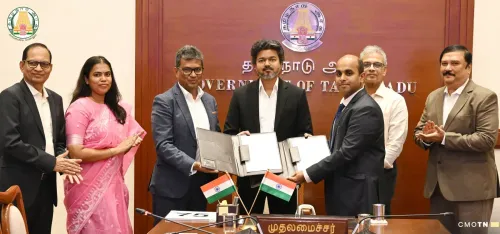
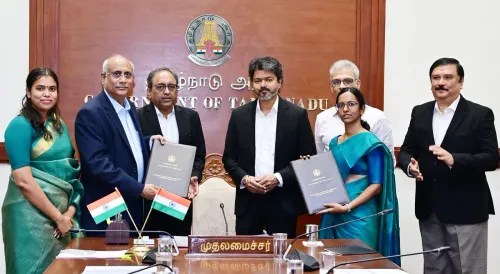
Chief Minister S. Joseph Vijay witnessed the signing of MoUs with Hitachi Energy for two expansion projects — a technology-services unit in Porur and a manufacturing facility in Chengalpattu — together valued at Rs 1,000 crore and targeting 1,000 high-skill technology jobs in Tamil Nadu.
Key Takeaways
Rs 1,000 crore in combined investment committed by Hitachi Energy across two Tamil Nadu facilities.
1,000 high-technology jobs are projected to be created through the two expansion projects.
Hitachi Energy Technology Services Private Limited in Porur will expand its technology-services operations.
Hitachi Energy India in Chengalpattu will scale up its manufacturing capacity.
The MoUs were signed in the presence of Chief Minister S.
Joseph Vijay on 7 July 2026 .
The deals align with Tamil Nadu's Industrial Policy 2021 focus on high-value manufacturing and skilled employment near Chennai.
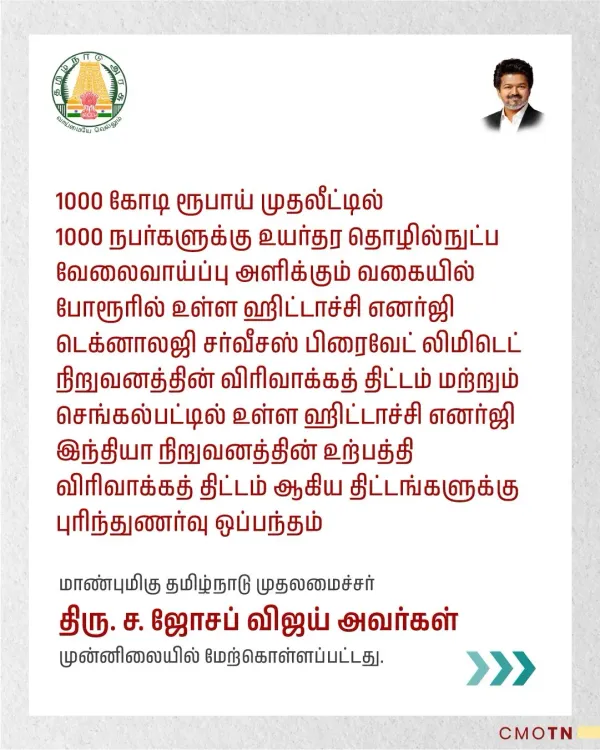
The Chief Minister's Office of Tamil Nadu announced on Tuesday, 7 July 2026 that Memoranda of Understanding were signed in the presence of Chief Minister S. Joseph Vijay for two expansion projects by Hitachi Energy in the state — together promising an investment of Rs 1,000 crore and 1,000 high-technology jobs.
Context
The MoUs cover two distinct Hitachi Energy entities in the Chennai metropolitan region. The first is an expansion of Hitachi Energy Technology Services Private Limited, located in Porur, a Chennai suburb that has emerged as a hub for IT and technology-services operations. The second is a manufacturing expansion by Hitachi Energy India at its facility in Chengalpattu, an industrial district south of Chennai with established manufacturing clusters.
The Tamil Nadu government's post stated that the two projects together will create 1,000 high-quality technology employment opportunities backed by a combined investment of Rs 1,000 crore. The signing took place in the presence of Chief Minister Joseph Vijay, underscoring the state's top-level commitment to the deals.
Policy Backdrop
Tamil Nadu's Industrial Policy 2021 set an explicit target of attracting higher-value manufacturing and technology investments, with a focus on skilled employment generation in the Chennai region. The state has since pursued a consistent strategy of signing targeted MoUs with global energy and technology firms to anchor high-skill jobs near the city.
Hitachi Energy, the global Japanese firm specialising in power grids, electrification, and energy technology, already maintains a manufacturing presence in India. The two Chennai-region facilities — one focused on technology services, the other on manufacturing — represent a deepening of that footprint. The pairing of a services expansion in Porur with a manufacturing scale-up in Chengalpattu reflects a dual-track approach to capacity growth in the power and automation sector.
Tamil Nadu has attracted similar investment commitments from global energy and automation companies periodically since the early 2010s, positioning the state as a preferred destination for advanced manufacturing in South India.
Stakeholders and Impact
The most direct beneficiaries are technology professionals and energy-sector workers in the Chennai metropolitan area. The 1,000 projected roles are characterised as high-grade technology positions, suggesting demand for engineers, energy systems specialists, and digital-infrastructure talent rather than general-labour categories.
Chengalpattu's existing industrial base — home to automotive, electronics, and manufacturing clusters — means local supply chains and ancillary services could also see activity. For Porur, the technology-services expansion adds to a corridor already dense with IT campuses, potentially intensifying competition for skilled talent in western Chennai.
The Rs 1,000 crore commitment also signals confidence from a global energy-technology major in Tamil Nadu's regulatory and infrastructure environment, which state officials have consistently cited as a differentiator when competing with other industrial states for foreign direct investment.
What's Next
The immediate milestones to watch are the disbursement timelines for the announced investment and the phased rollout of the 1,000 jobs — both of which will be subject to review during scheme implementation assessments. MoUs of this scale typically carry conditions tied to land allocation, infrastructure provisioning, and hiring benchmarks.
Tamil Nadu's investment promotion apparatus will likely integrate these commitments into the state's broader FDI tracking framework. How quickly the Porur technology-services unit and the Chengalpattu manufacturing facility move from MoU to ground-level expansion will be the key indicator of whether this announcement translates into durable economic impact for the region.
Point of View
And publicly own, the state's aggressive FDI posture. With Rs 1,000 crore and 1,000 jobs on paper, the harder test will be implementation: Tamil Nadu's track record on MoU conversion is generally strong, but timelines for Hitachi Energy's capital deployment will determine whether this becomes a headline or a benchmark. The announcement also reinforces Chengalpattu's emergence as a serious manufacturing corridor, potentially attracting follow-on investments from other global energy firms watching the state's policy environment.
NationPress
7 Jul 2026
Frequently Asked Questions
What is the Hitachi Energy MoU signed in Tamil Nadu?
Two MoUs were signed with Hitachi Energy for expansion projects in Tamil Nadu — one for a technology-services facility in Porur and another for a manufacturing scale-up in Chengalpattu — together committing Rs 1,000 crore in investment and 1,000 high-technology jobs.
Who is CM Joseph Vijay?
S. Joseph Vijay is the Chief Minister of Tamil Nadu, in whose presence the Hitachi Energy MoUs were signed on 7 July 2026.
Where are the Hitachi Energy facilities in Tamil Nadu?
Hitachi Energy Technology Services Private Limited operates in Porur, a Chennai suburb, while Hitachi Energy India's manufacturing facility is located in Chengalpattu, an industrial district south of Chennai.
How many jobs will the Hitachi Energy expansion create in Tamil Nadu?
The two expansion projects are expected to generate 1,000 high-quality technology employment opportunities in Tamil Nadu.
What is Tamil Nadu's industrial policy on foreign investment?
Tamil Nadu's Industrial Policy 2021 targets higher-value manufacturing and technology investments with a focus on skilled employment generation, particularly in the Chennai metropolitan region, and the state has consistently signed MoUs with global energy and technology firms under this framework.