CM Vijay writes to PM Modi on delimitation safeguards

Synopsis
Tamil Nadu Chief Minister Joseph Vijay has written to Prime Minister Narendra Modi, urging him to consider the Tamil Nadu Legislative Assembly's resolution on the proposed delimitation and enact a constitutional amendment to protect southern states' parliamentary representation ahead of the post-2026 census.
Key Takeaways
CM Joseph Vijay wrote to PM Narendra Modi on 13 August 2026 over the Union government's proposed parliamentary and assembly constituency delimitation.
The letter urges the Centre to consider the resolution passed by the Tamil Nadu Legislative Assembly and make a suitable constitutional amendment.
The seat freeze, locked to the 1971 census under the 84th and 87th Constitutional Amendments , is set to lift after the first post-2026 census.
Southern states fear that population growth disparities since 1971 will shift Lok Sabha seats northward, reducing their relative representation.
A constitutional amendment protecting state representation would require a special majority in both Houses of Parliament.
With the post-2026 census threatening to redraw India's political map in ways that could cost southern states parliamentary clout, Tamil Nadu Chief Minister Joseph Vijay has fired off a formal letter to Prime Minister Narendra Modi, urging the Centre to consider the resolution passed by the Tamil Nadu Legislative Assembly and enact a suitable constitutional amendment before the delimitation exercise proceeds.
What the Tamil Nadu assembly resolution demands
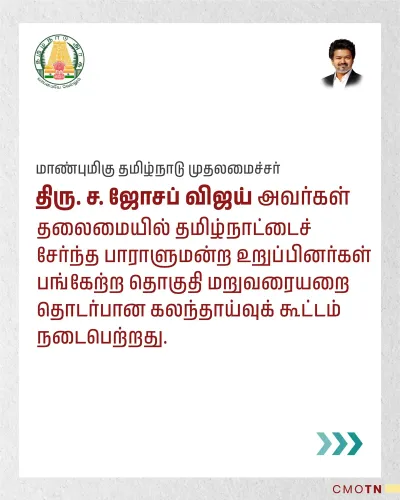
The Chief Minister's Office confirmed on Thursday, 13 August 2026 that CM Vijay has written to PM Modi specifically on the Union government's proposed delimitation of parliamentary and state assembly constituencies. The letter calls on the Prime Minister to examine the assembly resolution and act on it through an appropriate constitutional amendment — a direct signal that Chennai is not content to wait and watch as New Delhi shapes the redraw.
Why southern states see delimitation as existential
The stakes are not abstract. Under the Constitution (Eighty-fourth Amendment) Act, 2001 and the subsequent 87th Amendment, the freeze on readjusting Lok Sabha and assembly seat numbers — locked to the 1971 census — was extended until the first census after 2026. That census is now imminent, meaning the freeze is about to lift for the first time in over five decades.
The arithmetic worries the South. States like Tamil Nadu controlled population growth aggressively in the decades since 1971, achieving lower fertility rates earlier than many northern states. If seats are reallocated purely on current population, states that succeeded at family planning stand to lose representation relative to states that grew faster — a perverse outcome that Tamil Nadu and other southern states have long flagged as constitutionally unjust.
CM Vijay's move and what a constitutional amendment could fix
By anchoring his letter to a formal legislative resolution, CM Vijay elevates the demand beyond party politics: this is the elected assembly of Tamil Nadu — one of India's largest economies — speaking with a unified voice. The ask is a constitutional amendment that builds in safeguards, ensuring delimitation does not mechanically punish states for their own demographic success.
Any such amendment would need to pass both Houses of Parliament with a special majority, making it a significant political undertaking for the Modi government. Whether the Centre responds with a standalone safeguard mechanism, a revised delimitation formula, or a broader constitutional review will define the terms of the debate for every state south of the Vindhyas.
The letter from Chennai has been sent. The next move belongs to New Delhi — and the whole of southern India is watching.
Point of View
Tamil Nadu frames delimitation as a constitutional grievance of the state, not a political skirmish. It forces the Modi government to respond on the record ahead of what could become the most consequential redrawing of India's electoral map since independence. For the BJP, any concession to southern states risks friction with its northern base; any refusal risks hardening the South's growing sense of federal alienation — a tension that will define the politics of the delimitation decade.
NationPress
28 Sept 2026
Frequently Asked Questions
What is delimitation and why does it matter for Tamil Nadu?
Delimitation is the process of redrawing parliamentary and assembly constituency boundaries and reallocating seats based on population. Tamil Nadu fears that because its population grew more slowly than northern states since 1971, a fresh delimitation could reduce its share of Lok Sabha seats.
Why has the delimitation exercise been frozen since 1971?
The 84th Constitutional Amendment (2001) and the 87th Amendment extended the freeze on seat readjustment — based on the 1971 census — until after the first census following 2026, to avoid penalising states that successfully controlled population growth.
What did the Tamil Nadu Legislative Assembly resolve on delimitation?
The Tamil Nadu Legislative Assembly passed a resolution urging the Union government to take the state's concerns into account and make appropriate constitutional provisions before proceeding with delimitation. The specific text of the resolution has been communicated to PM Modi through CM Vijay's letter.
What constitutional amendment is Tamil Nadu asking for?
Tamil Nadu is urging an amendment that would build safeguards into the delimitation framework so that states with lower population growth are not disproportionately disadvantaged in parliamentary seat allocation.
Which other southern states share Tamil Nadu's concerns on delimitation?
Several southern states — including Kerala, Karnataka, Andhra Pradesh, and Telangana — have raised similar concerns, arguing that their success in reducing fertility rates should not cost them political representation in Parliament.