CM Vishnu Deo Sai marks one year of Mukhyamantri Grameen Bus Yojana
Synopsis
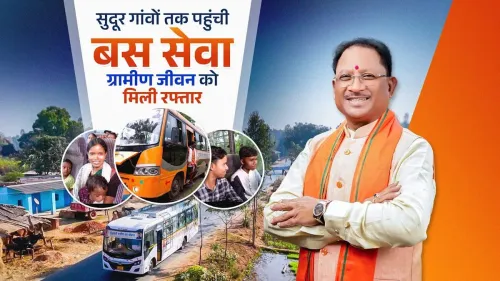
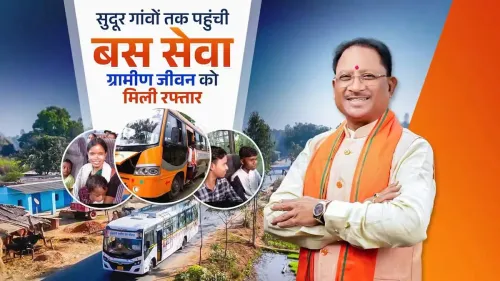
Chhattisgarh CM Vishnu Deo Sai marked one year of the Mukhyamantri Grameen Bus Yojana on October 4, 2026, hailing the scheme for connecting remote villages to education, healthcare, employment, and markets through regular bus services.
Key Takeaways
Mukhyamantri Grameen Bus Yojana has completed one year of operations in Chhattisgarh as of October 2026 .
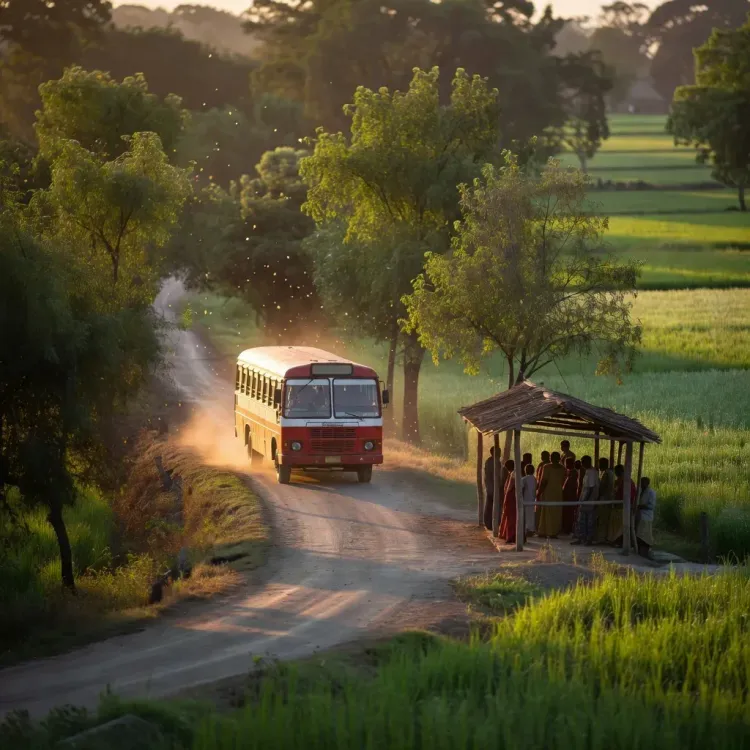
The scheme targets remote and rural areas that previously lacked any regular public bus connectivity.
CM Vishnu Deo Sai identified four key benefits : improved access to education, healthcare, employment, and markets for villagers.
The BJP state government frames the scheme as foundational rural infrastructure, not merely a transport add-on.
Chhattisgarh's geography — large forested and tribal belts — makes last-mile connectivity a persistent developmental challenge.
The anniversary announcement signals the government's intent to highlight rural outreach as a core political and policy priority.
A year ago, reaching a bus stop meant a journey in itself for millions living in Chhattisgarh's remotest villages. Today, Chhattisgarh Chief Minister Vishnu Deo Sai has marked the completion of one successful year of the Mukhyamantri Grameen Bus Yojana, declaring that the distance once standing between rural communities and opportunity is now being steadily erased.
What the scheme set out to solve
For years, villages deep inside Chhattisgarh's hinterland had no reliable public bus connectivity. Getting a child to school, reaching a district hospital, or simply travelling to the nearest market required navigating a patchwork of shared vehicles, long walks, and unpredictable waits. The Mukhyamantri Grameen Bus Yojana was designed specifically to plug that gap — bringing scheduled, regular bus services to areas where none existed.
CM Sai, posting on Sunday, October 4, 2026, framed the scheme in terms far beyond logistics: 'यह केवल परिवहन सुविधा का विस्तार नहीं' ('This is not merely an expansion of transport facility') — it is, he wrote, a campaign to connect the dreams, capabilities, and possibilities of rural people with new avenues of development.
Four doors that connectivity opens
The chief minister specifically named the four pillars that regular bus access now unlocks for village residents: education, healthcare, employment, and market access. Each of these sectors demands physical mobility — a student who cannot reliably reach a college, a patient who cannot reach a specialist, a daily-wage earner who cannot get to work on time, all face compounding disadvantages that a single missing transport link can cause.
By anchoring the scheme's first anniversary around this four-point framework, the BJP government in Raipur is signalling that rural connectivity is being treated as foundational infrastructure — on par with roads, power, and water — rather than a secondary welfare add-on.
One year in: the political and developmental stakes
Chhattisgarh, a state with vast forested and tribal regions, has historically struggled with the last-mile connectivity problem. The BJP government, which returned to power in Chhattisgarh in late 2023 under CM Sai, has positioned rural outreach and infrastructure as its signature domestic agenda. A scheme completing its first year — and being publicly celebrated at the top — is a marker of both administrative follow-through and political messaging ahead of future electoral cycles.
The broader implication is clear: when villages are stitched into the transport network, the state's economic activity does not merely spread geographically — it compounds. A student who can reach college returns as a skilled worker. A farmer who can reach the market gets a better price. The bus, in this framing, is not a vehicle. It is a multiplier.
One year of routes may be the headline — but the real count is every village, every early-morning commuter, and every first-generation college student who now boards that bus.
Point of View
Health, and livelihood — rather than a standalone transport scheme — the BJP is building a narrative of holistic rural empowerment that doubles as political capital. The emphasis on 'one year of success' also reflects a broader BJP playbook of marking scheme anniversaries publicly to sustain administrative momentum and voter recall. Whether ridership data and route expansion figures bear out the optimism will determine how durable that narrative proves.
NationPress
4 Oct 2026
Frequently Asked Questions
What is the Mukhyamantri Grameen Bus Yojana in Chhattisgarh?
The Mukhyamantri Grameen Bus Yojana is a Chhattisgarh state government scheme that provides regular, scheduled bus services to remote and rural villages that previously had no reliable public transport connectivity.
How long has the Mukhyamantri Grameen Bus Yojana been running?
The scheme has completed one year of operations as of October 2026, with CM Vishnu Deo Sai marking the anniversary on October 4, 2026.
What benefits does the Grameen Bus Yojana provide to villagers?
According to CM Sai, the scheme improves rural access to education, healthcare, employment, and markets — addressing a long-standing last-mile connectivity problem in Chhattisgarh's hinterland.
Who launched the Mukhyamantri Grameen Bus Yojana?
The scheme was launched by the BJP government in Chhattisgarh under Chief Minister Vishnu Deo Sai, who took office after the BJP's return to power in the state in late 2023.
Why is rural bus connectivity important in Chhattisgarh?
Chhattisgarh has large forested and tribal regions where physical remoteness has historically limited residents' access to schools, hospitals, and job markets, making reliable public transport a foundational development need.