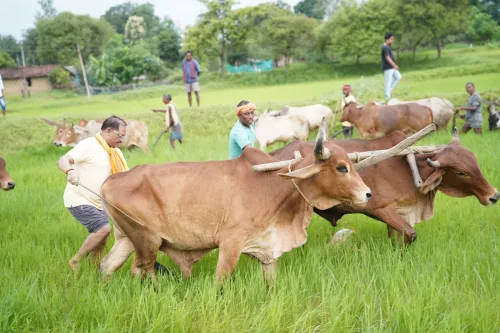
CM Vishnu Deo Sai ploughs fields in his home village Bagiya

Synopsis
Chhattisgarh Chief Minister Vishnu Deo Sai returned to his ancestral village Bagiya on 18 August 2026 and ploughed fields with bullocks, performing the traditional kharif-season biyasi and calling farming not a livelihood but a 'sanskar of life' rooted in his farming family heritage.
Key Takeaways
Chhattisgarh Chief Minister Vishnu Deo Sai visited his ancestral village Bagiya on 18 August 2026 and ploughed fields using bullocks.
He performed biyasi , the traditional second ploughing done during the kharif season, a labour-intensive farming practice common across central India.
Sai described farming as ' a sanskar of life ' — not merely a livelihood — citing his origins in a farming family from the Jashpur region.
He said the soil of Bagiya taught him 'the dignity of labour, harmony with nature, and staying connected to one's roots.' The visit comes during the active paddy-cultivation season in Chhattisgarh , one of India's most agrarian states.
Roots run deep for Chhattisgarh Chief Minister Vishnu Deo Sai. On Tuesday, 18 August 2026, he returned to his ancestral village Bagiya and did what his forebears have done for generations — guided a pair of bullocks across a field, turning the soil in the traditional practice of biyasi (second ploughing of the season).
In a post shared on X, the Chief Minister described the moment in his own words: 'The connection with one's soil fills the mind with a unique sense of warmth and energy. I ploughed the fields in my home village Bagiya with bullocks and performed biyasi. The earthy fragrance of the soil and the greenery of the fields brought old memories of farming back to life.'
Farming as 'a sanskar of life', not just a livelihood
Sai, who comes from a farming family of the Jashpur region of Chhattisgarh, drew a deliberate distinction between farming as economic necessity and farming as cultural identity. 'Because I come from a farmer's family,' he wrote, 'farming is not merely a livelihood for me — it is a sanskar (a value instilled in the soul) of life. This very soil has taught me the dignity of labour, harmony with nature, and staying connected to one's roots.'
The gesture is personal, not ceremonial. Biyasi — the second tilling done after the first monsoon rains have softened the earth — is a labour-intensive, time-sensitive task that working farmers across central India carry out every kharif season. A sitting Chief Minister picking up the plough himself, rather than posing beside one, carries a different weight.
Why the image of a ploughing CM lands differently in Chhattisgarh
Chhattisgarh is one of India's most agrarian states. A substantial share of its population depends on paddy cultivation, and the kharif season — anchored by rice — is the heartbeat of the rural economy. For a Chief Minister whose political base includes tribal and farming communities across districts like Jashpur, Raigarh, and Surguja, the act of returning to the field is a statement about identity as much as it is a photograph.
Sai's BJP government has positioned support for farmers — through paddy procurement, irrigation expansion, and rural welfare schemes — as a central plank of its administration. The image of the Chief Minister in the mud, not behind a desk, reinforces that framing without a word of policy language.
The soil of Bagiya, it turns out, still has something to say about the man who governs from Raipur.
Point of View
When farmer sentiment is most acute. For a BJP government that has staked significant political capital on paddy procurement and rural welfare in a predominantly farming state, the image of the CM in the field rather than at a podium is a deliberate counter to perceptions of urban-elite governance. It also speaks to Chhattisgarh's tribal and OBC farming communities — Sai's core constituency — in a language they understand viscerally. The move fits a broader BJP pattern of leaders performing their rural origins as a form of political authentication.
NationPress
18 Aug 2026
Frequently Asked Questions
Where is Vishnu Deo Sai's home village Bagiya?
Bagiya is the ancestral village of Chhattisgarh Chief Minister Vishnu Deo Sai, located in the Jashpur district of Chhattisgarh.
What is biyasi in farming?
Biyasi refers to the second ploughing of agricultural fields, typically carried out after the first monsoon rains have softened the soil, as part of kharif season preparation in central India.
Is Vishnu Deo Sai from a farming family?
Yes, Chief Minister Vishnu Deo Sai comes from a farming family in the Jashpur region of Chhattisgarh and has publicly described farming as a 'sanskar of life' rooted in his upbringing.
What crops does Chhattisgarh mainly grow?
Chhattisgarh is one of India's major paddy-producing states. Rice is the dominant kharif crop, earning the state the nickname 'rice bowl of central India'.
Why did CM Vishnu Deo Sai plough fields in August 2026?
August falls in the heart of the kharif agricultural season. Sai visited his home village Bagiya and performed biyasi — the traditional second ploughing — describing it as a reconnection with his farming roots and cultural identity.