CM Mohan Yadav: 5 New Ayurvedic Colleges, AYUSH Push in MP
Synopsis
MP Chief Minister Dr. Mohan Yadav has announced 5 new Ayurvedic colleges and 50-bed AYUSH hospitals across 12 districts, with Union approval secured for colleges in 7 districts under the National AYUSH Mission. Six district AYUSH offices are ready and 20 mobile units cover gaps.
Key Takeaways
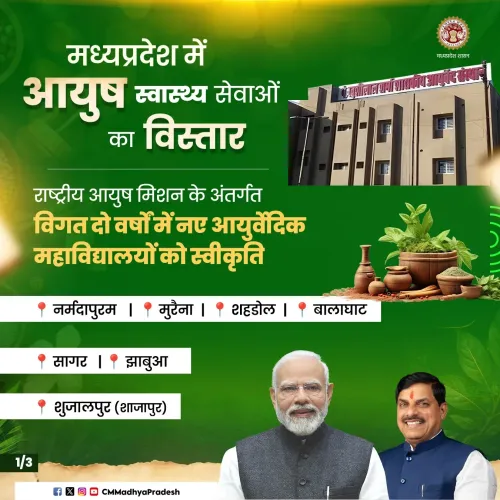
5 new Ayurvedic colleges are being established in Madhya Pradesh, with Union government approval already received for colleges in Narmadapuram, Murena, Shahdol, Balaghat, Sagar, Jhabua and Shajapur under the National AYUSH Mission.
50-bed AYUSH hospitals are being launched in 12 districts to provide inpatient traditional medicine care.
6 district AYUSH offices have been completed across the state.
53 of 80 AYUSH dispensary buildings have been constructed; work on the remaining 27 is ongoing.
20 AYUSH Mobile Medical Units have been deployed in districts that currently lack any AYUSH medical facility.
Madhya Pradesh Chief Minister Dr. Mohan Yadav announced on Friday, 22 May 2026 that the state is in the process of establishing 5 new Ayurvedic colleges and launching 50-bed AYUSH hospitals in 12 districts, underlining the government's push to expand traditional medicine infrastructure across the state.
In his post, the Chief Minister stated: 'प्रदेश में 5 नए आयुर्वेदिक कॉलेज स्थापित करने और 12 जिलों में 50 बिस्तर क्षमता के आयुष अस्पताल प्रारंभ करने की कार्यवाही चल रही है' — 'Work is under way to establish 5 new Ayurvedic colleges in the state and to launch 50-bed AYUSH hospitals in 12 districts.'
Context
Dr. Yadav noted that under the National AYUSH Mission, the Union government has approved construction of new Ayurvedic colleges in Narmadapuram, Murena, Shahdol, Balaghat, Sagar, Jhabua and Shajapur over the past two years. These seven districts span geographically diverse and, in several cases, historically underserved parts of Madhya Pradesh. The approvals mark a significant step in closing the gap between demand for traditional medicine education and available institutional capacity in the state.
Policy Backdrop
The National AYUSH Mission, launched in 2014 by the Union government, was designed to mainstream Ayurveda, Yoga, Unani, Siddha and Homeopathy within India's public healthcare system through state-level college construction, hospital upgrades and dispensary networks. Madhya Pradesh has pursued phased expansion under this framework, with central funding channelled to districts that lack adequate AYUSH infrastructure. The Ministry of AYUSH has been the nodal body coordinating approvals and financial releases to participating states.
Dr. Yadav also confirmed that 6 district AYUSH offices have been completed, and that 53 of 80 AYUSH dispensary buildings have been constructed. The remaining dispensaries and the new colleges represent the next tranche of the state's infrastructure push under the mission.
Stakeholders and Impact
The expansion is expected to directly benefit rural patients in districts currently without AYUSH facilities, Ayurveda students seeking college seats closer to home, and AYUSH practitioners who need institutional bases for clinical practice. For districts where no AYUSH medical facility exists, the state has deployed 20 AYUSH Mobile Medical Units as an interim measure, ensuring continuity of traditional medicine services until permanent infrastructure is operational.
The 50-bed hospitals, once functional, will provide inpatient AYUSH care — a step up from the outpatient-only dispensary model that has historically characterised rural AYUSH delivery in the state. This has particular significance for tribal and agrarian districts such as Jhabua, Shahdol and Balaghat, where access to any formal healthcare remains limited.
What's Next
The construction timelines for the seven newly approved Ayurvedic colleges and the 12 district AYUSH hospitals will be closely watched. Progress reports from the state health department and funding-release notifications from the Ministry of AYUSH are expected to provide clearer operational dates. The rollout of the 20 mobile medical units across facility-deficient districts will serve as an early indicator of the state's implementation pace. Subsequent state budget presentations may also detail capital allocations for the remaining 27 AYUSH dispensary buildings yet to be constructed.
Point of View
Not merely a supplementary system. By securing Union approvals for colleges in seven districts — many of them tribal or agrarian — the state is translating a national policy priority into ground-level infrastructure in constituencies that matter electorally and socially. The deployment of mobile medical units as a bridge measure reflects a pragmatic acknowledgement that construction timelines lag community need. How quickly these colleges and hospitals become operational will determine whether this announcement marks genuine systemic change or remains a work-in-progress on paper.
NationPress
19 Sept 2026
Frequently Asked Questions
How many new Ayurvedic colleges is Madhya Pradesh setting up?
Madhya Pradesh is in the process of establishing 5 new Ayurvedic colleges. The Union government has already approved colleges in 7 districts — Narmadapuram, Murena, Shahdol, Balaghat, Sagar, Jhabua and Shajapur — under the National AYUSH Mission.
What is the National AYUSH Mission?
The National AYUSH Mission is a central government scheme launched in 2014 to promote and integrate Ayurveda, Yoga, Unani, Siddha and Homeopathy into India's public healthcare system by funding new colleges, hospitals and dispensaries across states.
Which districts in MP will get new 50-bed AYUSH hospitals?
CM Dr. Mohan Yadav stated that 50-bed AYUSH hospitals are being launched in 12 districts of Madhya Pradesh, though the specific list of all 12 districts was not named in the post.
What are AYUSH Mobile Medical Units in Madhya Pradesh?
These are 20 mobile units deployed by the Madhya Pradesh government in districts that currently have no AYUSH medical facility, providing traditional medicine services until permanent infrastructure is built.
How many AYUSH dispensaries have been built in Madhya Pradesh?
As of CM Yadav's announcement, 53 out of 80 planned AYUSH dispensary buildings have been constructed in Madhya Pradesh, with work on the remaining 27 ongoing.