CM Yogi Cites Women's Labour Rise as UP's Law-Order Dividend
Synopsis
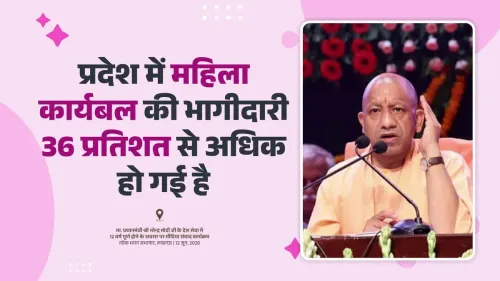
CM Yogi Adityanath says UP's female labour-force participation has jumped from 13% in 2017 to 36% today, attributing the shift to his government's zero-tolerance crime policy and improved women's safety, enabling a thriving night economy across the state.
Key Takeaways
CM Yogi Adityanath posted on 30 October 2026 claiming female labour-force participation in Uttar Pradesh rose from ~13% in 2017 to 36% under his government.
He attributed the change to a 'zero tolerance' crime policy adopted after the BJP's 2017 election victory in UP.
The post frames extended market hours and night-shift employment for women as direct dividends of improved law and order.
He credited Prime Minister Narendra Modi 's central government and the 'double engine' coordination model as key enablers.
The female labour participation figures cited are significant but await independent verification from official Periodic Labour Force Survey data.
The post positions UP's 'night economy' as a political and economic benchmark for the state's governance transformation.
A number tells the story starkly: Uttar Pradesh Chief Minister Yogi Adityanath claimed on Friday, 30 October 2026 that the state's female labour-force participation has surged from roughly 13 percent in 2017 to 36 percent today — a near-tripling he attributes directly to the law-and-order transformation his government has driven over the past nine years.
Markets that now stay lit after dark
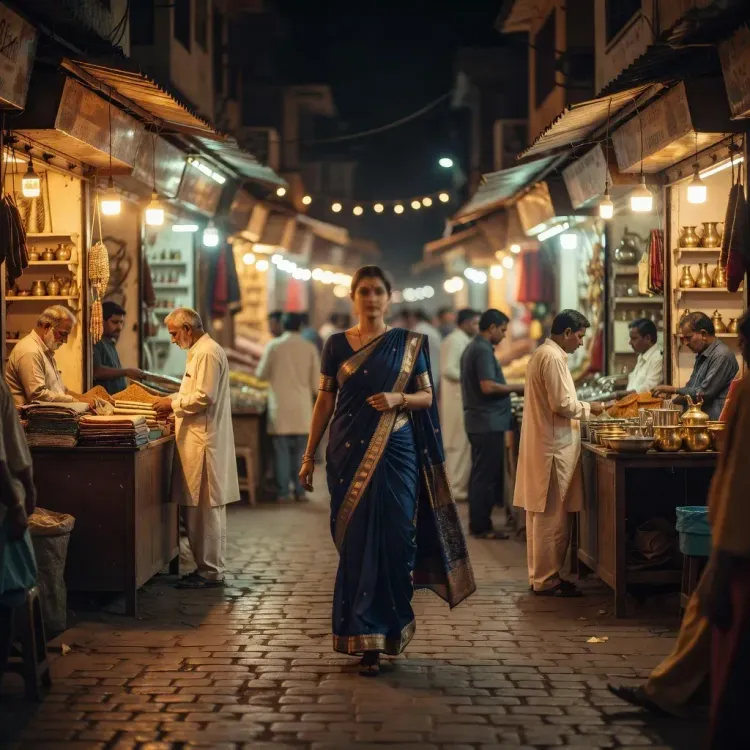
In a detailed post in Hindi, CM Yogi painted a before-and-after portrait of commercial life in Uttar Pradesh. 'रात्रि के समय जगमगाते बाजारों और व्यावसायिक प्रतिष्ठानों की रोशनी' — 'the glow of markets and businesses lit up through the night' — is, he wrote, not merely the light of commerce but the light of a trader's confidence. Before 2017, he argued, business activity wound down at sunset because crime and insecurity made extended hours untenable. Families worried when women worked late shifts. Night was, effectively, a curfew that no government had formally imposed but fear had enforced.
That framing matters because it positions law-and-order not as a security issue in isolation but as an economic policy. Safer streets, the argument runs, unlock longer trading hours, expand business opportunities, and free women to participate in the workforce without the shadow of family anxiety over their safety.
The 'zero tolerance' pivot of 2017
After the BJP government took office in March 2017, Uttar Pradesh adopted what it called a 'zero tolerance' approach to crime — a policy Yogi Adityanath has repeatedly invoked as the cornerstone of his administration. In Friday's post he credited this approach, alongside what he described as the 'double engine government' model — coordinated governance between the state and Prime Minister Narendra Modi's central government — for rebuilding public confidence in the state's law-and-order machinery.
The phrase 'जीरो टॉलरेंस' ('zero tolerance') has been central to Yogi Adityanath's political brand since 2017, applied to organised crime, mafia networks, and communal disturbances. Its extension here to encompass women's safety and economic participation signals an attempt to broaden the governance narrative beyond policing into social and economic outcomes.
From security to prosperity — the numbers behind the claim
The most striking assertion in the post is statistical. CM Yogi stated that women's labour-force participation in UP stood at approximately 13 percent in 2017 and has now climbed to 36 percent. If accurate, that shift would represent one of the sharpest increases in female economic participation in any large Indian state over a comparable period. The claim awaits independent verification against official Periodic Labour Force Survey data for Uttar Pradesh — but its deployment underscores the government's intent to frame women's empowerment as a measurable governance output, not merely a symbolic commitment.
He described working women who confidently discharge their duties on night shifts as 'मातृशक्ति' — 'the power of mothers/womanhood' — a term that carries deep cultural resonance in the Hindu nationalist political vocabulary, elevating individual economic achievement into a symbol of collective social progress.
UP's 'night economy' as a political benchmark
The post lands at a moment when Uttar Pradesh, India's most populous state with over 240 million people, is positioning itself as a destination for industrial investment and skilled employment. The emergence of a functioning night economy — shops open, women in the workforce after dark, traders expanding operations — is being presented as evidence that the governance model is producing tangible quality-of-life changes, not just headline-level crime statistics. The next milestone to watch: whether forthcoming labour-force survey data corroborates the participation-rate figures Yogi Adityanath cited, and whether the state announces formal policy measures to deepen the night-economy and women's safety architecture he described.
For a state that was once synonymous with lawlessness in national political conversation, the Chief Minister's arithmetic is a direct challenge to that old narrative — and a benchmark against which voters will measure his third term.
Point of View
CM Yogi is arguing that public safety is a prerequisite for economic inclusion, a framing that challenges opposition critiques of his administration as purely punitive. The 'double engine government' attribution also serves to tightly bind the state's perceived successes to Prime Minister Modi's brand. Whether the claimed labour-participation jump holds up to statistical scrutiny will determine how durable this narrative proves — if the numbers are validated, they represent a genuinely powerful governance story; if disputed, they become a liability.
NationPress
30 Oct 2026
Frequently Asked Questions
What did CM Yogi Adityanath say about women's employment in UP?
CM Yogi Adityanath claimed that Uttar Pradesh's female labour-force participation rate has risen from approximately 13 percent in 2017 to 36 percent in 2026, which he attributed to improved law and order under his government's zero-tolerance crime policy.
What is the 'double engine government' model Yogi Adityanath mentioned?
The 'double engine government' refers to coordinated governance between the BJP-led Uttar Pradesh state government under CM Yogi Adityanath and the BJP-led central government under Prime Minister Narendra Modi, with the idea that aligned governments at both levels accelerate development and policy implementation.
How has law and order in Uttar Pradesh changed since 2017?
After the BJP government took office in March 2017, Uttar Pradesh adopted a stated zero-tolerance approach to crime, focusing on dismantling organised criminal networks and prioritising women's safety. CM Yogi credits these measures with enabling extended business hours and greater female workforce participation.
What is UP's night economy and why is it significant?
UP's night economy refers to markets, shops, and businesses that now remain open and active after dark — something CM Yogi says was restricted before 2017 due to crime and insecurity. Its growth is presented as evidence that improved law and order has created new economic opportunities for traders and working women.
Are the female labour participation figures cited by Yogi Adityanath verified?
The claim that UP's female labour-force participation rose from about 13 percent in 2017 to 36 percent currently has not yet been independently verified against official Periodic Labour Force Survey data for Uttar Pradesh and should be treated as a government assertion pending official confirmation.