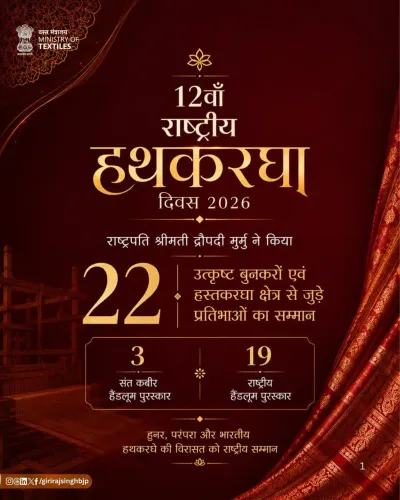
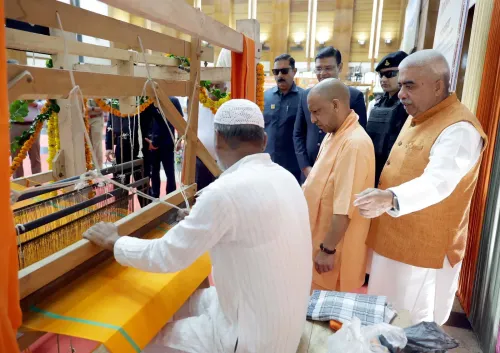
CM Yogi Honours UP Weavers on National Handloom Day 2026
Synopsis
Chief Minister Yogi Adityanath marked National Handloom Day 2026 in Lucknow by distributing financial assistance cheques under two state welfare schemes, presenting Sant Kabir Handloom Awards for 2026-27, and signing MoUs with major handloom buyers — positioning artisan welfare as a 'double engine government' priority.
Key Takeaways
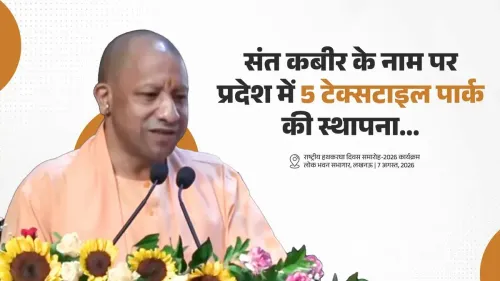
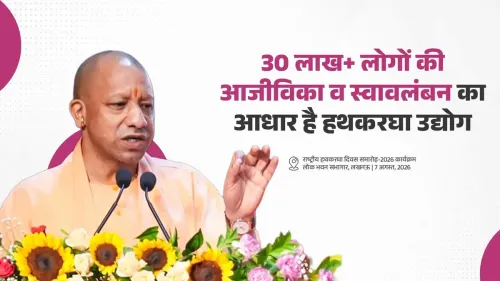
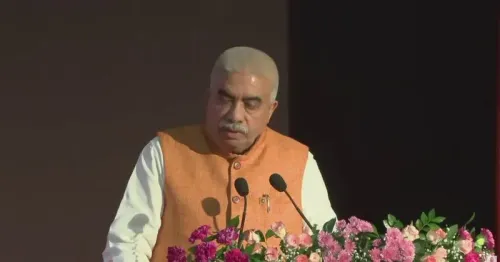
CM Yogi Adityanath attended the National Handloom Day 2026 ceremony in Lucknow on 7 August 2026 .
Cheques were distributed to beneficiaries of the Handloom and Powerloom Industry Development Scheme and the Jhalakari Bai Kori Handloom and Powerloom Development Scheme .
The Sant Kabir State Level Handloom Awards for financial year 2026-27 were presented to deserving weavers.
MoUs were signed with major buyers of handloom products to expand market access for UP artisans.
CM Yogi stated that artisan honour, self-respect, and prosperity are top priorities of the 'double engine government.' National Handloom Day has been observed on 7 August every year since 2015 , when the Government of India instituted it to honour the Swadeshi movement.
On a day that belongs to India's weavers, Chief Minister Yogi Adityanath turned Lucknow into a stage for craft, recognition, and rupees — distributing cheques, signing MoUs, and handing out the Sant Kabir State Level Handloom Awards for financial year 2026-27 at the National Handloom Day ceremony on 7 August 2026. The Chief Minister's Office of Uttar Pradesh announced the event, framing it as the state's most visible annual salute to its handloom and powerloom artisan community.
Cheques, awards, and MoUs in one afternoon
The ceremony packed three distinct actions into a single programme. Beneficiaries under the Handloom and Powerloom Industry Development Scheme and the Jhalakari Bai Kori Handloom and Powerloom Development Scheme received direct financial assistance cheques from the Chief Minister's hands — a deliberate optic that puts the head of government, not a mid-tier bureaucrat, at the point of delivery. Simultaneously, memoranda of understanding were exchanged with major buyers of handloom products, a step designed to bridge the gap between the loom and the market.
The Sant Kabir State Level Handloom Award, named after the weaver-saint whose legacy is inseparable from Uttar Pradesh's textile identity, recognised weavers for excellence in craft. The award has become the state's flagship annual acknowledgement of artisan skill, distributed each year on 7 August — the date the Government of India designated as National Handloom Day in 2015 to commemorate the Swadeshi movement and honour the sector's contribution to the freedom struggle.
Two schemes, one community in focus
The Jhalakari Bai Kori Handloom and Powerloom Development Scheme carries particular symbolic weight. Named after a noted figure from the weaver community, it targets artisan empowerment and development — a signal that the state's welfare architecture is being built around the identities and histories of the communities it serves, not just generic beneficiary categories.
The Handloom and Powerloom Industry Development Scheme provides financial support and infrastructure to weavers across the state. Together, the two schemes form the backbone of Uttar Pradesh's effort to sustain traditional textile clusters that employ lakhs of rural artisans, many concentrated in districts like Varanasi, Mubarakpur, and Mau.
The 'double engine' pitch and what it means for weavers
CM Yogi told the gathering that the 'honour, self-respect, and prosperity of artisans' — hathshilpiyon ka samman, swabhiman aur samriddhi — rank among the highest priorities of the 'double engine government,' the term used for aligned state and central administrations. The phrase is more than political shorthand: it signals that Uttar Pradesh's handloom initiatives are designed to run in parallel with central textile policy frameworks, potentially unlocking additional funding channels and export promotion support.
The MoU exchanges with major buyers are the most market-facing element of the day's events. Heritage craft that cannot find buyers dies quietly; linking weavers directly to institutional purchasers gives their output a guaranteed channel and their livelihoods a floor. Whether those agreements translate into sustained orders through 2026-27 will be the real test of the afternoon's ambition.
Point of View
Which is the harder and more durable reform. The 'double engine' framing is also a deliberate signal ahead of any central textile-policy reviews, positioning the state as a cooperative partner eligible for enhanced central support. The real measure of success will be whether the 2026-27 buyer agreements generate verifiable, recurring orders for weavers rather than remaining ceremonial signatures.
NationPress
21 Sept 2026
Frequently Asked Questions
What is National Handloom Day and why is it celebrated on 7 August?
National Handloom Day is observed every year on 7 August across India. The Government of India instituted it in 2015 to commemorate the launch of the Swadeshi movement on that date in 1905 and to honour the contribution of handloom weavers to the country's heritage and freedom struggle.
What is the Sant Kabir State Level Handloom Award?
The Sant Kabir State Level Handloom Award is Uttar Pradesh's annual award for excellence in handloom weaving, named after the weaver-saint Kabir. It is distributed each year on National Handloom Day to recognise outstanding artisans from across the state.
What is the Jhalakari Bai Kori Handloom and Powerloom Development Scheme?
The Jhalakari Bai Kori Handloom and Powerloom Development Scheme is a Uttar Pradesh state welfare programme named after a noted figure from the weaver community. It targets artisan empowerment and development, providing financial and infrastructural support to handloom and powerloom weavers.
What MoUs were signed at the National Handloom Day event in Lucknow in 2026?
At the 7 August 2026 ceremony in Lucknow, memoranda of understanding were exchanged between the Uttar Pradesh government and major buyers of handloom products. The MoUs aim to create direct market linkages for UP weavers, though specific buyer details have not been officially confirmed in public records.
What did CM Yogi Adityanath say about weavers at the Handloom Day event?
CM Yogi Adityanath stated that the honour, self-respect, and prosperity of artisans are among the highest priorities of the 'double engine government,' and reaffirmed the Uttar Pradesh government's commitment to preserving the state's handloom tradition and securing weavers' futures.