CM Yogi hails Ayodhya's transformation under Modi

Synopsis
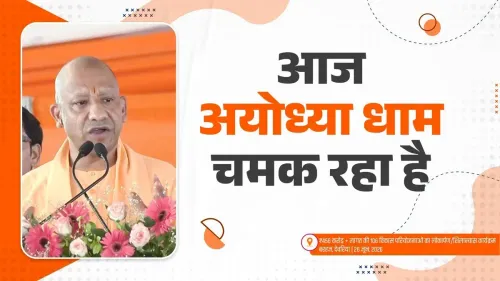
Uttar Pradesh CM Yogi Adityanath says Ayodhya has shed decades of neglect since 2017, pointing to the Ram Janmabhoomi temple, Ram Path, an international airport, and a modern railway station as proof that PM Modi's leadership is delivering both cultural restoration and economic opportunity.
Key Takeaways
CM Yogi Adityanath posted on 1 November 2026 contrasting Ayodhya's pre-2017 'neglect and disorder' with its current development.
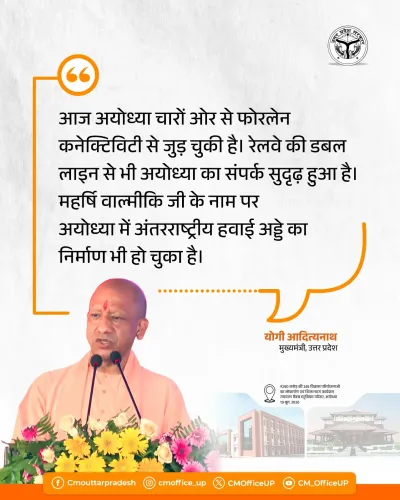
Key infrastructure cited: Shri Ram Janmabhoomi Mandir , Ram Path , Dharm Path , Ayodhya International Airport , and a modernised railway station .
The 2019 Supreme Court verdict cleared the legal path for the Ram temple's construction.
CM Yogi links rising pilgrim tourism to trade growth, youth employment, and local family prosperity.
The post frames Ayodhya as a flagship symbol of the 'Viksit Bharat — Viksit Uttar Pradesh' agenda.
The message explicitly attributes the transformation to Prime Minister Narendra Modi's leadership.
A city once described as neglected and disordered is today being held up as the face of resurgent India — and Uttar Pradesh Chief Minister Yogi Adityanath wants every Indian to know why. In a post on Sunday, 1 November 2026, the Chief Minister offered a sweeping account of how Ayodhya has changed since 2017, crediting Prime Minister Narendra Modi's leadership for the city's dramatic reimagining.
Writing in Hindi, CM Yogi opened with a declaration: 'Ayodhya sabhyata ki janmabhoomi, sanskriti ki praanadhara aur aastha ki shaashvat jyoti hai' — 'Ayodhya is the birthplace of civilisation, the lifeblood of culture, and the eternal flame of faith.' But the post quickly pivots from reverence to accusation: before 2017, he wrote, the sacred city was 'forced to endure the acid sting of neglect, disorder, and appeasement.'
From crumbling lanes to international connectivity
The Chief Minister's case for transformation rests on a list of concrete infrastructure: the Shri Ram Janmabhoomi Mandir, the Ram Path pilgrim corridor, Dharm Path, a new international airport, and a modernised railway station. Each project, he argues, is tied directly to pilgrim convenience and the city's dignity as Ram Nagari — the city of Lord Ram.
The Ram Janmabhoomi temple's construction became possible after the Supreme Court's 2019 verdict settled a decades-long legal dispute over the site. The Uttar Pradesh government subsequently fast-tracked a broader urban overhaul, including airport and rail upgrades, framing the city not merely as a religious destination but as an economic engine.
Tourism driving jobs, trade, and local prosperity
CM Yogi's post draws a direct line from rising pilgrim footfall to economic gains on the ground. Growing tourism, he wrote, is 'strengthening trade, new opportunities are connecting youth to employment, and local families are nurturing fresh hopes of prosperity.' The framing anchors a religious revival firmly inside the 'Viksit Bharat — Viksit Uttar Pradesh' (Developed India — Developed Uttar Pradesh) growth narrative championed by both the state and central governments.
The broader pattern is consistent. Since 2017 the Yogi administration has pursued a similar playbook in Varanasi and other pilgrimage hubs — combining temple corridor upgrades with modern connectivity to generate tourism revenue and signal a restoration of cultural identity alongside physical infrastructure.
The political arithmetic behind the spiritual pitch
The post closes with 'Jay Jay Shri Ram' — a salutation that doubles as a political signal. By explicitly contrasting pre-2017 'appeasement' with post-2017 development, CM Yogi is reinforcing a core BJP argument: that only this government has invested in Hindu pilgrimage cities with the seriousness they deserve. The message targets Ayodhya's residents and the hundreds of millions of Sanatani devotees across the country, reminding them that temple-city development is not just heritage policy — it is electoral identity.
Whether the jobs and trade numbers match the rhetoric is a question for the coming quarters. But for now, Ayodhya is being positioned as proof-of-concept for what 'Viksit Bharat' looks like from the ground up.
Point of View
Ties religious restoration to economic development, and positions both as exclusive BJP achievements ahead of any upcoming electoral cycle. The 'Viksit Bharat — Viksit Uttar Pradesh' framing deliberately merges central and state government credit, making Prime Minister Modi a co-protagonist in what is essentially a state-level story. This is consistent with the BJP's broader strategy of converting pilgrimage-city upgrades into durable cultural-identity politics, where the temple and the airport become a single, inseparable campaign symbol.
NationPress
1 Nov 2026
Frequently Asked Questions
What infrastructure has been built in Ayodhya since 2017?
Since 2017 the Uttar Pradesh government has developed the Shri Ram Janmabhoomi Mandir, the Ram Path pilgrim corridor, Dharm Path, a new international airport, and a modernised railway station in Ayodhya.
When was the Ram Janmabhoomi temple construction approved?
The Supreme Court's 2019 verdict cleared the legal path for construction of the Ram Janmabhoomi temple in Ayodhya, ending a decades-long dispute over the site.
What is the 'Viksit Bharat — Viksit Uttar Pradesh' plan CM Yogi refers to?
'Viksit Bharat — Viksit Uttar Pradesh' is the development narrative promoted by the BJP-led central and state governments, linking infrastructure investment to India's broader goal of becoming a developed nation, with Ayodhya positioned as a flagship example.
How is Ayodhya's development supposed to help local youth and families?
CM Yogi argues that rising pilgrim tourism is boosting local trade, creating employment opportunities for youth, and improving the economic prospects of families in Ayodhya.
Why does CM Yogi criticise the period before 2017 in his Ayodhya post?
CM Yogi describes pre-2017 Ayodhya as suffering from neglect, poor civic infrastructure, and 'appeasement' politics, using the contrast to argue that only the BJP government has prioritised the city's religious and economic development.