CM Yogi Thanks Moradabad, Kundarki Voters After BJP Win
Synopsis
Uttar Pradesh Chief Minister Yogi Adityanath on 29 June 2026 credited voters of Moradabad and Kundarki for a BJP electoral win, framing the result as the triumph of 'Ram Rajya' — a post that sharpens the ideological battleground ahead of the 2027 UP Assembly elections.
Key Takeaways
CM Yogi Adityanath posted on 29 June 2026 thanking voters of Moradabad and Kundarki following an electoral result in the two constituencies.
He used historical terms 'Turk' and 'Babur' to describe the defeated side, framing the win as the arrival of 'Ram Rajya' .
Kundarki and Moradabad are located in western Uttar Pradesh , a politically competitive region with a significant Muslim population.
The post reinforces the BJP 's cultural-political messaging that CM Yogi has deployed since taking office in 2017 .
The result and rhetoric are seen as an early indicator of campaign themes ahead of the 2027 Uttar Pradesh Assembly elections .
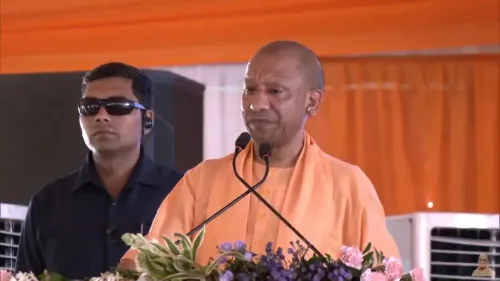
Uttar Pradesh Chief Minister Yogi Adityanath on Monday, 29 June 2026 thanked voters of Moradabad and Kundarki for what he described as a decisive electoral verdict, invoking the imagery of 'Ram Rajya' triumphing over opposing forces in a pointed social-media post following results in the two constituencies.
Posting in Hindi on X, CM Yogi wrote: 'मैं मुरादाबाद और कुंदरकी वासियों को धन्यवाद दूंगा... जिन्होंने 'तुर्क' को परास्त कर साबित कर दिया कि 'बाबर' का राज नहीं, अब 'रामराज' ही चलेगा...' — translating broadly as: 'I would like to thank the residents of Moradabad and Kundarki... who, by defeating the 'Turk', have proved that it is not the reign of 'Babur', but 'Ram Rajya' that will now prevail.'
Context
The post follows an electoral contest in the Kundarki assembly segment and surrounding Moradabad district, a region with a significant Muslim population in western Uttar Pradesh. The Bharatiya Janata Party (BJP), led in the state by CM Yogi Adityanath, has been contesting these seats as part of its broader consolidation drive in the region.
The use of the terms 'Turk' and 'Babur' — historical references to medieval Muslim rulers — alongside 'Ram Rajya', a concept associated with an idealised Hindu governance rooted in the Ramayana, signals the ideological framing CM Yogi chose to attach to the electoral outcome. Such language has characterised several of his public addresses in recent years.
Policy Backdrop
Yogi Adityanath, who heads the Gorakhnath Math in Gorakhpur and has served as Chief Minister of Uttar Pradesh since 2017, has consistently positioned his administration under the rubric of 'Ram Rajya' — a governance philosophy he links to law and order, infrastructure development, and cultural assertion. His government oversaw the consecration of the Ram Mandir in Ayodhya in January 2024, a landmark event that reinforced this political identity.
Moradabad and Kundarki sit in western Uttar Pradesh, a belt that has historically seen competitive multi-party contests involving the Samajwadi Party (SP), the BJP, and smaller regional formations. A BJP victory in Kundarki, if confirmed, would represent a significant shift in a constituency where the party has faced stiff competition.
Stakeholders and Impact
For the BJP, a win in Moradabad and Kundarki would be cited as validation of CM Yogi's governance record and his cultural-political messaging ahead of the 2027 Uttar Pradesh Assembly elections. The result would also be read as a test of the Samajwadi Party's hold over Muslim-majority and mixed constituencies in western UP.
Opposition parties are likely to contest the inflammatory historical framing in the post, arguing it deepens communal polarisation. Civil society groups have previously raised concerns about the use of medieval Mughal-era references in contemporary electoral discourse.
What's Next
With the 2027 Uttar Pradesh Assembly elections on the horizon, the electoral outcome in Kundarki and Moradabad will be closely studied by all parties recalibrating their strategies in western UP. CM Yogi Adityanath's post signals that the BJP intends to keep the 'Ram Rajya' narrative central to its campaign architecture — making the ideological contest in this region a preview of the larger battle ahead.
Point of View
Reinforcing identity lines in a region critical to the 2027 UP polls. Opposition parties will find it difficult to counter this framing on purely policy grounds, since the language operates on a cultural register that transcends routine electoral debate. The real test will be whether such rhetoric translates into durable vote consolidation in western UP's complex caste-community arithmetic.
NationPress
28 Sept 2026
Frequently Asked Questions
Who won the Kundarki election in 2026?
Based on CM Yogi Adityanath 's post on 29 June 2026 , the BJP appears to have won in Kundarki and Moradabad , though official result details should be verified with the Election Commission of India.
What did CM Yogi say about the Moradabad election result?
CM Yogi Adityanath thanked voters of Moradabad and Kundarki , saying they had 'defeated the Turk' and proved that it is 'Ram Rajya', not the reign of 'Babur', that will now prevail — invoking historical imagery to frame the electoral outcome.
What is 'Ram Rajya' and why does Yogi Adityanath use it?
'Ram Rajya' refers to the idealised rule of Lord Ram as described in the Ramayana , symbolising justice, prosperity, and dharmic governance. CM Yogi Adityanath uses it as a political philosophy underpinning his administration in Uttar Pradesh .
Why is Kundarki politically significant?
Kundarki is an assembly constituency in Moradabad district , western Uttar Pradesh , an area with a large Muslim population where the BJP has historically faced strong competition from the Samajwadi Party .
What is the significance of this result for the 2027 UP elections?
A BJP win in Kundarki and Moradabad would signal the party's growing reach in western Uttar Pradesh , a key battleground ahead of the 2027 Uttar Pradesh Assembly elections , and validate CM Yogi 's cultural-political messaging strategy.