CM Yogi Hails UP's Prof. Shyam Sundar on Padma Shri
Synopsis
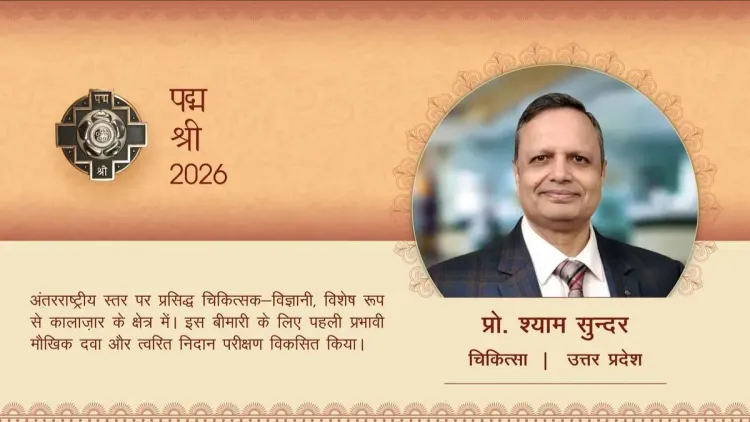
Uttar Pradesh CM Yogi Adityanath hailed Prof. Shyam Sundar, a BHU-affiliated Kala-azar expert, on receiving the Padma Shri from President Draupadi Murmu in New Delhi on 25 May 2026 for developing the first oral drug and rapid diagnostic tests for visceral leishmaniasis.
Key Takeaways
President Draupadi Murmu conferred the Padma Shri on Prof.
Shyam Sundar in New Delhi on 25 May 2026 for distinguished contributions to medicine.
Sundar is affiliated with Banaras Hindu University and is recognised as a leading expert on visceral leishmaniasis (Kala-azar).
He pioneered miltefosine , the first effective oral drug for Kala-azar, and developed rapid diagnostic tests that transformed case detection.
CM Yogi Adityanath publicly celebrated the honour, calling it a matter of 'immense pride' for Uttar Pradesh .
India's National Kala-azar Elimination Programme has relied on miltefosine and rapid diagnostics as clinical cornerstones since 2003 .
The Padma Shri is India's fourth-highest civilian award, presented annually since 1954 .
Uttar Pradesh Chief Minister Yogi Adityanath on Monday, 25 May 2026 congratulated Prof. Shyam Sundar, a renowned Kala-azar specialist from Uttar Pradesh, on being conferred the Padma Shri by President Draupadi Murmu at a ceremony in New Delhi for his outstanding contributions to medicine.
Context
In his post, CM Yogi described the honour as 'अत्यंत गौरव का विषय' ('a matter of immense pride'), noting that President Murmu personally conferred the award on Prof. Shyam Sundar for exceptional contributions in the field of medicine. He extended warm congratulations, calling the recognition 'the nation's respectful expression of your dedication, research, and spirit of service.'
The Padma Shri is India's fourth-highest civilian award, presented annually — a tradition that dates to 1954 — to recognise distinguished service across fields including science, medicine, and public health.
Policy Backdrop
Prof. Shyam Sundar, affiliated with Banaras Hindu University, is credited with pioneering the development of miltefosine — the first effective oral drug for visceral leishmaniasis, commonly known as Kala-azar — along with rapid diagnostic tests that transformed case detection in endemic regions. These breakthroughs have been foundational to India's national elimination efforts.
India's National Kala-azar Elimination Programme, integrated under the National Vector Borne Disease Control Programme since 2003, set successive elimination targets for 2015 and 2020, with miltefosine and rapid diagnostics forming the clinical backbone of the programme's case-management strategy. The disease remains endemic in parts of Bihar, Jharkhand, West Bengal, and Uttar Pradesh.
Stakeholders and Impact
Patients in Kala-azar-endemic districts are the most direct beneficiaries of Prof. Sundar's research: the shift from painful intravenous treatments to an oral regimen dramatically improved treatment adherence and access in remote, under-resourced communities. Medical researchers working on neglected tropical diseases also gain renewed visibility through such civilian recognition.
The Chief Minister's public acknowledgement signals the Uttar Pradesh government's intent to spotlight homegrown scientific achievement, reinforcing institutional pride around Banaras Hindu University as a centre of global-standard tropical-medicine research.
What's Next
Attention now turns to progress reports on remaining Kala-azar-endemic blocks across eastern India ahead of the next national elimination review. Sustained investment in rapid diagnostics and oral therapies — the pillars of Prof. Sundar's work — will be critical to crossing the elimination threshold. Any further Padma recognitions for public-health researchers in the current cycle are also being watched by the medical community.
Point of View
The Chief Minister reinforces the state's identity as a hub of nationally significant research. The recognition also draws quiet political capital from India's Kala-azar elimination drive, a programme that has spanned multiple governments and remains unfinished. The post fits a pattern of state leaders using Padma announcements to claim shared ownership of national scientific milestones.
NationPress
9 Oct 2026
Frequently Asked Questions
Who is Prof. Shyam Sundar and why did he receive the Padma Shri?
Prof. Shyam Sundar is a Kala-azar specialist from Uttar Pradesh affiliated with Banaras Hindu University . He received the Padma Shri in 2026 for pioneering miltefosine, the first effective oral drug for visceral leishmaniasis, and for developing rapid diagnostic tests that transformed disease detection.
What is Kala-azar and why is it significant in India?
Kala-azar, or visceral leishmaniasis, is a vector-borne parasitic disease endemic in parts of eastern India including Bihar , Jharkhand , West Bengal , and Uttar Pradesh . India has run a national elimination programme since 2003 , and oral therapies like miltefosine have been central to reducing its incidence.
What did CM Yogi Adityanath say about Prof. Shyam Sundar's Padma Shri?
CM Yogi Adityanath called the award 'a matter of immense pride,' stating that it represents 'the nation's respectful expression' of Prof. Sundar's dedication, research, and spirit of service, and extended his heartfelt congratulations.
What is miltefosine and what is its importance?
Miltefosine is the first effective oral drug developed for treating Kala-azar (visceral leishmaniasis). Its development by Prof. Shyam Sundar replaced painful intravenous treatments, significantly improving patient access and treatment adherence in remote endemic areas.
What is the Padma Shri award?
The Padma Shri is India's fourth-highest civilian honour, awarded annually since 1954 by the President of India to recognise distinguished contributions in fields such as science, medicine, arts, and public service.