CM Yogi Highlights UP Women Workforce Rise From 12% to 36%

Synopsis
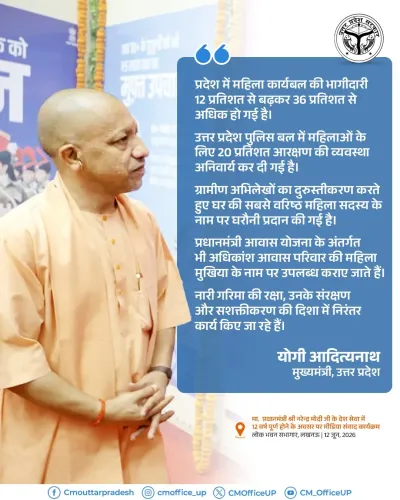
UP CM Yogi Adityanath says women's workforce participation in the state has tripled from 12% to over 36% since 2017, with women leading more than half of UP's startups, citing a raft of state and central schemes driving the shift.
Key Takeaways
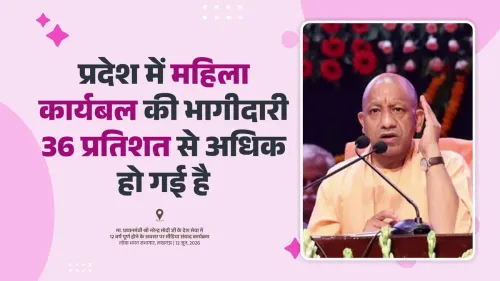
Women's workforce participation in UP has risen from 12% to over 36% since 2017 , according to CM Yogi Adityanath.
More than 50% of active startups in Uttar Pradesh are reportedly led by women.
CM Yogi credits Mission Shakti, Kanya Sumangala Yojana, Sukanya Samridhi Yojana, Rani Lakshmibai Scooty Yojana , and the new Lokmata Ahilyabai Holkar Working Women Hostel scheme as key enablers.
The post frames the shift as moving UP from 'updrав pradesh' (unrest) to 'utsav pradesh' (celebration) — a recurring BJP narrative on law-and-order improvement since 2017.
The overarching slogan 'Sashakt Nari — Samridh Uttar Pradesh' ties women's empowerment directly to the state's economic growth pitch.
The agenda is positioned as a state-level contribution to Prime Minister Modi's 'Viksit Bharat 2047' national development goal.
A state where daughters once feared to cross their own doorstep is now one where women clock night shifts, lead startups, and drive an economy — that is the transformation Uttar Pradesh Chief Minister Yogi Adityanath laid out in a detailed post on X on Sunday, October 11, 2026, framing eight years of governance as a pivot from what he called 'updrав pradesh' (a state of unrest) to 'utsav pradesh' (a state of celebration).
From 12% to 36%: The Workforce Number That Tells the Story
The sharpest statistic in CM Yogi's post is the one that anchors everything else: women's workforce participation in Uttar Pradesh has climbed from 12% to over 36% since 2017. That is a three-fold increase in a state of more than 240 million people — the most populous in the country. Yogi attributes the shift to a sustained policy push under what his government calls the 'double-engine' model, aligned with Prime Minister Narendra Modi's central schemes.
Equally striking is the startup figure. The CM states that more than 50% of active startups in Uttar Pradesh are today led by women — a claim that, if borne out, would place the state ahead of several more industrialised peers on female entrepreneurship. The post does not cite a source agency for either number, but the directional shift it describes aligns with the state's sustained push into industrial corridors and digital economy zones over the past several years.
Night Shifts, Scooties, and Hostels: The Policy Stack Behind the Numbers
Yogi's post names a dense stack of schemes — central and state — that his government credits for the change. On health and nutrition: Pradhan Mantri Matru Vandana Yojana and Poshan Abhiyan are cited for supporting maternal and infant wellbeing. On financial security for daughters: Mukhyamantri Kanya Sumangala Yojana and Sukanya Samridhi Yojana are highlighted as vehicles for long-term economic safety.
The safety and mobility layer is equally detailed. Mission Shakti and Operation Kayakalp address security. Kasturba Balika Vidyalayas expand residential schooling for girls. The Safe City initiative, the Rani Lakshmibai Scooty Yojana (providing two-wheelers to enable mobility), and the newly named Lokmata Ahilyabai Holkar Working Women Hostel scheme round out what the CM frames as an end-to-end ecosystem — from a girl's birth to her working life.
The hostel scheme, named after the 18th-century Maratha queen Ahilyabai Holkar, signals a deliberate cultural framing: the post closes by invoking the Sanskrit verse 'Yatra naryastu pujyante ramante tatra devata' — 'where women are revered, the divine resides' — tying the policy agenda to a classical moral argument.
The 'Sashakt Nari, Samridh UP' Vision and What It Signals
The overarching slogan CM Yogi anchors the post to is 'Sashakt Nari — Samridh Uttar Pradesh' (Empowered Women — Prosperous Uttar Pradesh), which he positions as a building block toward the broader national goal of 'Viksit Bharat' (Developed India) by 2047. The framing is deliberate: women's economic participation is cast not as a welfare outcome but as an engine of state GDP — a subtle but significant rhetorical upgrade from traditional 'beneficiary' language.
The post arrives ahead of a period when Uttar Pradesh's economic performance will come under heightened scrutiny as the state pitches itself as a top investment destination. A tripling of female labour-force participation, if independently validated, would be a compelling data point in that pitch.
Eight years in, the Yogi government is clearly betting that the story of UP's women is its most persuasive proof of transformation. The numbers are bold. The policy stack is real. Whether the outcomes match the ambition is a question the next independent survey will answer.
Point of View
The BJP's UP unit is attempting to reframe women's empowerment as an economic-competitiveness story, not just a social one. The 50%-women-led-startups claim, if independently verified, would be a powerful counter to opposition arguments about UP's development deficit. The invocation of Ahilyabai Holkar and Sanskrit scripture alongside modern policy language reflects the BJP's consistent strategy of embedding contemporary governance in a Hindu cultural idiom. The post also reinforces the 'double-engine government' framing — keeping PM Modi's brand equity central to UP's achievements — which serves both state and national electoral messaging heading into future cycles.
NationPress
11 Oct 2026
Frequently Asked Questions
What is the current women workforce participation rate in Uttar Pradesh?
According to CM Yogi Adityanath's post on October 11, 2026, women's workforce participation in Uttar Pradesh has grown from 12% to over 36% since 2017.
What is the Lokmata Ahilyabai Holkar Working Women Hostel scheme?
It is a UP government initiative named after the 18th-century Maratha queen Ahilyabai Holkar, aimed at providing safe residential accommodation for working women in the state, as cited by CM Yogi Adityanath.
What is the Rani Lakshmibai Scooty Yojana in Uttar Pradesh?
The Rani Lakshmibai Scooty Yojana is a UP government scheme that provides two-wheelers to women, aimed at improving their mobility and enabling them to access education and employment more easily.
What is Mukhyamantri Kanya Sumangala Yojana?
Mukhyamantri Kanya Sumangala Yojana is a Uttar Pradesh government scheme that provides financial assistance to girl children at key stages of their life — from birth through higher education — to ensure their economic security and encourage families to invest in daughters.
What does 'double engine government' mean in the context of UP?
'Double engine government' is a BJP term referring to the alignment of the state government in Uttar Pradesh and the central government in New Delhi both being led by the BJP, which the party argues enables faster policy implementation and fund flow to the state.