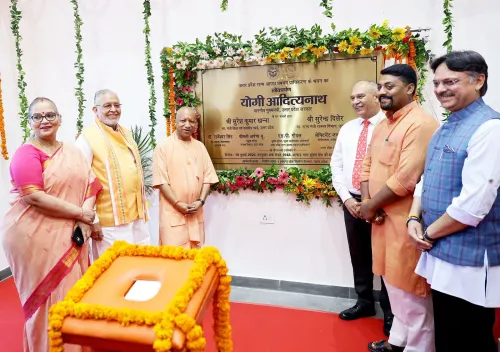
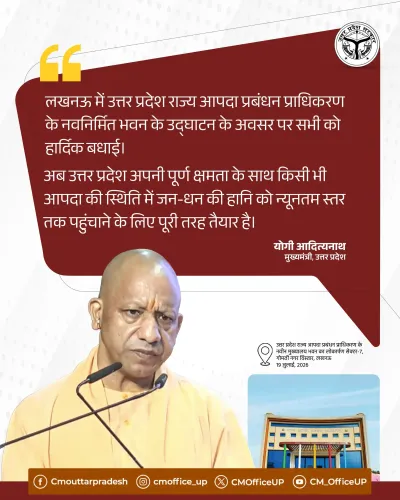
CM Yogi inaugurates UPSDMA HQ worth ₹200 Cr in Lucknow

Synopsis
Chief Minister Yogi Adityanath inaugurated the new headquarters of the Uttar Pradesh State Disaster Management Authority in Lucknow on 19 July 2026. The purpose-built facility, constructed at a cost of over ₹200 crore, is designed to strengthen the state's disaster preparedness and emergency coordination capacity.
Key Takeaways
Chief Minister Yogi Adityanath inaugurated the new UPSDMA headquarters in Lucknow on 19 July 2026 .
The building was constructed at a cost of over ₹200 crore .
UPSDMA was established under the Disaster Management Act, 2005 to coordinate disaster preparedness, mitigation, and response in Uttar Pradesh.
The new facility is expected to serve as a central coordination hub for emergency responders and district administrations across the state.
Flood-prone districts in Uttar Pradesh and emergency response teams are among the primary beneficiaries of the upgraded infrastructure.
The inauguration was live-streamed, reflecting the government's focus on public transparency around major administrative milestones.
The Chief Minister's Office of Uttar Pradesh announced on Sunday, 19 July 2026, that Chief Minister Yogi Adityanath attended the inauguration of the new headquarters building of the Uttar Pradesh State Disaster Management Authority (UPSDMA) in Lucknow, constructed at a cost of over ₹200 crore.
Context
The official post from the Chief Minister's Office read: 'लखनऊ में ₹200 करोड़+ की लागत से निर्मित उत्तर प्रदेश राज्य आपदा प्रबंधन प्राधिकरण (UPSDMA) के नवीन मुख्यालय भवन के लोकार्पण कार्यक्रम में सम्मिलित होते मुख्यमंत्री' — meaning 'Chief Minister participating in the inauguration ceremony of the new headquarters building of the Uttar Pradesh State Disaster Management Authority (UPSDMA), built at a cost of over ₹200 crore in Lucknow.' The event was live-streamed, underscoring the government's intent to broadcast the milestone publicly.
UPSDMA was constituted under the Disaster Management Act, 2005, the central legislation that mandated every Indian state to establish a dedicated State Disaster Management Authority. The new building marks a significant physical upgrade for the authority, which until now operated without a purpose-built headquarters of its own.
Policy Backdrop
The Disaster Management Act, 2005 created the legal architecture for coordinated preparedness, mitigation, and response across India's states and union territories. Uttar Pradesh, one of India's most populous and geographically diverse states, faces recurrent threats including floods along the Ganga, Yamuna, and Ghaghra river systems, as well as extreme weather events across the Indo-Gangetic plains.
Under Chief Minister Yogi Adityanath, who has led the state since 2017, Uttar Pradesh has pursued a series of physical infrastructure upgrades for state agencies as part of a broader administrative modernisation drive. A dedicated, well-resourced UPSDMA headquarters is intended to strengthen the state's command-and-control capacity during disaster events, enabling faster coordination between district administrations, emergency responders, and central agencies.
Stakeholders and Impact
The most direct beneficiaries of an upgraded UPSDMA headquarters are the state's emergency response personnel — including SDRF teams, district collectors, and civil defence volunteers — who rely on a central coordination node during crises. Flood-prone districts in eastern and central Uttar Pradesh, which bear the heaviest burden of seasonal disasters, stand to gain from improved institutional capacity.
The new facility is also expected to serve as a nerve centre for training, data management, and inter-agency communication. With climate variability intensifying across the Indo-Gangetic plains, a modern, purpose-built headquarters positions UPSDMA to better integrate with national early-warning systems operated by central meteorological and disaster management bodies.
What's Next
Attention will now turn to the operationalisation of the new headquarters — including staffing, technology integration, and any revision of the state's disaster management plan. Observers will watch whether the facility accelerates UPSDMA's coordination with the National Disaster Management Authority (NDMA) and central early-warning platforms ahead of the monsoon season. The inauguration sets the stage for the Yogi administration to demonstrate tangible improvements in disaster response outcomes in the months ahead.
Point of View
Not just reactive relief. For a state as flood-vulnerable as Uttar Pradesh, a modern command-and-control facility could meaningfully reduce coordination gaps during crises. The timing — mid-monsoon season — amplifies the political and operational messaging. Whether the hardware translates into faster, more effective disaster response will be the real test of this investment.
NationPress
19 Jul 2026
Frequently Asked Questions
What is UPSDMA and why was a new headquarters built?
UPSDMA stands for Uttar Pradesh State Disaster Management Authority, established under the Disaster Management Act, 2005, to coordinate disaster preparedness and response in the state. A new headquarters was built to provide the authority with a purpose-built, modern facility to strengthen its operational and coordination capacity.
How much did the new UPSDMA headquarters in Lucknow cost?
The new UPSDMA headquarters building in Lucknow was constructed at a cost of over ₹200 crore, as stated by the Chief Minister's Office of Uttar Pradesh.
Who inaugurated the UPSDMA headquarters in Lucknow?
Chief Minister Yogi Adityanath inaugurated the new UPSDMA headquarters building in Lucknow on 19 July 2026.
Where is the new UPSDMA headquarters located?
The new UPSDMA headquarters is located in Lucknow, the capital city of Uttar Pradesh.
How does the new UPSDMA building help Uttar Pradesh handle disasters?
The new headquarters is designed to serve as a central coordination hub for emergency responders, district administrations, and civil defence personnel, enabling faster and more effective disaster response across Uttar Pradesh, particularly in flood-prone regions.