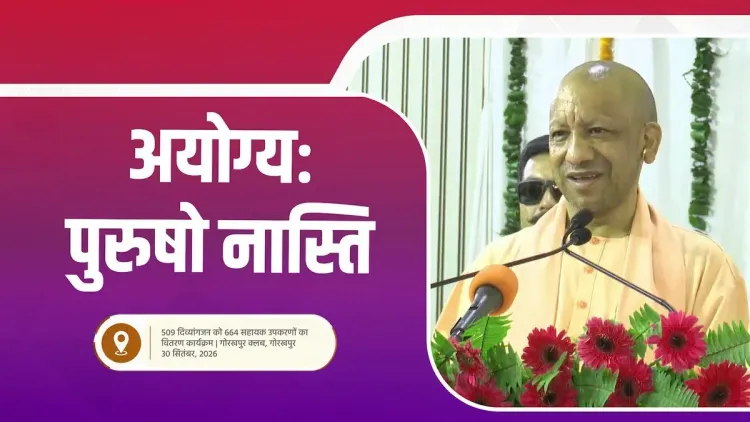
CM Yogi Invokes Sanskrit Maxim: 'No Person Is Unworthy'
Synopsis
Chief Minister Yogi Adityanath of Uttar Pradesh invoked the Sanskrit maxim 'Ayogyah puruso nasti' — no person is unworthy — on 30 September 2026, reaffirming a recurring pattern of anchoring his governance messaging in classical Indian philosophical thought.
Key Takeaways
CM Yogi Adityanath shared the Sanskrit maxim 'Ayogyah puruso nasti' ('no person is unworthy') via the official CMOfficeUP account on 30 September 2026 .
The quote asserts that Indian culture has never regarded any individual as incomplete or without worth.
Yogi Adityanath has governed Uttar Pradesh since 2017 and regularly draws on Sanskrit and Hindu philosophical concepts in public communication.
The statement carries no direct policy or scheme attachment — it functions as cultural and aspirational framing.
This approach is consistent with a broader BJP -led state government pattern of linking governance messaging to traditional Indian thought.
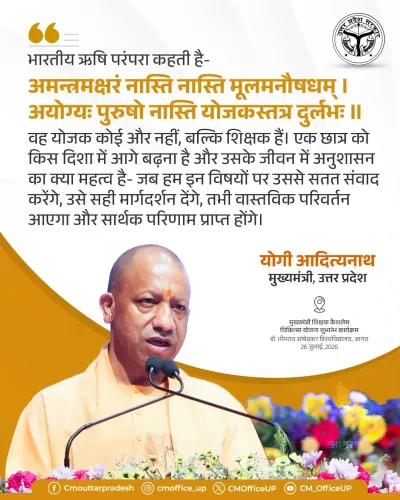
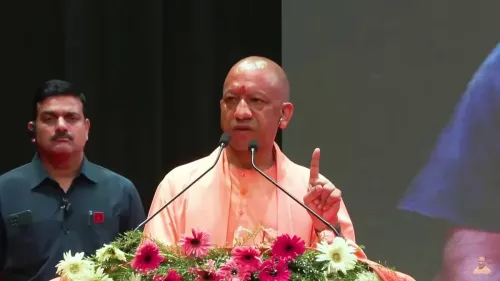
A single Sanskrit phrase — and a philosophy stretching back millennia — resurfaced in Indian public discourse on Wednesday, 30 September 2026, when the Chief Minister's Office of Uttar Pradesh shared a pointed cultural assertion from Chief Minister Yogi Adityanath: that no human being is incomplete, and no person is unworthy.
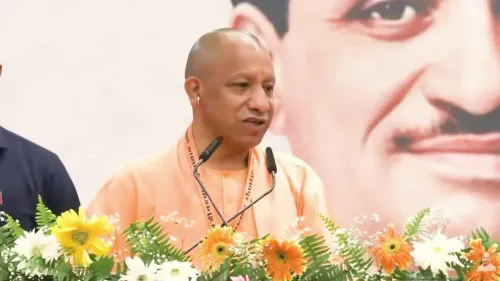
In the post, CM Yogi Adityanath quoted the Sanskrit maxim 'Ayogyah puruso nasti' — meaning, 'there is no such thing as an unworthy person' — to anchor a broader cultural argument. 'Our culture has never accepted that any person is incomplete,' he said. 'It has been said among us — Ayogyah puruso nasti — that is, no person is unworthy.'
'Ayogyah puruso nasti' — what the maxim actually says
The phrase is drawn from classical Indian philosophical tradition, asserting the inherent capability and dignity of every individual. It reflects a school of thought that refuses to write off any human being as beyond redemption or contribution — a sentiment that cuts across caste, circumstance, and condition. For a chief minister leading India's most populous state, invoking it publicly is a signal: governance, at least in its aspirational register, must begin from a place of human worth.Yogi's pattern of anchoring messaging in Sanskrit thought
CM Yogi Adityanath, who has governed Uttar Pradesh since 2017, has consistently reached for Sanskrit maxims and Hindu philosophical concepts when framing public statements. This is not incidental — it forms a deliberate rhetorical thread running through his administration's communication, linking governance to what the BJP describes as India's civilisational heritage. The approach mirrors a wider pattern among BJP-led state governments of embedding traditional Indian thought into public-facing messaging. These statements rarely carry a direct policy attachment. They function instead as cultural framing — setting a tone, projecting confidence in indigenous intellectual traditions, and reaching an audience that responds to the idea that modern India need not borrow its values entirely from outside. The real question such statements raise is whether they translate into inclusive governance on the ground — or whether they remain, for now, stirring words awaiting a programme to match them.Point of View
Untethered from specific policy action, can begin to feel symbolic rather than substantive. Whether this maxim finds expression in measurable inclusion outcomes — skill programmes, social welfare reach, anti-discrimination enforcement — will determine how it ages.
NationPress
30 Sept 2026
Frequently Asked Questions
What does 'Ayogyah puruso nasti' mean?
'Ayogyah puruso nasti' is a Sanskrit maxim meaning 'there is no unworthy person' — a classical Indian philosophical assertion that every human being possesses inherent capability and dignity.
What did CM Yogi Adityanath say on 30 September 2026?
CM Yogi Adityanath stated that Indian culture has never regarded any person as incomplete, citing the Sanskrit maxim 'Ayogyah puruso nasti' to argue that no individual is unworthy.
Why does CM Yogi often use Sanskrit quotes in his speeches?
Yogi Adityanath regularly invokes Sanskrit maxims and Hindu philosophical ideas as part of a deliberate communication style that links governance messaging to India's classical intellectual heritage, consistent with BJP-led state government practice.
Is this quote linked to any specific UP government scheme or policy?
No specific scheme or policy has been attached to this statement. It functions as a cultural and aspirational expression rather than a direct policy announcement.
How long has Yogi Adityanath been Chief Minister of Uttar Pradesh?
Yogi Adityanath has served as Chief Minister of Uttar Pradesh since 2017.