CM Yogi Invokes Chanakya on National Strength and Sovereignty
Synopsis
Uttar Pradesh CM Yogi Adityanath cited ancient philosopher Chanakya on 8 July 2026, declaring that a nation with such a teacher can never be impoverished and foreign powers cannot challenge it — reflecting his government's sustained emphasis on India's civilisational heritage and strategic self-reliance.
Key Takeaways
Yogi Adityanath posted on X on 8 July 2026 invoking Acharya Chanakya as a symbol of national strength and sovereignty.
He stated that a nation guided by a teacher like Chanakya 'can never be impoverished' and that 'foreign powers cannot dare to look up at it.' Chanakya , the fourth-century BCE author of the Arthashastra , is credited with shaping the Maurya Empire through strategic statecraft.
The post aligns with the Uttar Pradesh government's broader promotion of Sanskrit studies and ancient Indian knowledge systems.
The National Education Policy 2020 provides a national policy basis for integrating traditional Indian wisdom into modern curricula.
A video was attached to the post, suggesting the message may be part of a wider cultural or educational communication initiative.
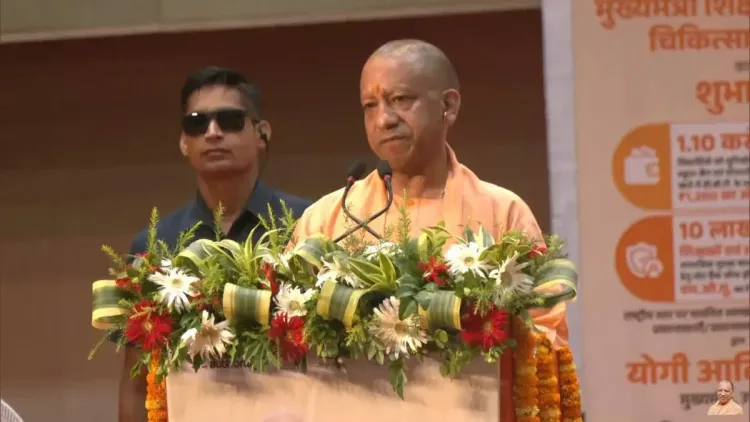
Uttar Pradesh Chief Minister Yogi Adityanath on Wednesday, 8 July 2026, invoked the legacy of ancient philosopher and strategist Chanakya in a post on X, asserting that a nation guided by a teacher of Chanakya's stature can never be impoverished and that foreign powers would not dare to raise their eyes against it.
In Hindi, the Chief Minister wrote: 'Acharya Chanakya jaisa guru hoga toh desh kabhi vipann nahin ho sakta. Videshi taaqtein aankhen uthakar nahin dekh saktin...' — translated: 'If there is a teacher like Acharya Chanakya, the nation can never be impoverished. Foreign powers cannot dare to look up at it...'
Context
Chanakya, also known as Kautilya, was a fourth-century BCE philosopher, economist, and royal advisor whose treatise Arthashastra laid out principles of statecraft, diplomacy, and economic governance. He is widely credited with guiding the establishment of the Maurya Empire under Chandragupta Maurya, making him one of ancient India's most celebrated strategic minds.
Indian political leaders across the spectrum have long drawn on Chanakya's legacy to argue for strategic self-reliance and a firm posture against external interference. Yogi Adityanath's invocation follows this tradition while placing particular emphasis on the role of education and mentorship in national strength.
Policy Backdrop
The reference to Chanakya as a guru — a teacher or guide — aligns with a broader cultural and educational emphasis that has shaped governance in Uttar Pradesh under Yogi Adityanath. The state administration has actively promoted Sanskrit studies, ancient Indian texts, and cultural heritage programmes in public messaging and institutional initiatives.
At the national level, the National Education Policy 2020 explicitly called for the integration of Indian knowledge systems and traditional wisdom into mainstream curricula, providing a policy foundation for references to ancient thinkers such as Chanakya in contemporary governance discourse.
Stakeholders and Impact
Students and educators in Uttar Pradesh — India's most populous state with over 24 crore residents — are the primary stakeholders in any policy or cultural programme that flows from such messaging. The framing of Chanakya as a model of intellectual and strategic leadership carries implications for how history and civics are presented in state-run institutions.
The post's reference to foreign powers not daring to challenge a Chanakya-guided nation also speaks to a broader audience concerned with India's strategic sovereignty, signalling that the Chief Minister views traditional wisdom as directly relevant to contemporary geopolitical confidence.
What's Next
Observers will watch for follow-up statements or announced programmes in Uttar Pradesh that build on this cultural messaging — including possible curriculum changes, seminars on ancient statecraft, or events centred on Chanakya's Arthashastra. The post's timing and the presence of a video suggest it may be part of a larger communication initiative, the full details of which are yet to emerge.
As Yogi Adityanath continues to position Uttar Pradesh as a standard-bearer for India's civilisational identity, invocations of figures like Chanakya are likely to recur as a rhetorical and policy touchstone in the months ahead.
Point of View
Tying ancient Indian intellectual heritage to contemporary governance credibility. The dual emphasis on education — the guru metaphor — and geopolitical confidence maps neatly onto both the National Education Policy 2020 and India's assertive foreign-policy posture in recent years. By framing Chanakya not merely as a historical figure but as a living standard for national leadership, the Chief Minister signals that cultural messaging and strategic self-reliance are inseparable in his political vision. This pattern is likely to intensify as Uttar Pradesh positions itself as a model state ahead of future electoral cycles.
NationPress
7 Oct 2026
Frequently Asked Questions
What did Yogi Adityanath say about Chanakya?
Yogi Adityanath said on 8 July 2026 that if a nation has a teacher like Acharya Chanakya , it can never be impoverished and foreign powers would not dare to challenge it.
Who was Chanakya and why is he important in Indian politics?
Chanakya , also known as Kautilya , was a fourth-century BCE philosopher and strategist who authored the Arthashastra and guided the founding of the Maurya Empire . Indian leaders frequently cite him as a symbol of strategic self-reliance and strong governance.
What is the connection between Chanakya and the National Education Policy?
The National Education Policy 2020 called for integrating Indian knowledge systems and traditional wisdom into curricula, creating a policy basis for referencing ancient thinkers like Chanakya in state education programmes.
How has Yogi Adityanath promoted Indian cultural heritage in Uttar Pradesh?
The Uttar Pradesh government under Yogi Adityanath has promoted Sanskrit studies , ancient Indian texts, and cultural heritage programmes, and regularly invokes figures from India's civilisational past in public messaging.
What does Chanakya's Arthashastra say about foreign powers?
The Arthashastra outlines principles of statecraft, diplomacy, and economic governance, emphasising that a well-governed and strategically prepared state can deter external threats — a theme Yogi Adityanath echoed in his post.