Rahul Gandhi Raises UGC-NET Paper Leak Allegations
Synopsis
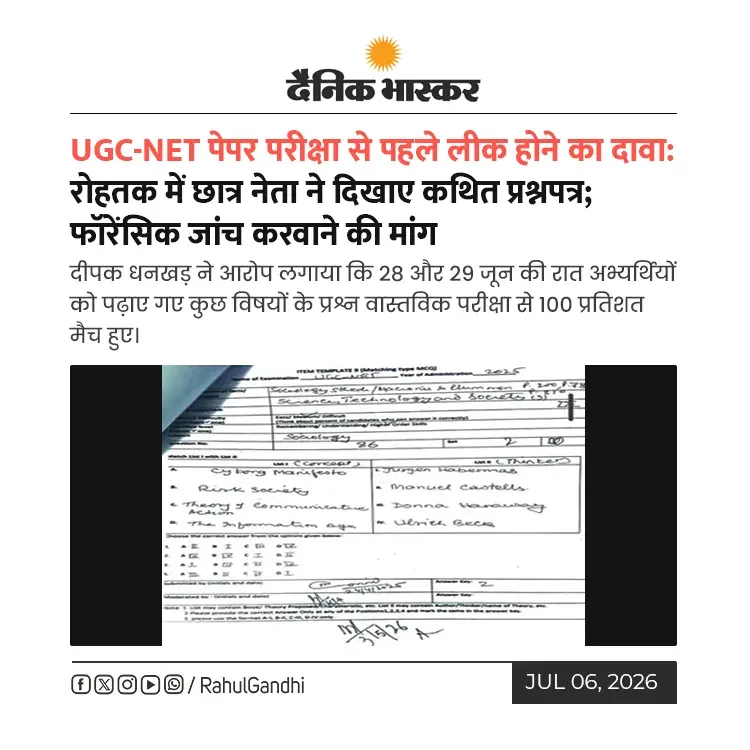
Congress leader Rahul Gandhi on July 8, 2026, alleged that a 100-page PDF of the UGC-NET question paper setting was circulated before last week's examination — raising fresh concerns about NTA's exam security just weeks after the NEET paper-leak controversy.
Key Takeaways
Rahul Gandhi alleged on July 8, 2026 that a 100-page PDF linked to the UGC-NET question paper setting was circulated just before the examination.
He noted the allegations emerged only weeks after the NEET paper-leak controversy , pointing to a pattern of examination security failures.
The National Testing Agency (NTA) , established in 2017 , is the sole body responsible for conducting both NEET and UGC-NET .
The UGC-NET determines eligibility for assistant professorships and Junior Research Fellowships, affecting lakhs of aspirants annually.
Recurring paper-leak allegations since 2023 have fuelled demands for independent oversight and structural reform of the NTA .
Pressure is mounting on the Ministry of Education to order a high-level inquiry into examination security protocols.
Congress leader Rahul Gandhi on Wednesday, July 8, 2026, raised serious allegations about the UGC-NET examination conducted the previous week, claiming that a 100-page PDF of the question paper setting was circulated just before the test — weeks after the NEET paper-leak controversy had already shaken the country's centralised examination system.
Context
In his post on X, Gandhi flagged two specific concerns: first, that a 100-page PDF linked to the question paper setting of the UGC-NET was circulated shortly before the examination; and second, that such material was supposed to be accessible only to the National Testing Agency (NTA). He described the allegations as 'extremely shocking' (बेहद चौंकाने वाले), noting they emerged just weeks after the NEET paper-leak episode.
The UGC-NET — the University Grants Commission National Eligibility Test — determines eligibility for assistant professorships and Junior Research Fellowships at Indian universities. It is among the most consequential examinations conducted by the NTA, affecting hundreds of thousands of aspirants annually.
Policy Backdrop
The National Testing Agency was established in 2017 under the Ministry of Education to centralise and standardise the conduct of major national-level entrance and eligibility tests, including NEET and UGC-NET, which were previously managed by multiple bodies. The consolidation was intended to improve consistency and reduce administrative fragmentation.
However, since 2023, recurring allegations of question paper leaks and premature circulation of examination material have dogged several NTA-conducted tests. The 2024 NEET-UG paper-leak allegations triggered student protests across the country, parliamentary scrutiny, and Supreme Court-monitored investigations into result processes and examination integrity. Opposition leaders, including Gandhi, have consistently linked these incidents to what they describe as a systemic failure in centralised testing oversight.
Stakeholders and Impact
The most directly affected are the lakhs of examination aspirants — graduate students and researchers — who appear for UGC-NET each cycle to qualify for academic careers and fellowships. Any credible allegation of pre-exam circulation of question material fundamentally undermines the fairness of the selection process for these candidates.
University faculty recruitment pipelines also depend on the integrity of UGC-NET results, meaning that prolonged uncertainty over the examination's validity has downstream consequences for higher education institutions across India. Demands for independent oversight of the NTA and structural reform of its security protocols have grown louder with each successive controversy.
What's Next
Gandhi's post is likely to intensify pressure on the Ministry of Education and the NTA to respond publicly to the specific allegation about the circulated PDF. Calls for a high-level independent inquiry committee or a parliamentary standing committee review of NTA functioning and examination security protocols are expected to grow in the coming days.
If the allegations are substantiated, they could reignite the broader national debate over whether centralising high-stakes examinations under a single agency — without commensurate transparency and accountability mechanisms — serves the interests of India's student community.
Point of View
He shifts the political focus from individual misconduct to institutional failure. This puts the Ministry of Education in a defensive posture, particularly given that parliamentary scrutiny of the NTA has already intensified. The cumulative weight of successive exam controversies makes it increasingly difficult for the government to contain the issue as a law-and-order matter rather than a policy crisis.
NationPress
8 Jul 2026
Frequently Asked Questions
What did Rahul Gandhi say about UGC-NET?
Rahul Gandhi alleged that a 100-page PDF of the UGC-NET question paper setting was circulated just before the examination, and that such material should have been accessible only to the NTA. He described the allegations as 'extremely shocking.'
What is UGC-NET and who conducts it?
UGC-NET, or the University Grants Commission National Eligibility Test, determines eligibility for assistant professorships and Junior Research Fellowships at Indian universities. It is conducted by the National Testing Agency (NTA), established in 2017 under the Ministry of Education.
How is the UGC-NET controversy linked to the NEET paper leak?
The UGC-NET allegations emerged just weeks after the NEET paper-leak controversy, both involving the NTA. Opposition leaders argue these incidents reflect a pattern of systemic failure in centralised examination security rather than isolated events.
What action could follow Rahul Gandhi's UGC-NET allegations?
Gandhi's post is expected to intensify demands for a high-level independent inquiry or a parliamentary standing committee review of NTA's examination security protocols and overall functioning.
Who is affected by the UGC-NET paper leak allegations?
Lakhs of graduate students and researchers who appeared for UGC-NET to qualify for academic positions and fellowships are directly affected, as any credible paper-leak allegation undermines the fairness of the entire selection process.