CM Yogi Lays Foundation of SAEL Solar Plant in Gautam Buddha Nagar
Synopsis
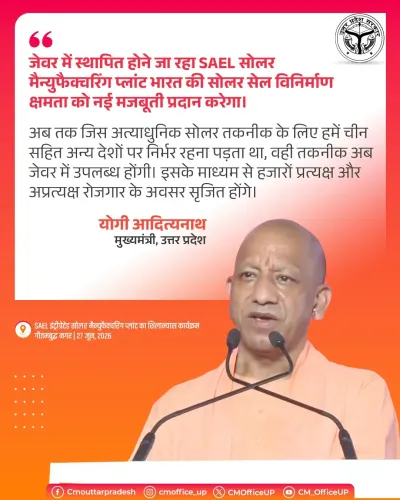
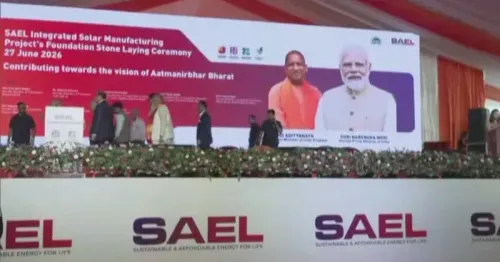
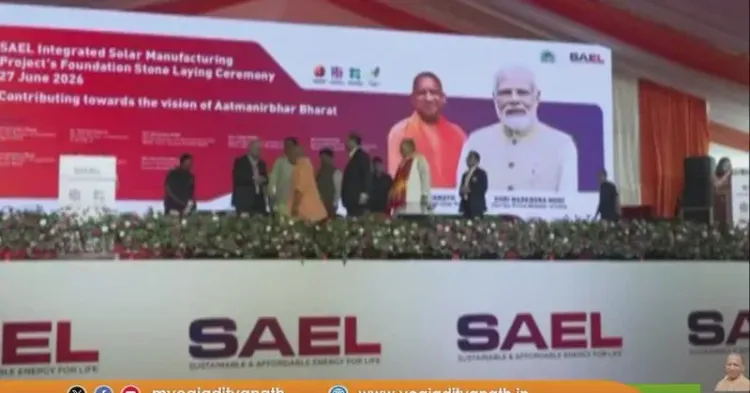
Uttar Pradesh Chief Minister Yogi Adityanath addressed the foundation stone laying ceremony of the SAEL Integrated Solar Manufacturing Project in Gautam Buddha Nagar on 27 June 2026, reinforcing the state's role in India's push for domestic solar manufacturing and its 500 GW clean energy target by 2030.
Key Takeaways
CM Yogi Adityanath addressed the foundation stone laying of the SAEL Integrated Solar Manufacturing Project in Gautam Buddha Nagar on 27 June 2026 .
The project is located in the NCR industrial belt, covering the Noida and Greater Noida zones of western Uttar Pradesh .
The initiative aligns with India's national target of 500 GW non-fossil fuel capacity by 2030 .
The central government's PLI scheme for solar PV modules (approved 2021 ) provides the policy framework incentivising such integrated manufacturing investments.
The project is expected to generate employment for the local industrial workforce and strengthen domestic solar supply chains.
Uttar Pradesh has been developing industrial corridors and green energy parks to attract renewable energy manufacturing capital.
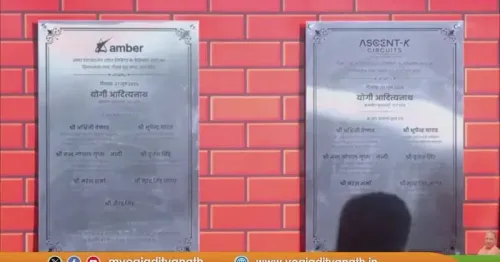
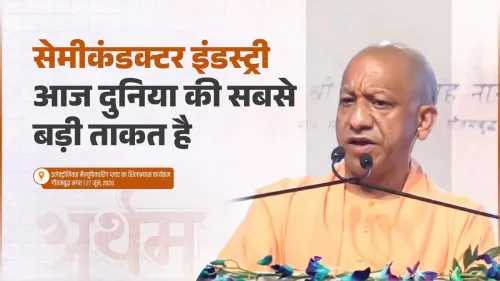
Uttar Pradesh Chief Minister Yogi Adityanath on Saturday, 27 June 2026 addressed the foundation stone laying ceremony of the SAEL Integrated Solar Manufacturing Project in Gautam Buddha Nagar, marking a significant step in the state's push to anchor domestic renewable energy manufacturing in the National Capital Region industrial belt.
Context
Gautam Buddha Nagar, home to the Noida and Greater Noida industrial zones in western Uttar Pradesh, has emerged as a preferred destination for high-value manufacturing investment owing to its proximity to Delhi and well-developed logistics infrastructure. The district sits within the NCR growth corridor, making it a natural fit for integrated industrial projects that require both skilled labour and supply-chain connectivity. The foundation ceremony signals that the state government is actively channelling this locational advantage toward the green energy sector.
Policy Backdrop
The project aligns with India's target of achieving 500 GW of non-fossil fuel power capacity by 2030, a commitment that demands a sharp ramp-up in domestic solar module production to reduce reliance on imported components. The central government's Production Linked Incentive (PLI) scheme for high-efficiency solar PV modules, approved in 2021, was designed precisely to incentivise integrated manufacturing — covering wafers, cells, and modules — on Indian soil. Uttar Pradesh has complemented these national efforts by developing industrial corridors and green energy parks intended to attract anchor investments of this nature.
The roots of India's solar ambition stretch back to the Jawaharlal Nehru National Solar Mission launched in 2010, which first established grid-connected solar power as a policy priority. Successive administrations have deepened that commitment, and state governments now play a pivotal execution role by providing land, connectivity, and single-window clearances to project developers. An integrated solar manufacturing facility — one that consolidates multiple production stages under one roof — represents a more capital-intensive and strategically valuable category of investment than simple assembly operations.
Stakeholders and Impact
The renewable energy sector, local industrial workforce, and component supply-chain firms in the Gautam Buddha Nagar region stand to benefit directly from the project's execution. Integrated solar manufacturing plants typically generate employment across skilled, semi-skilled, and ancillary categories, with downstream effects on logistics, construction, and services in the host district. For the state government, the ceremony reinforces Uttar Pradesh's positioning as an investment-ready destination at a time when competing states are aggressively courting green-energy capital.
At the national level, every addition to domestic solar manufacturing capacity reduces India's import bill for photovoltaic components, a strategic priority given the concentration of global solar supply chains in China. Projects of this nature also contribute to the Atmanirbhar Bharat framework by building indigenous capability in a technology sector that is central to the country's long-term energy security.
What's Next
Attention will now turn to project execution milestones — civil construction timelines, equipment commissioning, and the ramp-up of manufacturing capacity — as well as the number of direct and indirect jobs created in Gautam Buddha Nagar. State and central regulatory approvals for any further solar supply-chain units linked to this project will be closely watched by industry. The Yogi Adityanath government's ability to translate foundation-stone ceremonies into operational plants on schedule will be a key measure of Uttar Pradesh's industrial governance in the renewable energy space.
Point of View
The state is attempting to build cluster effects that could draw further supply-chain units. This also fits a broader national pattern in which state governments have become the primary execution layer for India's clean energy ambitions, translating central PLI incentives into ground-level industrial activity. Whether the SAEL project delivers on its manufacturing and employment potential on schedule will test that execution credibility.
NationPress
26 Sept 2026
Frequently Asked Questions
What is the SAEL Integrated Solar Manufacturing Project in Gautam Buddha Nagar?
The SAEL Integrated Solar Manufacturing Project is a solar manufacturing facility whose foundation stone was laid in Gautam Buddha Nagar, Uttar Pradesh, on 27 June 2026. It is designed as an integrated plant covering multiple stages of solar module production, aligning with India's domestic manufacturing push under the PLI scheme for solar PV modules.
Why did CM Yogi Adityanath attend the SAEL solar project ceremony?
Chief Minister Yogi Adityanath addressed the foundation stone laying ceremony to underscore the Uttar Pradesh government's commitment to attracting renewable energy manufacturing investment, particularly in the NCR-adjacent industrial zones of Gautam Buddha Nagar.
What is India's solar manufacturing target and how does this project fit in?
India aims to achieve 500 GW of non-fossil fuel power capacity by 2030, which requires significant domestic solar manufacturing capacity. Integrated projects like the SAEL plant in Gautam Buddha Nagar contribute to reducing import dependence on solar components and support the central government's PLI scheme for high-efficiency solar PV modules.
Where exactly is Gautam Buddha Nagar and why is it chosen for solar manufacturing?
Gautam Buddha Nagar is a district in western Uttar Pradesh within the National Capital Region, encompassing Noida and Greater Noida. Its proximity to Delhi, developed logistics infrastructure, and existing industrial ecosystem make it an attractive location for large-scale manufacturing investments.
What is the PLI scheme for solar PV modules?
The Production Linked Incentive scheme for high-efficiency solar PV modules was approved by the central government in 2021 to incentivise domestic manufacturing of solar wafers, cells, and modules, reducing India's reliance on imported photovoltaic components, particularly from China.