CM Yogi: SAEL Solar Plant in Jewar to End China Tech Dependence
Synopsis
Chief Minister Yogi Adityanath has announced that a SAEL solar manufacturing plant will be set up in Jewar, Uttar Pradesh, aiming to build domestic solar cell capacity, end reliance on Chinese technology, and generate thousands of jobs.
Key Takeaways
SAEL is set to establish a solar manufacturing plant in Jewar , Gautam Buddh Nagar, Uttar Pradesh.
CM Yogi Adityanath stated the plant will strengthen India's solar cell manufacturing capacity.
The facility aims to make advanced solar technology — previously sourced from China — available domestically.
The plant is expected to generate thousands of direct and indirect employment opportunities in the region.
The announcement aligns with India's Atmanirbhar Bharat push and the central PLI Scheme for Solar PV Modules notified in 2021 .
Uttar Pradesh's Solar Energy Policy (first issued 2017 ) has provided the state-level framework to attract such investments.
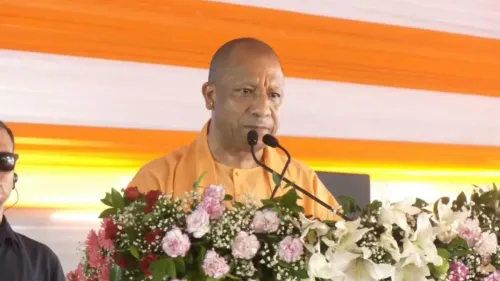
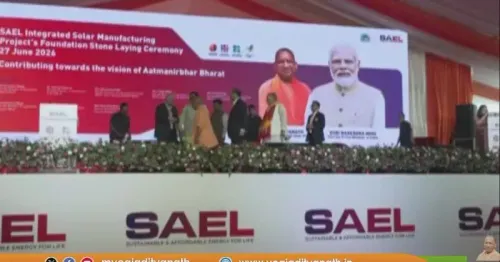
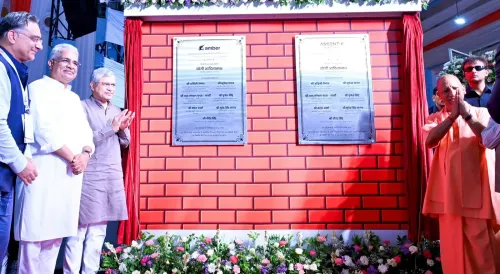
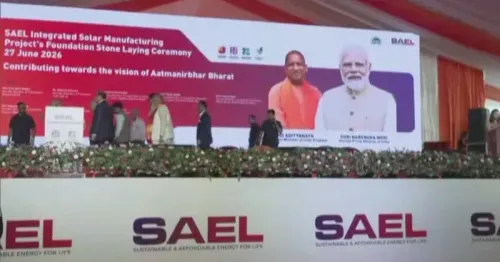
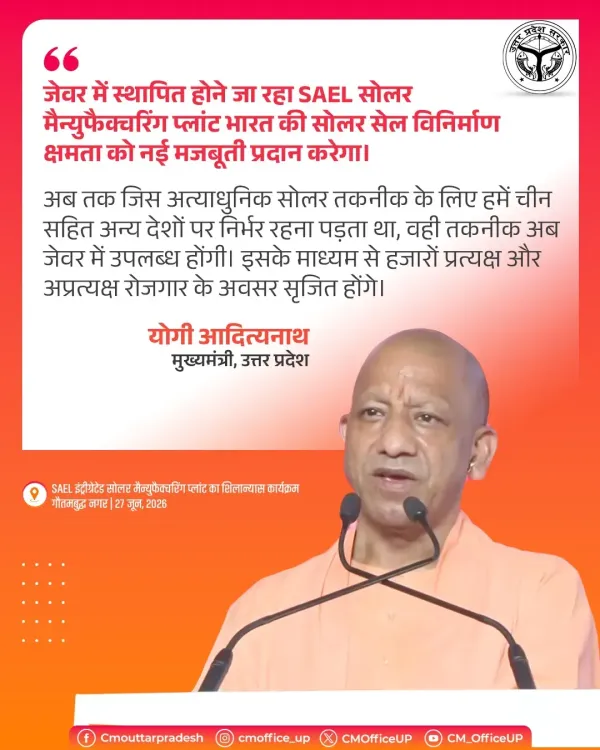
The Chief Minister's Office of Uttar Pradesh on Saturday, 27 June 2026 quoted Chief Minister Yogi Adityanath announcing that a SAEL solar manufacturing plant is set to be established in Jewar, pledging to strengthen India's domestic solar cell manufacturing capacity and reduce dependence on Chinese technology.
Sharing his remarks on the development, CM Yogi Adityanath said: 'जेवर में स्थापित होने जा रहा SAEL सोलर मैन्युफैक्चरिंग प्लांट भारत की सोलर सेल विनिर्माण क्षमता को नई मजबूती प्रदान करेगा।' (The SAEL solar manufacturing plant to be established in Jewar will provide new strength to India's solar cell manufacturing capacity.) He added that advanced solar technology for which India had to depend on China and other countries will now be available domestically in Jewar, and that the plant will generate thousands of direct and indirect employment opportunities.
Context
Jewar, located in Gautam Buddh Nagar district of Uttar Pradesh, is already in the spotlight as the site of the upcoming Noida International Airport. The region is rapidly emerging as a preferred destination for large-scale industrial investment, given its proximity to the Delhi-Mumbai Industrial Corridor and upcoming logistics infrastructure. The announcement of the SAEL solar manufacturing plant adds a significant renewable energy manufacturing anchor to this industrial cluster.
SAEL is an Indian company active in solar power generation and manufacturing. Its proposed Jewar facility is positioned to produce solar cells using technology that India has historically sourced from China, which dominates global ingot, wafer, and cell production.
Policy Backdrop
India's push to build domestic solar manufacturing capacity has been a central pillar of the Atmanirbhar Bharat framework. The central government notified the Production Linked Incentive (PLI) Scheme for Solar PV Modules in 2021, with a second tranche designed specifically to incentivise domestic production of high-efficiency solar cells and modules, reducing import dependence on Chinese supply chains.
Uttar Pradesh has complemented this national push through its own Solar Energy Policy, first issued in 2017 and subsequently amended, offering land and power incentives to attract solar manufacturers. The state has actively sought to position itself as a hub for green manufacturing, leveraging its large workforce and improving logistics network.
Stakeholders and Impact
The plant is expected to benefit multiple stakeholder groups. Local residents of Jewar and surrounding areas in Gautam Buddh Nagar stand to gain from direct employment on the shop floor, while MSME component suppliers across the region could see indirect job creation through ancillary supply chains. Renewable energy manufacturers nationally are also watching the development, as increased domestic cell production could ease module procurement costs across the sector.
CM Yogi Adityanath emphasised the employment dimension, stating that thousands of direct and indirect jobs would be created through the facility — a priority for a state with one of India's largest labour pools. The plant also aligns with India's broader target of expanding domestic solar capacity to reduce vulnerability to global supply chain disruptions concentrated in China.
What's Next
Attention will now turn to construction milestones and formal employment target announcements from SAEL, as well as any further policy support that Uttar Pradesh may extend to accelerate the plant's commissioning. The development will also be watched in the context of upcoming tranches under the national PLI solar scheme, where additional bids for manufacturing capacity are anticipated. If the Jewar facility reaches full operation, it could serve as a template for similar solar manufacturing investments across the state.
Point of View
Using high-profile projects near the Noida International Airport to signal investor confidence. By explicitly framing the plant as a counter to Chinese technology dependence, the statement draws a direct line to the national Atmanirbhar Bharat narrative — giving the announcement political resonance beyond state borders. The emphasis on job creation is equally deliberate: employment generation in western UP is a recurring electoral and governance priority for the Yogi administration. Whether SAEL's Jewar facility delivers at the scale implied will be the real test of this announcement's substance.
NationPress
26 Sept 2026
Frequently Asked Questions
What is the SAEL solar plant in Jewar?
The SAEL solar manufacturing plant in Jewar, Gautam Buddh Nagar, Uttar Pradesh, is a proposed facility that will manufacture solar cells domestically, reducing India's dependence on Chinese solar technology, as announced by Chief Minister Yogi Adityanath on 27 June 2026.
Where is Jewar located and why is it significant?
Jewar is a town in Gautam Buddh Nagar district, Uttar Pradesh, and is the site of the upcoming Noida International Airport. Its strategic location near the Delhi-Mumbai Industrial Corridor makes it a growing hub for large-scale industrial and infrastructure investment.
How does this plant help reduce India's dependence on China for solar technology?
India has historically relied on China for solar ingots, wafers, and cells. The SAEL plant in Jewar is intended to produce these components domestically, supporting the broader Atmanirbhar Bharat framework and the central government's PLI Scheme for Solar PV Modules launched in 2021.
What is the PLI scheme for solar modules?
The Production Linked Incentive (PLI) Scheme for Solar PV Modules was notified by the central government in 2021 to incentivise domestic manufacturing of high-efficiency solar cells and modules, with the goal of reducing import dependence on China.
How many jobs will the Jewar SAEL solar plant create?
Chief Minister Yogi Adityanath stated that the SAEL solar plant in Jewar will generate thousands of direct and indirect employment opportunities, benefiting local workers and MSME suppliers in the Gautam Buddh Nagar region.