CM Yogi: UP Produces 21% of India's Food on 11% of Farmland
Synopsis
Chief Minister Yogi Adityanath's office has cited a striking land-efficiency figure: Uttar Pradesh generates 21 per cent of India's foodgrain from only 11 per cent of its cultivable land, spotlighting the state's outsized role in national food security.
Key Takeaways
Uttar Pradesh produces 21 per cent of India's total foodgrain output despite holding only 11 per cent of the country's cultivable land.
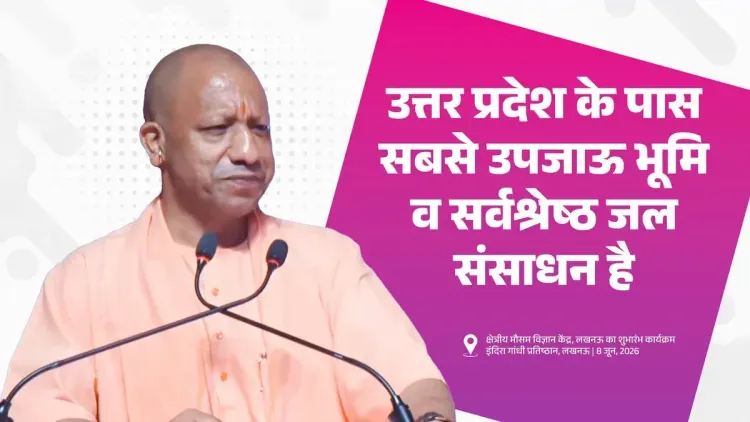
The statement was made by Chief Minister Yogi Adityanath and shared by the official CM Office UP account on 8 June 2026 .
UP's productivity gains are underpinned by central schemes including the National Food Security Mission and Pradhan Mantri Krishi Sinchayee Yojana .
The state is a leading producer of wheat, rice, and sugarcane , crops central to both rural incomes and national food security.
The land-to-output framing signals a possible push by the state government for performance-linked central agricultural funding.
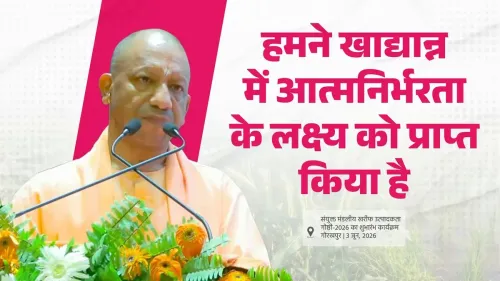
The Chief Minister's Office of Uttar Pradesh on Monday, 8 June 2026 shared a statement by Chief Minister Yogi Adityanath highlighting the state's outsized contribution to national food production — producing 21 per cent of India's foodgrain output from just 11 per cent of the country's cultivable land.
Context
The post quotes CM Yogi Adityanath directly: 'उत्तर प्रदेश देश की मात्र 11 प्रतिशत कृषि योग्य भूमि के साथ 21 प्रतिशत खाद्यान्न का उत्पादन करता है' — 'Uttar Pradesh produces 21 per cent of the country's foodgrain with merely 11 per cent of the nation's cultivable land.' The figure underscores a near two-to-one output-to-area ratio that the state government has been keen to project as evidence of governance effectiveness in the agriculture sector.
Uttar Pradesh holds roughly one-ninth of India's net sown area, yet its flat, fertile plains — particularly the Gangetic belt — have historically supported intensive cultivation of wheat, rice, and sugarcane. The state is consistently among the top producers in all three crops at the national level.
Policy Backdrop
The productivity gains cited by CM Yogi trace a lineage back to Green Revolution-era investments in high-yielding seed varieties and canal irrigation, but have been reinforced in the current policy cycle by centrally sponsored programmes. The National Food Security Mission and the Pradhan Mantri Krishi Sinchayee Yojana (PMKSY), both operational since 2015, have channelled resources into expanded micro-irrigation coverage, soil health management, and input subsidies across Uttar Pradesh's districts.
State-level procurement infrastructure — particularly for wheat through the Food Corporation of India network — has also ensured that higher yields translate into measurable procurement figures, reinforcing the land-to-output narrative the government is advancing.
Stakeholder and Economic Impact
The direct beneficiaries of this productivity story are Uttar Pradesh's estimated 2.3 crore farm households, who depend on cereal and sugarcane cultivation for a significant share of their income. A higher output-to-area ratio, if sustained, implies better returns per acre and greater food security for the state's predominantly rural population.
At the national level, UP's disproportionate contribution to the foodgrain basket has implications for India's overall cereal buffer stocks and the functioning of the public distribution system. Any disruption — through drought, pest pressure, or procurement failure — in a state producing more than a fifth of national output carries systemic risk for food inflation across the country.
What's Next
Attention will now turn to the next round of state-wise agricultural production estimates from the Ministry of Agriculture and Farmers Welfare, which will either validate or complicate the figures cited by the Chief Minister's Office. Analysts will also watch for Uttar Pradesh's forthcoming budget allocations for irrigation expansion and seed replacement programmes, which would signal whether the state intends to push its productivity ratio even higher. The framing of this data point — land efficiency rather than absolute output — suggests the state government may be building a case for greater central resource allocation tied to per-acre performance metrics.
Point of View
The Yogi Adityanath government is making a sophisticated governance argument: that Uttar Pradesh delivers disproportionate national value from a constrained resource base. This framing aligns with a broader BJP state-government playbook of using data-driven messaging to project administrative competence ahead of budget cycles and elections. The implicit ask — more central investment in a high-performing agricultural state — is politically astute, given that UP is both the most electorally significant state and a linchpin of India's food security architecture. Whether the figures withstand independent scrutiny will determine how durable this narrative proves.
NationPress
22 Sept 2026
Frequently Asked Questions
How much foodgrain does Uttar Pradesh produce compared to its land share?
According to a statement by CM Yogi Adityanath , Uttar Pradesh produces 21 per cent of India's foodgrain while accounting for only 11 per cent of the country's cultivable land — nearly double its proportional share.
Why is Uttar Pradesh so productive agriculturally despite limited farmland?
UP's productivity reflects decades of Green Revolution investment, fertile Gangetic plains, high-yielding crop varieties, and more recently, central schemes like the Pradhan Mantri Krishi Sinchayee Yojana that have expanded irrigation coverage across the state.
What crops does Uttar Pradesh mainly produce?
Uttar Pradesh is among India's top producers of wheat, rice, and sugarcane , all of which are critical to national food security and rural incomes in the state.
What is the significance of UP's food production for India?
With over a fifth of national foodgrain output, UP is central to India's cereal buffer stocks and the public distribution system. Any production shortfall in the state can have direct consequences for food inflation nationwide.
What government schemes support agriculture in Uttar Pradesh?
Key central programmes include the National Food Security Mission and the Pradhan Mantri Krishi Sinchayee Yojana (PMKSY) , both operational since 2015 , which support irrigation, soil health, and input access for farmers in UP .