CM Yogi: UP Produces 55% of India's Ethanol, Eyes 100 CBG Plants
Synopsis
Chief Minister Yogi Adityanath says Uttar Pradesh alone contributes roughly 55 per cent of India's total ethanol output and leads the country in CBG plant installations, with a fresh target to add 100 more CBG plants within one year.
Key Takeaways
Uttar Pradesh accounts for approximately 55 per cent of India's total ethanol production, according to CM Yogi Adityanath .
The state already hosts the highest number of CBG plants in the country.
CM Yogi has set a target of establishing 100 new CBG plants in Uttar Pradesh within the next one year .
The push aligns with India's national goal of 20% ethanol blending in petrol by 2025-26 under the Ethanol Blended Petrol Programme .
UP's Ethanol Policy 2021 and the central SATAT scheme (2018) provide the policy and financial scaffolding for this expansion.
Sugarcane farmers, distilleries, CBG entrepreneurs, and oil marketing companies are the primary beneficiaries.
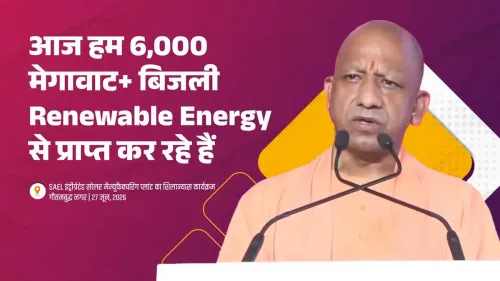
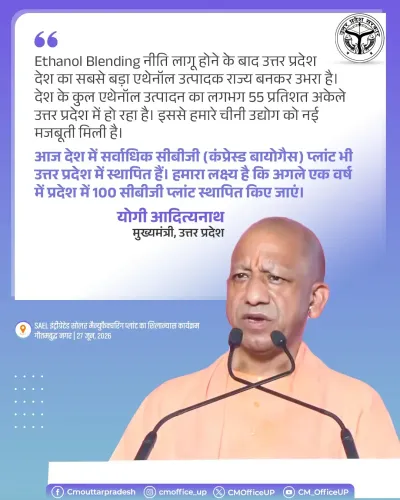
The Chief Minister's Office of Uttar Pradesh announced on Saturday, 27 June 2026 that the state now accounts for approximately 55 per cent of India's total ethanol production and hosts the highest number of Compressed Biogas (CBG) plants in the country, with Chief Minister Yogi Adityanath setting a target of 100 new CBG plants within the next one year.
Context
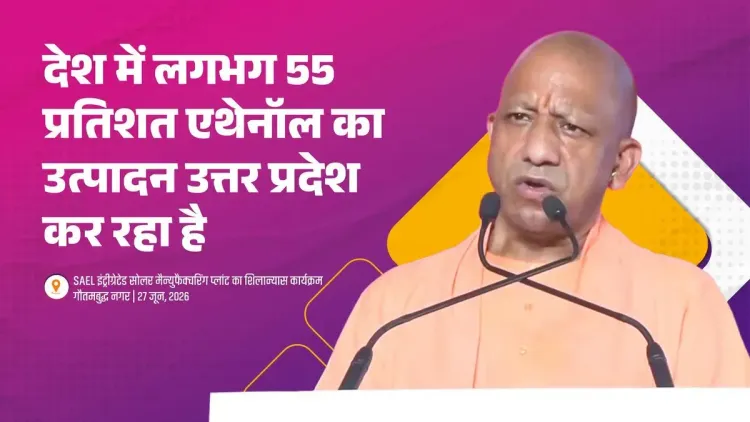
Addressing the announcement, CM Yogi Adityanath stated — 'आज देश के कुल एथेनॉल उत्पादन का लगभग 55 प्रतिशत अकेले उत्तर प्रदेश में हो रहा है' ['Today, approximately 55 per cent of the country's total ethanol production is happening in Uttar Pradesh alone']. He further noted that Uttar Pradesh already leads the nation in CBG plant installations and has committed to adding 100 more CBG plants over the coming year.
Uttar Pradesh is India's largest sugarcane-producing state, and its extensive network of sugar mills and integrated distilleries has historically made it a dominant player in molasses-based ethanol output. The state's Ethanol Policy of 2021 further incentivised new distillery capacity and diversification into maize-based ethanol, reinforcing its lead position.
Policy Backdrop
The claims align with India's accelerated push under the Ethanol Blended Petrol (EBP) Programme, under which the country advanced its 20 per cent ethanol blending target from 2030 to 2025-26. The central government's National Policy on Biofuels 2018 expanded eligible feedstocks and set blending targets across transport fuels, giving states like Uttar Pradesh a clear mandate to scale up production infrastructure.
On the CBG front, the Union government's SATAT scheme, launched in October 2018 by the Ministry of Petroleum and Natural Gas, aimed to establish 5,000 CBG plants across the country using agricultural residue and municipal solid waste, with offtake guarantees from oil marketing companies. Uttar Pradesh's agri-waste surplus — including press mud and spent wash from sugar mills — gives it a natural feedstock advantage for CBG production.
Stakeholders and Impact
The ethanol and CBG expansion directly benefits sugarcane farmers across Uttar Pradesh's western and central belts, as integrated processing of sugarcane by-products adds value beyond raw sugar and improves mill liquidity for cane price payments. Biofuel distilleries and CBG entrepreneurs stand to gain from fresh state-level incentives expected to accompany the 100-plant target.
For oil marketing companies, higher domestic ethanol availability reduces dependence on imported crude, directly supporting India's energy security goals. The circular-economy model — converting agricultural residue into gas — also addresses stubble-burning concerns that affect air quality across the Indo-Gangetic Plain every post-harvest season.
What's Next
The government's stated one-year timeline for 100 new CBG plants will be closely tracked against progress benchmarks and any revision of state blending mandates ahead of the 2025-26 ethanol season. Execution will hinge on land clearances, feedstock tie-ups, and offtake agreements with oil marketing companies under the SATAT framework.
If achieved, the 100-plant milestone would further consolidate Uttar Pradesh's position as the anchor state in India's biofuel economy and could set a template for other sugarcane-surplus states to replicate the integrated ethanol-CBG model.
Point of View
Broadening the revenue base for agri-waste and reducing the state's exposure to sugarcane price volatility. However, the credibility of the 100-plant-in-one-year pledge will be tested by ground-level execution — land, feedstock contracts, and SATAT offtake agreements have historically been bottlenecks. If delivered, this could reframe Uttar Pradesh not just as a sugarcane state but as India's green-energy manufacturing hub.
NationPress
27 Jun 2026
Frequently Asked Questions
How much of India's ethanol is produced in Uttar Pradesh?
According to Chief Minister Yogi Adityanath , approximately 55 per cent of India's total ethanol production currently takes place in Uttar Pradesh , driven by the state's large sugarcane belt and integrated distillery network.
What is a CBG plant and why is Uttar Pradesh focusing on it?
Compressed Biogas (CBG) is produced by compressing biogas generated from organic waste such as agricultural residue, press mud, and spent wash. Uttar Pradesh is focusing on CBG because it has abundant agri-waste from sugar mills and the central government's SATAT scheme provides offtake guarantees, making it commercially viable.
What is the SATAT scheme?
The SATAT scheme was launched in October 2018 by India's Ministry of Petroleum and Natural Gas to establish 5,000 CBG plants across the country using agricultural residue and municipal waste, with oil marketing companies committed to buying the output.
What is India's ethanol blending target?
India has advanced its target of 20 per cent ethanol blending in petrol from 2030 to 2025-26 under the Ethanol Blended Petrol (EBP) Programme , aiming to cut crude oil imports and reduce carbon emissions.
How does UP's ethanol production benefit sugarcane farmers?
When sugarcane by-products like molasses are processed into ethanol or CBG, mills generate additional revenue, which improves their ability to pay State Advised Prices (SAP) to sugarcane farmers on time and reduces outstanding dues.