CM Yogi Calls for Disaster Awareness in Daily Life
Synopsis
Uttar Pradesh Chief Minister Yogi Adityanath on 19 July 2026 urged citizens to make disaster alertness and preparedness a daily habit, sharing a video on X during peak monsoon season. The call aligns with India's Disaster Management Act framework and the Sendai Framework, targeting community-level resilience in flood-prone UP.
Key Takeaways
CM Yogi Adityanath posted on 19 July 2026 calling for disaster alertness, preparedness, and awareness to be part of daily life.
Uttar Pradesh is one of India's most flood-vulnerable states, with major rivers including the Ganga, Yamuna, Ghaghra and Rapti prone to monsoon inundation.
The message aligns with India's Disaster Management Act, 2005 and the National Policy on Disaster Management, 2009 , which stress community resilience.
The Uttar Pradesh State Disaster Management Authority (UPSDMA) is the nodal state agency responsible for preparedness and response.
India's commitments under the Sendai Framework for Disaster Risk Reduction (2015–2030) emphasise public awareness alongside infrastructure measures.
State-level drills, public campaigns, and district-level preparedness reviews are expected to follow during the monsoon period.
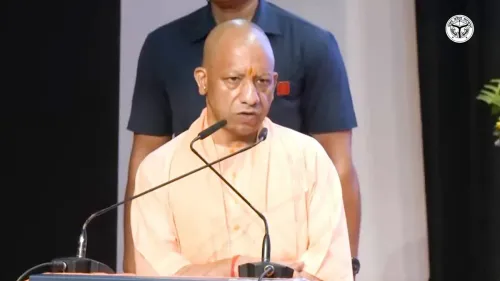
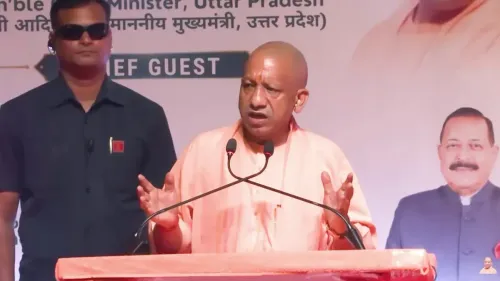
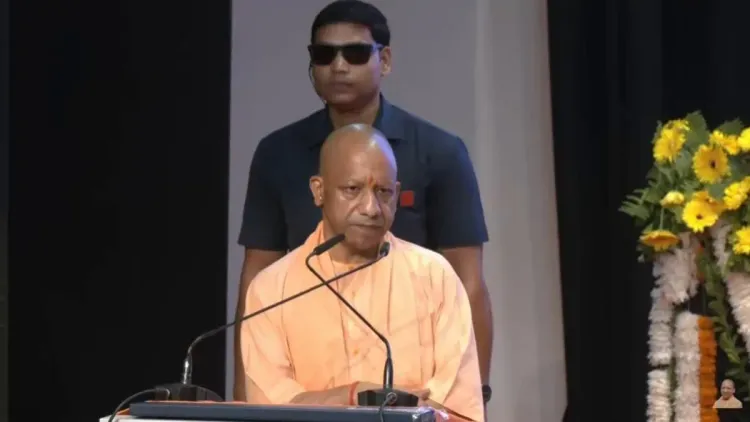
Uttar Pradesh Chief Minister Yogi Adityanath on Sunday, 19 July 2026, called for disaster alertness, preparedness, and awareness to become an integral part of everyday life, sharing a message on X accompanied by a video.
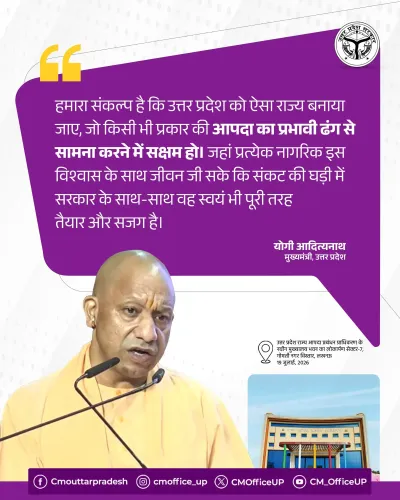
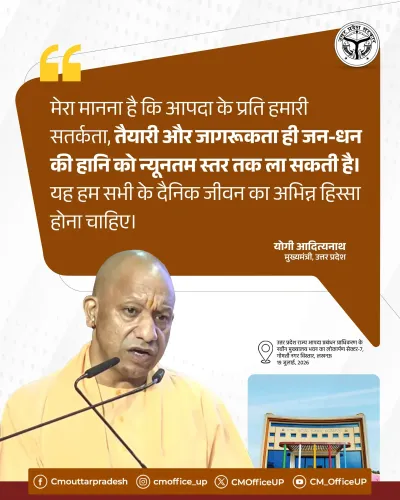
In his post, the Chief Minister wrote: 'Aapda ke prati satarkta, taiyari aur jagrukta hamare dainik jeevan ka hissa hona chahiye' — 'Alertness, preparedness and awareness towards disasters must become a part of our daily lives.' The message underlines a shift in official thinking: disaster management is not merely a reactive government function but a civic responsibility embedded in routine behaviour.
Context
Uttar Pradesh sits in the Ganga basin and is among India's most flood-vulnerable states, with districts along the Ganga, Yamuna, Ghaghra and Rapti rivers facing recurring inundation every monsoon season. The state government has historically issued advisories and conducted drills during the June–September monsoon window. CM Yogi Adityanath's administration has consistently linked routine governance messaging with disaster-preparedness communication, particularly as the monsoon intensifies.
The post arrives during the peak monsoon period, when river levels rise sharply and the risk to low-lying communities is highest. By framing preparedness as a daily habit rather than an emergency response, the message targets behavioural change at the community level — an approach aligned with national and global disaster-risk frameworks.
Policy Backdrop
India's institutional disaster-management architecture rests on the Disaster Management Act, 2005, which established the National Disaster Management Authority (NDMA) as the apex statutory body and mandated the creation of state-level counterparts. The Uttar Pradesh State Disaster Management Authority (UPSDMA) is the nodal agency for preparedness, mitigation, and response within the state.
The National Policy on Disaster Management, 2009, placed community resilience and proactive risk reduction at the centre of India's strategy. More recently, India's commitments under the Sendai Framework for Disaster Risk Reduction (2015–2030) have reinforced the emphasis on public awareness and last-mile outreach alongside physical infrastructure. CM Yogi's message echoes this policy lineage by stressing individual and community-level vigilance.
Stakeholders and Impact
The most directly affected audience is the flood-prone population of Uttar Pradesh — tens of millions of residents in districts such as Varanasi, Prayagraj, Gorakhpur, Ballia and Bahraich, where annual flooding disrupts agriculture, displacement, and livelihoods. Local administration, village-level disaster response teams, and NDRF and SDRF units are also implicated in the preparedness chain the Chief Minister is reinforcing.
For the broader governance ecosystem, the message signals that the state leadership expects preparedness to percolate beyond official agencies to individual citizens. Schools, gram panchayats, and urban local bodies are potential channels through which such awareness campaigns typically translate into on-ground action.
What's Next
The coming weeks are likely to see UPSDMA drills, public awareness campaigns, and district-level preparedness reviews as the monsoon deepens. The Chief Minister's public messaging often precedes or accompanies administrative directives to district magistrates and relief commissioners. Whether the video accompanying this post is part of a broader state campaign will become clearer as follow-up communications emerge from the state government.
With the Sendai Framework milestone year of 2030 approaching, Uttar Pradesh's ability to embed disaster awareness at the grassroots level will be a key test of how effectively India's largest state translates national policy into lived civic behaviour.
Point of View
Particularly during monsoon season. The framing moves the responsibility conversation from state machinery to the individual citizen — a politically low-risk but substantively important shift that mirrors the Sendai Framework's community-resilience logic. For a state as large and flood-prone as Uttar Pradesh, converting top-down advisories into bottom-up civic habits remains the central challenge. Whether this post is followed by concrete institutional action — drills, campaigns, district-level directives — will determine whether it registers as policy signal or routine seasonal messaging.
NationPress
18 Oct 2026
Frequently Asked Questions
What did CM Yogi Adityanath say about disaster preparedness?
CM Yogi Adityanath said that alertness, preparedness, and awareness towards disasters must become a part of daily life, sharing this message on X on 19 July 2026 with an accompanying video.
Why is Uttar Pradesh particularly vulnerable to floods?
Uttar Pradesh lies in the Ganga basin and has several major rivers — including the Ganga, Yamuna, Ghaghra, and Rapti — that swell during the June–September monsoon, putting millions of residents in low-lying districts at risk each year.
What is the Uttar Pradesh State Disaster Management Authority?
The Uttar Pradesh State Disaster Management Authority (UPSDMA) is the state-level nodal agency established under the Disaster Management Act, 2005, responsible for disaster preparedness, mitigation, and response in the state.
What is India's legal framework for disaster management?
India's primary legal framework is the Disaster Management Act, 2005, which created the National Disaster Management Authority (NDMA) and mandated state-level counterparts. It is supplemented by the National Policy on Disaster Management, 2009, and India's commitments under the Sendai Framework for Disaster Risk Reduction.
What action is expected from the UP government after CM Yogi's post?
State-level monsoon preparedness reviews, UPSDMA drills, and public awareness campaigns are expected in the coming weeks, consistent with the pattern of administrative follow-up that typically accompanies senior leadership messaging during the monsoon season.