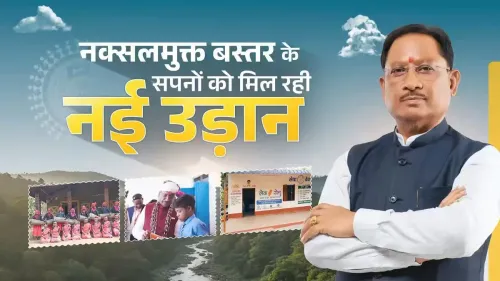
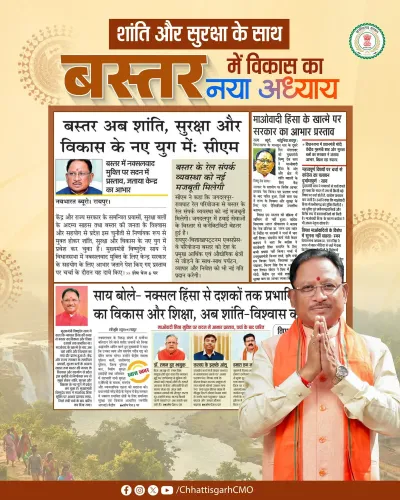
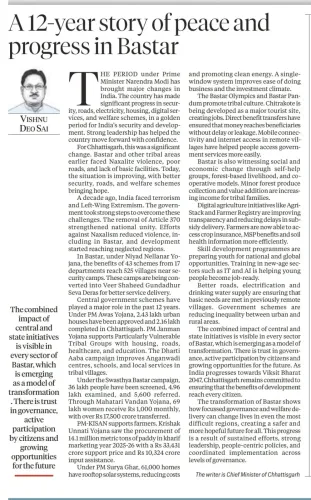
CM Office: Bastar a Symbol of Growth Under Modi's Vision
Synopsis
The Chhattisgarh Chief Minister's Office on 13 June 2026 declared Bastar a symbol of resilience and inclusive growth, crediting PM Modi's vision for security, infrastructure, and welfare gains in the historically LWE-affected division.
Key Takeaways
The Chhattisgarh CMO on 13 June 2026 officially framed Bastar as a transformed region of confidence and aspiration.
Progress is attributed to PM Narendra Modi's vision, with emphasis on security, infrastructure, connectivity, and welfare.
Bastar — a seven-district division with a majority tribal population — has a long history of Left-Wing Extremism .
The region was included in NITI Aayog's Aspirational Districts Programme in January 2018 to accelerate development outcomes.
The post links Bastar's growth to the national Viksit Bharat campaign targeting a developed India by 2047 .
The #12YearsOfNationBuilding tag places the post within a broader government communications campaign marking a governance milestone.
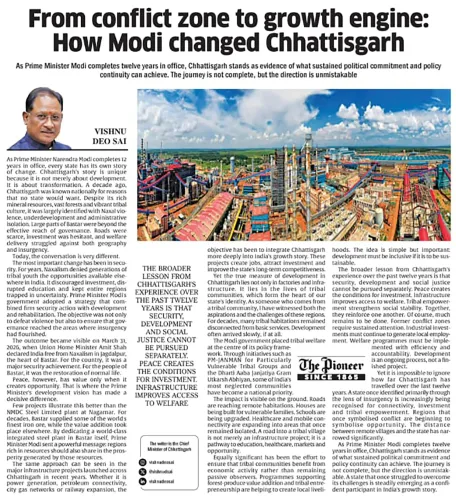
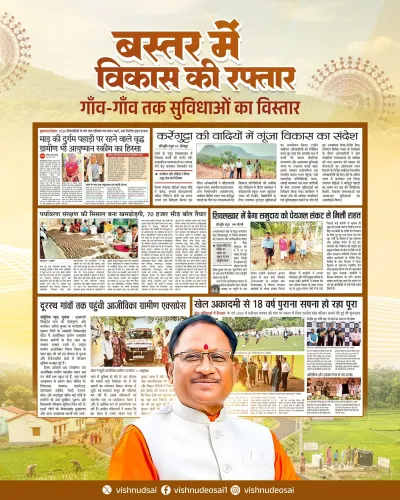
The Chief Minister's Office of Chhattisgarh on Saturday, 13 June 2026 highlighted Bastar as a region transformed through sustained focus on security, infrastructure, connectivity, and welfare, crediting the vision of Prime Minister Narendra Modi for the division's progress.
The official post, tagged #12YearsOfNationBuilding, described Bastar's story as 'one of confidence, aspiration, and transformation,' and positioned the region as a contributor to the broader national campaign of Viksit Bharat — a developed India by 2047.
Context
Bastar is a division in southern Chhattisgarh comprising seven districts with a predominantly tribal population. For decades, the region was among the most severely affected by Left-Wing Extremism (LWE), making governance, infrastructure delivery, and welfare outreach acutely difficult. The post's framing of Bastar as a 'symbol of resilience, empowerment, and inclusive growth' signals a deliberate shift in the official narrative — from conflict zone to development showcase.Policy Backdrop
The transformation narrative rests on a dual-track strategy pursued by successive central and state governments across India's LWE belt: pairing intensified security operations with accelerated infrastructure and welfare spending to reduce alienation in remote districts. At the national level, the National Policy and Action Plan on Left Wing Extremism (2015) formally integrated road connectivity and welfare delivery with security objectives in Chhattisgarh. In January 2018, NITI Aayog included several Bastar districts under its Aspirational Districts Programme, directing focused improvements in health, education, and infrastructure. More recently, PM Gati Shakti — the Centre's multi-modal connectivity initiative — has been cited as a vehicle for expanding road and digital networks into previously inaccessible parts of the region.Stakeholders and Impact
The primary beneficiaries of this policy convergence are Bastar's tribal communities, who constitute the majority of the division's population. Improved road connectivity has opened access to markets, schools, and healthcare facilities. Welfare schemes targeting nutrition, housing, and livelihoods have been extended to villages that were earlier difficult to reach. The Chhattisgarh government and the Union Ministry of Home Affairs are the principal institutional actors, while NITI Aayog's Aspirational Districts dashboard provides a performance-monitoring framework. The post's alignment with the Viksit Bharat campaign also signals an intent to embed Bastar's progress within the Centre's overarching development messaging ahead of the 2047 centenary goal.What's Next
Attention will now turn to the roll-out of additional road and digital connectivity projects under PM Gati Shakti and any mid-term review of Bastar's performance indicators on the Aspirational Districts dashboard. The #12YearsOfNationBuilding tag suggests this post is part of a wider communications campaign marking a governance milestone, meaning further official assessments of development outcomes across Chhattisgarh are likely to follow. If Bastar's trajectory continues to be highlighted as a model, it could influence the Centre's approach to other LWE-affected districts across central and eastern India.Point of View
The state government simultaneously reinforces Centre-state alignment and stakes a claim in the national development narrative. The #12YearsOfNationBuilding tag signals this is coordinated messaging tied to a specific political milestone, not a standalone policy update. Bastar's inclusion in this narrative is significant — if the region's transformation is independently verifiable, it would represent one of the more consequential governance achievements in India's LWE belt in recent decades.
NationPress
19 Sept 2026
Frequently Asked Questions
What is the current situation in Bastar Chhattisgarh?
According to the Chhattisgarh CMO , Bastar is now described as a region of confidence, aspiration, and transformation, with improvements in security, infrastructure, connectivity, and welfare attributed to PM Modi's development vision.
Why was Bastar included in the Aspirational Districts Programme?
NITI Aayog included Bastar districts in its Aspirational Districts Programme in January 2018 because the region lagged significantly on health, education, and infrastructure indicators, partly due to the impact of Left-Wing Extremism .
What is Viksit Bharat and how does Bastar relate to it?
Viksit Bharat is the central government's campaign for a fully developed India by 2047 . The Chhattisgarh CMO has positioned Bastar's growth story as a contribution to this national vision.
What is the National Policy on Left Wing Extremism?
The National Policy and Action Plan on Left Wing Extremism (2015) is a central government framework that integrates security operations with road connectivity and welfare delivery in LWE-affected states, including Chhattisgarh .
What does 12 Years of Nation Building mean?
The hashtag #12YearsOfNationBuilding used by the Chhattisgarh CMO appears to mark a governance milestone associated with the current central government's tenure, framing development achievements as part of a coordinated communications campaign.