Chhattisgarh CMO pays tribute to Maharaja Pravir Chandra Bhanjdev on jayanti
Synopsis
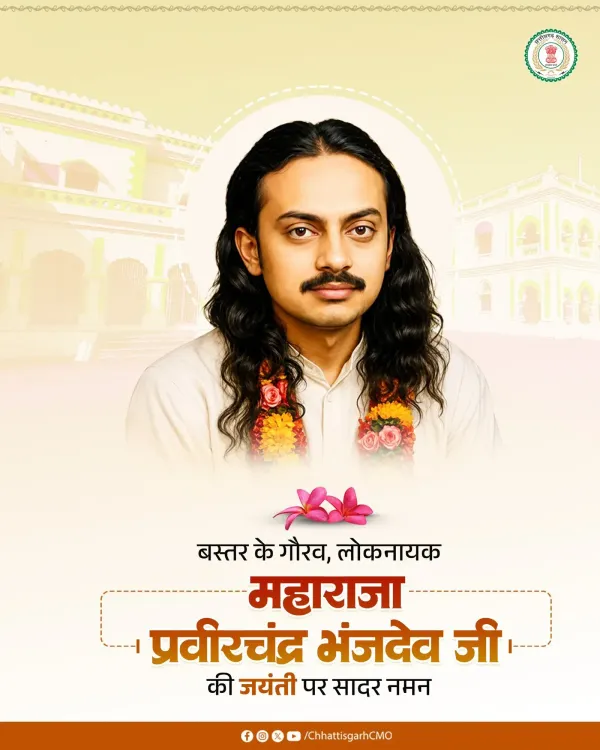
The Chief Minister's Office of Chhattisgarh paid tribute to Maharaja Pravir Chandra Bhanjdev on his birth anniversary on 25 June 2026, honouring the last ruler of Bastar as a Loknayak whose dedication to tribal culture and the soil of Bastar continues to guide the state.
Key Takeaways
The Chief Minister's Office of Chhattisgarh posted a formal tribute to Maharaja Pravir Chandra Bhanjdev on his birth anniversary on 25 June 2026 .
The Maharaja, born in 1929 , was the last ruler of the Bastar princely state and a vocal advocate for tribal rights and indigenous culture.
He died in 1966 in a police action that remains a significant event in Bastar's tribal collective memory.
The CMO described him as Loknayak (people's leader) and said his dedication to Bastar's soil and tribal culture 'will always guide us.' Chhattisgarh , formed in 2000 , has an explicit administrative focus on tribal development and cultural heritage, particularly in the Bastar division.
The Chief Minister's Office of Chhattisgarh on Thursday, 25 June 2026, paid homage to Maharaja Pravir Chandra Bhanjdev, the last ruler of the Bastar princely state, on his birth anniversary, honouring his legacy as a champion of tribal rights and indigenous culture.
Context
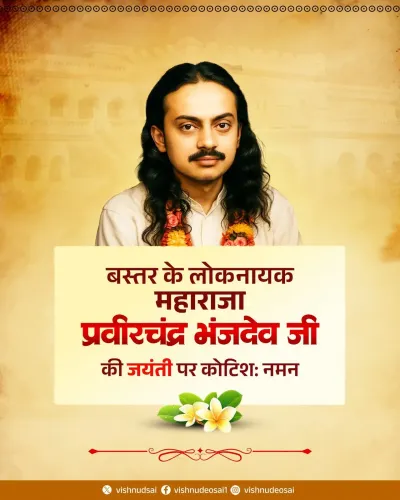
The CMO's post, written in Hindi, offered koti-koti naman (countless salutations) to the Maharaja, describing him as the Loknayak (people's leader) and an ideal for every person of Bastar. The tribute stated that 'your dedication to the soil of Bastar and tribal culture will always guide us.' The post was accompanied by an image and carried the official hashtag #महाराजा_प्रवीरचंद्र_भंजदेव_जी.Policy Backdrop
Maharaja Pravir Chandra Bhanjdev, born in 1929, was the hereditary ruler of the Bastar princely state in present-day Chhattisgarh. He became a prominent voice for the rights and cultural identity of the region's Adivasi communities. His life ended in a controversial police action in 1966, an event that left a deep and lasting imprint on the collective memory of Bastar's tribal population. Chhattisgarh was carved out of Madhya Pradesh in 2000 as a separate state, with an administrative mandate that explicitly emphasises tribal development, welfare, and cultural heritage preservation.Stakeholders and Impact
The tribute carries particular resonance for Bastar's large Adivasi communities, for whom the Maharaja remains a symbol of resistance and cultural pride. Bastar division, spread across southern Chhattisgarh, has historically been at the centre of debates over tribal land rights, forest resources, and insurgency. State governments across India have increasingly used social media to issue formal tributes to regional historical figures tied to indigenous identity, a practice that reinforces cultural recognition alongside welfare and security policies. For Bastar's tribal population, official acknowledgement of the Maharaja's legacy signals the state's intent to remain aligned with Adivasi cultural memory.What's Next
The birth anniversary tribute may precede broader state announcements on Bastar-specific tribal welfare schemes or cultural events. The Chhattisgarh government has in recent years focused on strengthening institutional recognition of tribal heritage across the state. Observers will watch for any follow-up policy measures or cultural programmes tied to the Maharaja's legacy in the months ahead.Point of View
The state government aligns itself with Adivasi cultural memory at a time when tribal identity politics remain central to governance in Bastar. This pattern of official commemoration serves a dual purpose: reinforcing the administration's Adivasi-friendly credentials while anchoring a narrative of continuity between the pre-state princely past and current tribal welfare commitments. The tribute also reflects a wider trend of state governments in central and eastern India using social media as a platform for indigenous cultural recognition alongside hard policy interventions.
NationPress
23 Sept 2026
Frequently Asked Questions
Who was Maharaja Pravir Chandra Bhanjdev?
Maharaja Pravir Chandra Bhanjdev, born in 1929, was the last ruler of the Bastar princely state in present-day Chhattisgarh. He was known for his strong advocacy of tribal rights and indigenous culture, and died in a police action in 1966.
Why is Maharaja Pravir Chandra Bhanjdev important to Bastar tribals?
He is regarded as a Loknayak, or people's leader, who championed the rights and cultural identity of Bastar's Adivasi communities. His death in 1966 left a lasting imprint on tribal collective memory in the region.
Why did the Chhattisgarh CMO post a tribute to Pravir Chandra Bhanjdev?
The Chief Minister's Office of Chhattisgarh posted the tribute on 25 June 2026 to mark the birth anniversary of Maharaja Pravir Chandra Bhanjdev, honouring his legacy as a symbol of tribal culture and dedication to Bastar.
What is the significance of Bastar in Chhattisgarh?
Bastar is a division in southern Chhattisgarh with a large Adivasi population. It has historically been at the centre of debates over tribal land rights, forest resources, and insurgency, making it a region of significant political and cultural importance.
When was Chhattisgarh formed and what is its tribal policy focus?
Chhattisgarh was carved out of Madhya Pradesh in 2000. The state has an explicit administrative emphasis on tribal development, welfare, and the preservation of indigenous cultural heritage, particularly in the Bastar division.