Can Congress Address Muslim Concerns When It Fails Its Own?
Click to start listening
Synopsis
In a revealing interview, Maulana Mahmood Madani critiques Congress's inability to address its own issues, let alone champion Muslim rights, urging a broader focus on national concerns like pollution and the essence of jihad.
Key Takeaways
- Maulana Mahmood Madani critiques Congress's focus on Muslim issues.
- Calls for addressing broader national issues like pollution.
- Stresses the importance of understanding 'jihad' in education.
- Claims all political parties have failed to tackle basic issues.
- Encourages a united approach to national challenges.
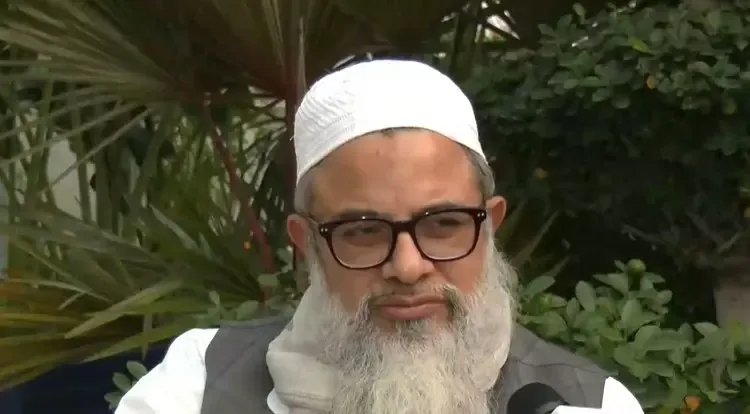
New Delhi, Dec 3 (NationPress) Maulana Mahmood Madani, the leader of Jamiat Ulama-e-Hind (JUH), remarked on Wednesday that it is impractical to anticipate any mainstream political party to primarily represent Muslim interests.
He stressed that the Congress party is currently incapable of effectively tackling Muslim issues due to its own challenges.
In an exclusive dialogue with IANS, Maulana Madani stated that politics should encompass a broader scope beyond just Muslim perspectives, addressing other pressing matters such as pollution.
When probed if Congress champions the rights of the Muslim community, the JUH leader responded, "This is a very political question. It is misguided to expect any mainstream political entity to solely advocate for Muslims or their concerns. I do not wish to harbor such expectations from any party. Presently, it (Congress) is not even capable of voicing its own issues -- how can it address those of others?"
Madani was similarly questioned about the AIMIM leader Asaduddin Owaisi, to which he replied that no party is actively engaging in fundamental issues, stating that all have "failed" in this regard.
"Politics should not be viewed solely through the lens of Muslims. For the benefit of the country and nation-building efforts, issues like pollution, whether it be air, water, or even the pollution of minds, should be the focus. Political parties and civil society need to combat these together or independently, as per their discretion. I believe our parties are not adequately addressing basic issues. In this context, everyone has failed," the JUH chief added.
Furthermore, Madani elaborated on the concept of 'jihad', asserting its importance extends beyond Muslims to include the entire nation, advocating for its inclusion in educational curricula to ensure children grasp its true meaning and significance.
He indicated that 'jihad' (traditionally understood as a struggle or fight against adversaries of Islam or to protect the Muslim community) has faced persistent misinterpretation, often being wrongfully associated with violence.
Madani accused certain individuals identifying as followers of Sanatan Dharma and other faiths of deliberately misrepresenting the sacred Islamic principle of jihad, equating it with terrorism and fostering animosity against Islam and Muslims.
Point of View
It's crucial to recognize that the concerns raised by Maulana Madani reflect a broader sentiment among citizens. Political parties must address foundational issues affecting all communities, rather than focusing narrowly on specific groups. A united approach to national challenges is essential for progress.
NationPress
03/12/2025
Frequently Asked Questions
What did Maulana Mahmood Madani say about Congress?
Maulana Mahmood Madani stated that it is unrealistic to expect Congress to advocate solely for Muslims, as the party struggles with its own issues.
How does Madani view the role of political parties?
He believes that political parties should address important national issues, such as pollution, rather than focusing exclusively on one community's concerns.
What is the significance of 'jihad' according to Madani?
Madani asserts that 'jihad' is important for the entire nation and should be included in education to clarify its true meaning, which has been misinterpreted.