Did the Dalai Lama Just Win His First Grammy?
Synopsis
In a historic moment, the Dalai Lama, at 90, has won his first Grammy for Best Audio Book. This achievement reflects his ongoing commitment to universal responsibility and spreading messages of peace. Read on to explore his inspiring journey and the themes captured in his award-winning work.
Key Takeaways
Dalai Lama wins his first Grammy Award at age 90.
His work promotes peace and compassion .
Album features themes of mindfulness and harmony .
Recognition reflects shared universal responsibility .
India hosts approximately 100,000 Tibetans .
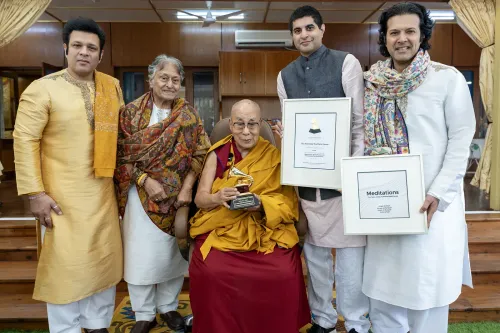
Dharamsala, Feb 2 (NationPress) The esteemed spiritual figure, Dalai Lama, aged 90, has achieved his inaugural Grammy Award for Best Audio Book, Narration, and Storytelling Recording. The Nobel Peace Laureate was in competition with notable personalities such as Milli Vanilli’s Fab Morvan, US Supreme Court Justice Ketanji Brown Jackson, show host Trevor Noah, and actress Kathy Garver.
Rufus Wainwright accepted the award on behalf of the Dalai Lama during a ceremony that was streamed on YouTube.
His work, “Meditations: The Reflections Of His Holiness The Dalai Lama”, showcases innovative collaborations infused with Hindustani classical music.
The album features collages of his insights on significant themes including mindfulness, harmony, and health, collected over recent years. Upon receiving the award, His Holiness expressed, “I accept this honor with appreciation and modesty. This recognition extends beyond me, symbolizing our collective universal responsibility. I genuinely believe that peace, compassion, environmental stewardship, and an understanding of our shared humanity are crucial for the well-being of all eight billion individuals on our planet.”
He added, “I hope this Grammy acknowledgment can help disseminate these essential messages more broadly.”
Sixty-six years ago, His Holiness the 14th Dalai Lama, under the disguise of a soldier, departed from Norbulingka Palace in Tibet, navigating a perilous 14-day journey into exile in India. Since that time, he has remained the most distinguished guest of the Indian government, often expressing his enjoyment of the freedoms he has. He has dedicated himself to promoting human values, religious harmony, and the preservation of Tibetan language and culture, a legacy derived from the teachings of India’s Nalanda University.
Tenzin Gyatso, the 14th Dalai Lama, fled to exile on March 17, 1959, following a Chinese crackdown on an uprising in Tibet.
A globally recognized figure of compassion, the Dalai Lama shares insights into his decades-long interactions with China in his latest book, ‘In Voice for the Voiceless’. This work serves as a reminder of Tibet’s ongoing struggle for autonomy and the hardships faced by his people.
The book documents his remarkable life journey, illustrating the profound loss of homeland to an oppressive force and the resilience required to forge a new existence in exile, while confronting the existential challenges of a nation, its populace, culture, and faith.
He was merely 16 when Communist China invaded Tibet in 1950, just 19 during his first encounter with Chairman Mao in Beijing, and 25 when he was compelled to flee to India and assume the role of a leader in exile.
Upon reaching India after a treacherous expedition, the Dalai Lama initially resided in Mussoorie, Uttarakhand, for about a year.
On March 10, 1960, just prior to relocating to Dharamsala, nestled in the upper regions of India’s Kangra Valley, the Dalai Lama stated: “As exiles, our immediate focus must be on resettlement and the preservation of our cultural traditions. We, the Tibetans, shall eventually reclaim freedom for Tibet.”
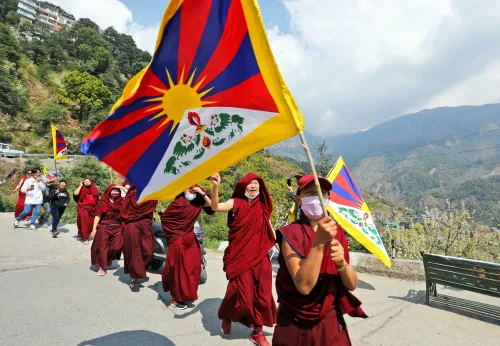
Presently, India is home to approximately 100,000 Tibetans and the government-in-exile.
Point of View
I recognize the significance of the Dalai Lama's Grammy win as not just a personal accolade, but a testament to his enduring advocacy for peace and compassion amidst global challenges. His recognition reinforces the importance of universal responsibility in today's world. NationPress stands firmly with these ideals.
NationPress
18 Oct 2026
Frequently Asked Questions
What is the significance of the Dalai Lama winning a Grammy?
The Dalai Lama's Grammy win symbolizes a broader recognition of his messages on peace, compassion, and universal responsibility, highlighting the importance of these values in today's society.
What themes are explored in the Dalai Lama's Grammy-winning album?
The album 'Meditations' explores themes such as mindfulness, harmony, and health, featuring collages of his remarks on these crucial topics.
How did the Dalai Lama escape to India?
The Dalai Lama escaped to India in 1959 after a 14-day journey disguised as a soldier, following a Chinese crackdown on an uprising in Tibet.
What is the current status of Tibetans in India?
Currently, India is home to approximately 100,000 Tibetans and the Tibetan government-in-exile, preserving their culture and traditions.
What does the Dalai Lama's latest book address?
His latest book, 'In Voice for the Voiceless,' addresses his experiences with China and the ongoing struggle for freedom faced by Tibetans.