China's Smear Campaign Against the Dalai Lama Exposed
Synopsis
Chinese authorities are reportedly targeting the Dalai Lama through a smear campaign involving sexual insinuations, reflecting a broader authoritarian strategy to maintain control amidst symbolic challenges.
Key Takeaways
Authoritarian tactics include reputational manipulation against symbolic leaders.
The Dalai Lama's Grammy recognition challenges the Chinese narrative.
Pro-China media amplifies false claims to undermine moral authority.
Symbolic defiance poses challenges that coercive measures cannot neutralize.
AI tools are essential for fact-checking and combating misinformation.
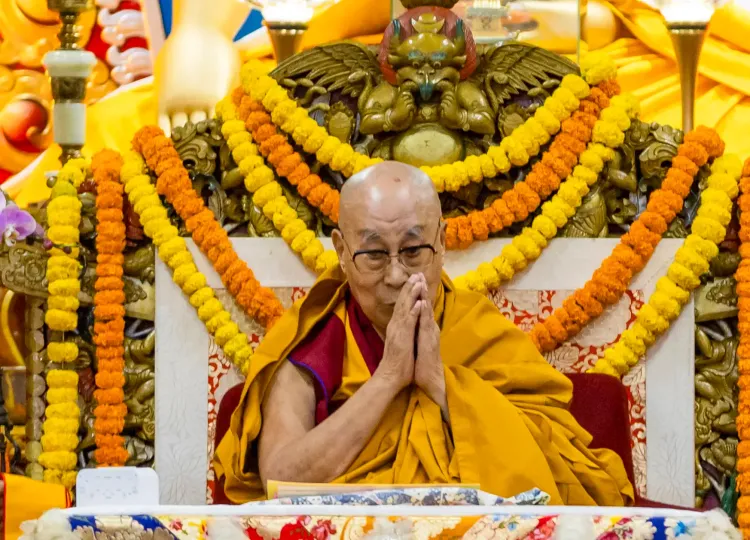
Taipei, March 4 (NationPress) A recent report reveals that Chinese officials have launched a campaign of sexual insinuation and reputational manipulation against the Dalai Lama, mirroring a larger trend of authoritarian strategies. Such actions indicate that authoritarian regimes often resort to disruption when faced with internationally recognized non-violent symbolic challenges, in order to uphold their political dominance.
The Dalai Lama made headlines on February 1 by winning his inaugural Grammy Award for the spoken word album Meditations. The Chinese government quickly denounced the accolade, accusing the organizers of engaging in 'anti-China manipulation'. Following this, a synchronized smear campaign began, attempting to connect the Dalai Lama with convicted sex offender Jeffrey Epstein, as detailed in an editorial by the Taipei Times.
The initial rumor, which originated from the Russian state-controlled broadcaster RT, was rapidly propagated by pro-China media outlets, aiming to undermine the Dalai Lama's moral standing. Grok, an AI-powered fact-checking tool, has flagged these claims as false due to insufficient credible evidence.
The report further emphasized that in 2023, pro-China internet activists, popularly referred to as the '50 Cent Army', circulated a selectively edited video from a public event held in Dharamsala, India. This footage attempted to misrepresent the Dalai Lama, though Tibetan representatives have asserted that the clip was taken out of context.
“These incidents demonstrate a persistent strategy of reputational assault rather than meaningful political discourse. China’s focus on the Dalai Lama reveals how modern authoritarian states confront symbolic threats that cannot be neutralized through traditional coercive measures,” the report stated.
The Dalai Lama's challenge to Beijing is underscored by his lack of material power, whether economic or military; instead, he possesses moral and symbolic authority, which is inherently resistant to coercion. His global prominence stems not only from his role as a spiritual leader but also from his previous position as Tibet's political leader and a key figure in the Tibetan exile movement.
International recognition, especially cultural accolades like a Grammy Award, not only contradicts Chinese state propaganda but also validates an alternative source of authority that directly opposes the narrative of the Chinese Communist Party (CCP).
“In authoritarian regimes, symbolic events, regardless of their scale, hold significant weight, as their legitimacy relies more on narrative control than on electoral approval. When a regime cannot dominate or influence international cultural institutions, it shifts from suppression to strategic distortion,” it concluded.
Point of View
I observe that the actions against the Dalai Lama reflect a significant concern regarding the methods employed by authoritarian regimes to undermine figures of moral authority. This strategy of reputational attack rather than substantive dialogue raises questions about the integrity and responsiveness of such regimes in the face of global scrutiny.
NationPress
30 Sept 2026
Frequently Asked Questions
What is the reason behind China's smear campaign against the Dalai Lama?
The campaign is part of China's broader efforts to undermine the Dalai Lama's moral authority in response to his global recognition and symbolic challenges to the Chinese Communist Party's narrative.
How did the Grammy Award impact the Dalai Lama's standing?
Winning the Grammy Award enhanced the Dalai Lama's international profile, contradicting Chinese state propaganda and validating alternative sources of authority.
What actions are taken by the '50 Cent Army'?
The '50 Cent Army' consists of pro-China internet activists who circulate edited content and misinformation to damage the reputations of figures like the Dalai Lama.
What is the significance of symbolic events in authoritarian regimes?
In authoritarian regimes, symbolic events carry disproportionate importance as they can challenge the narrative control that these regimes rely on for legitimacy.
How is AI being used in this context?
AI tools like Grok are being utilized to fact-check and debunk false claims made during smear campaigns, highlighting the importance of credible evidence in media discourse.