Childhood cancer survival data in India set to improve sharply in 5 years: AIIMS Delhi expert
Synopsis
A landmark AIIMS Delhi study consolidating three decades of Indian childhood cancer data — covering 182 studies and 22,886 children — signals a coming surge in survival evidence. With the UNGA 80 target of 60% survival by 2030 on the table, experts at PHOSSCON 2026 say the next five years could reshape how India tracks, treats and accounts for childhood cancer outcomes.
Key Takeaways
Dr Sameer Bakhshi of AIIMS New Delhi said childhood cancer survival data in India is set to improve sharply over the next five years .
An AIIMS-led study consolidated three decades of evidence across 182 studies involving 22,886 children .
Three-fourths of all available data on the subject has emerged in the last 10 years , according to Bakhshi.
The UNGA 80 resolution targets 60% or more childhood cancer survival by 2030 .
Punjab is developing an Integrated Childhood Cancer Care Framework with HBCH Mullanpur , AIIMS Bathinda , and CMC Ludhiana as hubs.
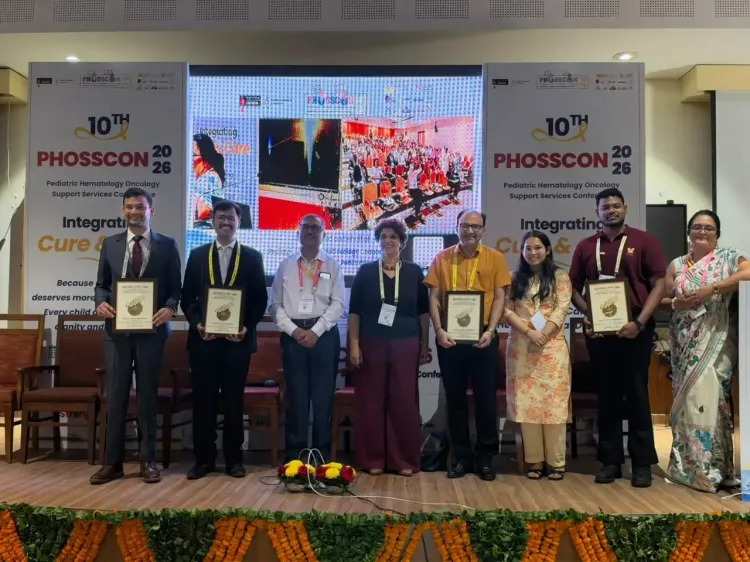
The 10th PHOSSCON conference was held at IISER Mohali on 25 October 2026 .
Researchers and clinicians tracking childhood cancer outcomes in India are on the cusp of a data breakthrough, according to Dr Sameer Bakhshi, Professor and Head of the Department of Medical Oncology at AIIMS, New Delhi. Speaking at the 10th Pediatric Haematology Oncology Support Services Conference (PHOSSCON 2026) in Mohali on 25 October 2026, Bakhshi said the quality and quantity of childhood cancer survival data in India is likely to improve significantly over the next five years, building on the momentum of the past decade.
Three Decades of Data, Compressed Into Ten Years
Bakhshi cited a landmark study led by his AIIMS team that consolidated three decades of Indian childhood cancer survival evidence, drawing on 182 studies involving 22,886 children. 'Of the information we have today, three-fourths has come in the last 10 years. On a graph, if the information for the last three decades is treated as almost a flat line, it could shoot up sharply in the next five years,' he said. The findings underscore how recent years have accelerated evidence generation in a field that had long suffered from sparse, fragmented data.
The 60% Survival Target by 2030
Poonam Bagai, organising chair of all 10 PHOSSCON editions and co-author of the AIIMS-led study, emphasised the significance of the research in the context of the UNGA 80 resolution, which sets a target of 60% or more survival for children with cancer by 2030. Bagai, who serves as a Member of the ICMR Central Ethics Committee on Human Research, founder of CanKids, and Childhood Cancer International's WHO South East Asia Region Representative, said the study offers insights that could help policymakers identify gaps and strengthen accountability in India's fight against childhood cancer. 'Today, we are asking a bigger question — not just how to help children through treatment, but how to help more children survive,' she said, reflecting on the decade-long journey since PHOSSCON's inception in 2015.
Punjab as a Model: An Integrated Care Framework
The conference, held over two days at the Indian Institute of Science Education and Research (IISER) Mohali, SAS Nagar, also highlighted Punjab as an instructive case study. Building on CanKids' partnership with the Punjab government since 2017, an Integrated Childhood Cancer Care Framework is being developed with HBCH Mullanpur, AIIMS Bathinda, and CMC Ludhiana as key hubs. The effort aligns with the state government's broader healthcare objectives and could serve as a replicable model for other states.
Key Themes at PHOSSCON 2026
Sessions at the two-day conference covered a range of systemic challenges, including access to treatment and financial protection for families, stronger collaboration between civil society and the medical community, and long-term survivorship care. Discussions also addressed shared learning and future roadmaps for paediatric haematology-oncology support services across India. The conference offered a platform to translate research evidence into actionable policy recommendations, with a particular focus on the infrastructure and data systems needed to reach the 2030 survival target.
With national-level data now gathering pace and state-level frameworks beginning to take shape, experts say the next five years will be pivotal in determining whether India can close the gap between current outcomes and the global 60% survival benchmark.
Point of View
But it also exposes how thin the baseline was. The 60% survival target by 2030 is ambitious against a backdrop where data collection itself is still maturing; meeting it will require not just clinical scale-up but a parallel investment in cancer registries and outcome tracking that India has historically underfunded. Punjab's integrated framework is a promising state-level signal, but replication demands political will and resources that remain unevenly distributed across the country.
NationPress
24 Oct 2026
Frequently Asked Questions
What did the AIIMS Delhi study on childhood cancer survival in India find?
The AIIMS Delhi-led study consolidated three decades of Indian childhood cancer survival evidence across 182 studies involving 22,886 children. It found that three-fourths of all available data in the field has been generated in just the last ten years, pointing to a significant acceleration in research output.
What is the UNGA 80 resolution target for childhood cancer survival?
The UNGA 80 resolution sets a target of 60% or more survival for children with cancer by 2030. Experts at PHOSSCON 2026 said the AIIMS study provides the evidence baseline needed to track India's progress toward this goal.
What is PHOSSCON 2026 and where was it held?
PHOSSCON 2026 is the 10th edition of the Pediatric Haematology Oncology Support Services Conference, held on 25 October 2026 at the Indian Institute of Science Education and Research (IISER) Mohali, SAS Nagar. It brought together clinicians, researchers and policymakers to discuss childhood cancer outcomes in India.
How is Punjab contributing to childhood cancer care in India?
Punjab is developing an Integrated Childhood Cancer Care Framework built on CanKids' partnership with the state government since 2017. HBCH Mullanpur, AIIMS Bathinda, and CMC Ludhiana serve as the key hubs of this framework, which is cited as a potential model for other states.
Why has childhood cancer survival data in India historically been limited?
According to Dr Sameer Bakhshi of AIIMS New Delhi, data on childhood cancer survival in India had remained sparse for decades, with available evidence on a 'flat line' for much of the last 30 years. Fragmented research, limited registry infrastructure, and policy deprioritisation are among the factors experts attribute to this gap.