Punjab CMO: Day 458 of Yudh Nashian Virudh nets 910g heroin
Synopsis
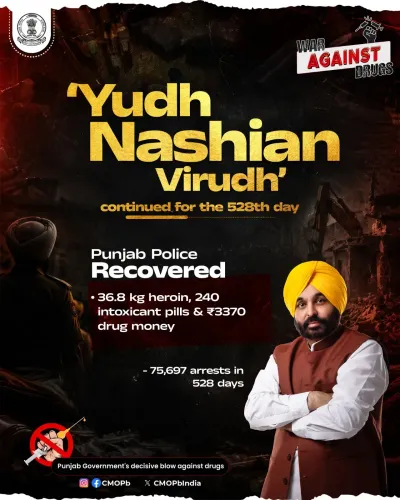
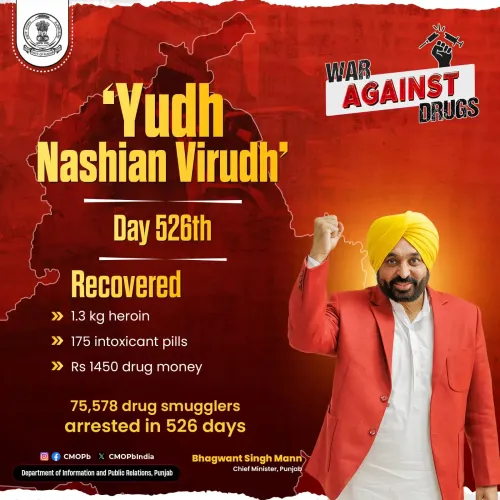
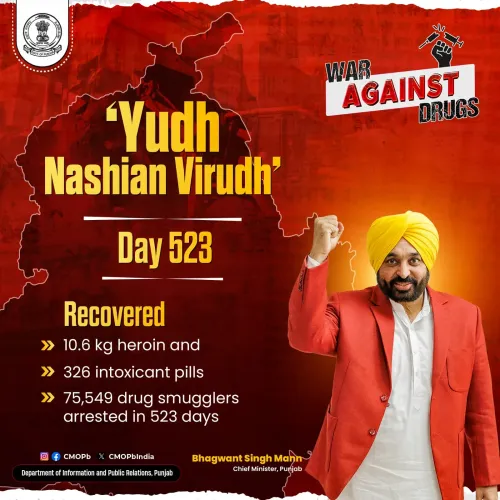
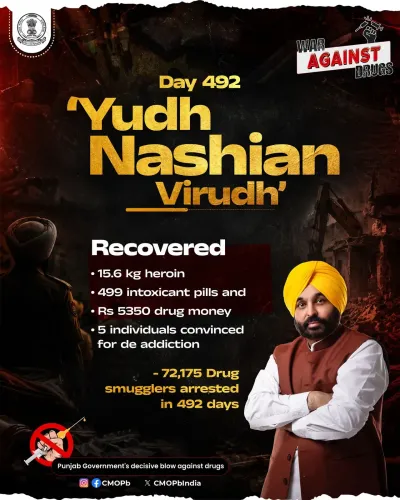
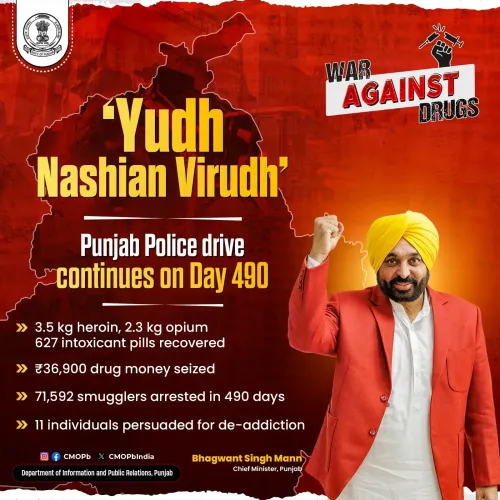
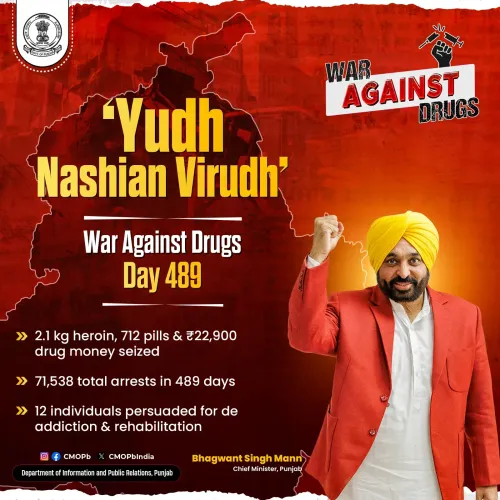
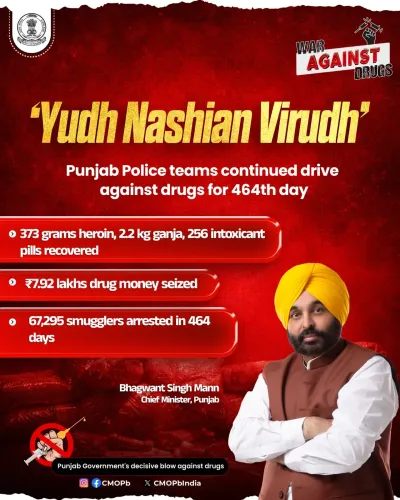
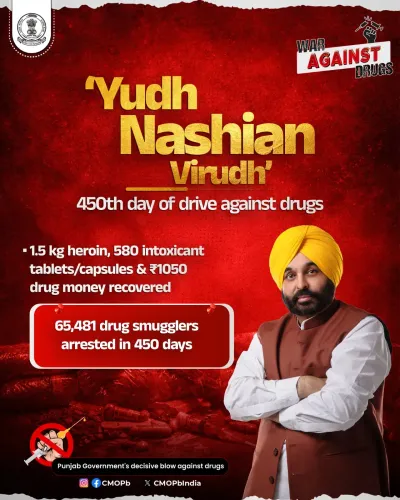
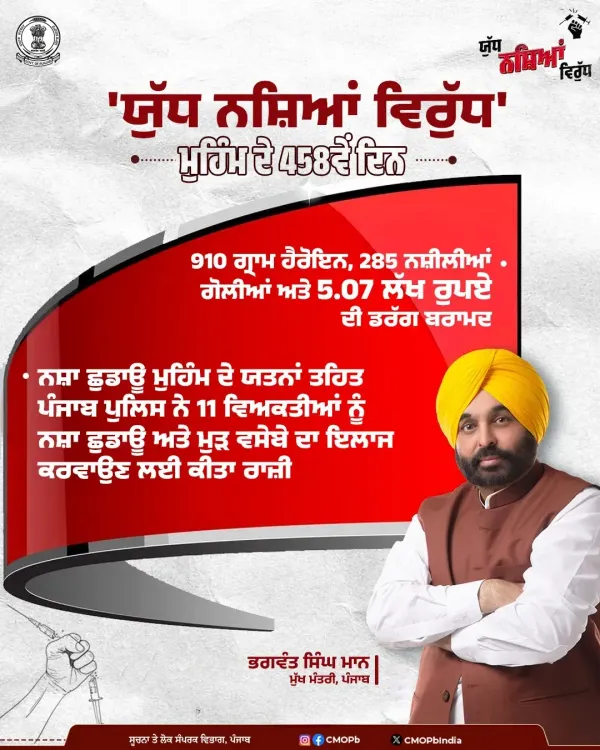
The Chief Minister's Office of Punjab said the state's anti-drug campaign Yudh Nashian Virudh entered its 458th day with 910g heroin, 285 pills and ₹5.07 lakh seized. Cumulative arrests now stand at 66,282, while 11 more individuals were referred for de-addiction and rehabilitation, the office said in a bilingual post directed by Chief Minister Bhagwant Singh Mann.
Key Takeaways
Day 458 of Yudh Nashian Virudh recorded 910g heroin, 285 intoxicant pills and ₹5.07 lakh drug money seized.
Cumulative arrests under the drive have reached 66,282, per the Chief Minister's Office.
11 individuals were persuaded to enter de-addiction and rehabilitation on the same day.
The campaign runs under directions of Chief Minister Bhagwant Singh Mann.
Punjab's border location with Pakistan continues to shape its narcotics enforcement posture.
The Chief Minister's Office of Punjab on 3 June 2026 said state police teams continued the anti-narcotics campaign 'Yudh Nashian Virudh' (War Against Drugs) into its 458th day, recovering 910 grams of heroin, 285 intoxicant pills and ₹5.07 lakh in drug money in the latest 24-hour cycle. The office, posting in Punjabi and English, said the cumulative arrest count under the drive has reached 66,282, with 11 individuals persuaded during the day to enter de-addiction and rehabilitation treatment.
Context
The post, made under the directions of Chief Minister Bhagwant Singh Mann, frames the drive as a sustained, daily operation rather than a one-off crackdown. In its own words, the office said 'Punjab Police teams continued their drive against drugs Yudh Nashian Virudh for the 458th day'.
The accompanying tally is presented in two parts: enforcement seizures on the one hand, and voluntary referrals for treatment on the other. The same release noted that 'the Punjab Police has convinced 11 persons to undergo de-addiction and rehabilitation treatment', signalling that the campaign is being projected as a combined supply-and-demand intervention.
Policy backdrop
Mr Mann, who has led the Aam Aadmi Party government in Punjab since March 2022, came to power on a manifesto that promised a zero-tolerance posture on narcotics. 'Yudh Nashian Virudh' is the operational expression of that pledge, structured as a statewide enforcement-plus-rehabilitation push co-ordinated through district police units.
Punjab's drug problem is closely tied to its geography. The state shares a long international border with Pakistan, a route that has historically been used for heroin trafficking. Successive governments in Chandigarh have combined seizure operations with de-addiction programmes, and the present drive continues that twin-track approach by publishing daily updates on contraband recovered, cash seized and individuals referred for treatment.
Stakeholders and impact
The immediate targets of the campaign are trafficking networks moving heroin and synthetic pills through Punjab's border districts and urban centres. The ₹5.07 lakh in 'drug money' flagged in the post points to the financial trail that police are attempting to disrupt alongside physical seizures.
On the demand side, the 11 persons referred for treatment on the 458th day underline an effort to reach substance users without routing every case through the criminal justice system. Punjab's youth, long identified as the most exposed demographic, remain the population the rehabilitation arm of the drive is built around.
For the Punjab Police, the daily bulletin format also serves an institutional purpose: it offers a steady public ledger of activity that can be cited during legislative scrutiny and budget discussions on policing and health infrastructure.
What's next
Attention will turn to the consolidated quarterly figures that the state police release, and to whether the de-addiction referral numbers scale alongside the seizure data. Questions on rehabilitation outcomes, capacity at government-run treatment centres and the fate of cases registered under the campaign are likely to surface when the Punjab Vidhan Sabha next convenes.
For the Mann government, sustaining a daily public count past the 458-day mark sets a high bar of its own making: any visible slowdown in seizures or referrals will be read against the cumulative 66,282 arrest figure it is now anchoring its anti-drug narrative to.
Point of View
Converting routine police work into a visible governance metric. By pairing seizure data with de-addiction referrals, the administration is trying to pre-empt the criticism that anti-drug drives in Punjab tend to be enforcement-heavy and treatment-light. The political risk is durability: a count that has reached 458 days and 66,282 arrests creates its own expectation curve. Independent verification of rehabilitation outcomes, not just arrest tallies, will determine whether this remains a campaign or matures into measurable policy.
NationPress
26 Sept 2026
Frequently Asked Questions
What is Yudh Nashian Virudh in Punjab?
Yudh Nashian Virudh, meaning 'War Against Drugs', is the Punjab government's statewide anti-narcotics campaign combining police seizures and arrests with de-addiction and rehabilitation referrals, run under directions of Chief Minister Bhagwant Singh Mann.
How many drug smugglers have been arrested in Punjab under the drive?
According to the Chief Minister's Office of Punjab, 66,282 drug smugglers have been arrested in 458 days under Yudh Nashian Virudh, as stated in its update on 3 June 2026.
How much heroin was seized on day 458 of the Punjab anti-drug drive?
Punjab Police recovered 910 grams of heroin on the 458th day of the campaign, along with 285 intoxicant pills and ₹5.07 lakh in drug money.
Who is leading Punjab's war against drugs?
The campaign is being driven by Punjab Police under the directions of Chief Minister Bhagwant Singh Mann, who has led the Aam Aadmi Party government in the state since March 2022.
Does the Punjab drug drive include rehabilitation?
Yes. The Chief Minister's Office said 11 individuals were convinced on day 458 alone to undergo de-addiction and rehabilitation treatment, alongside the enforcement actions.