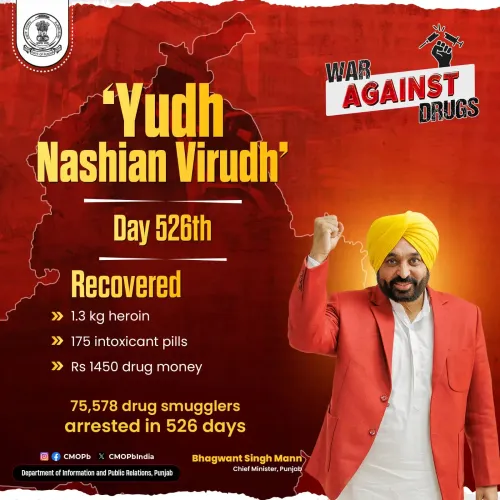
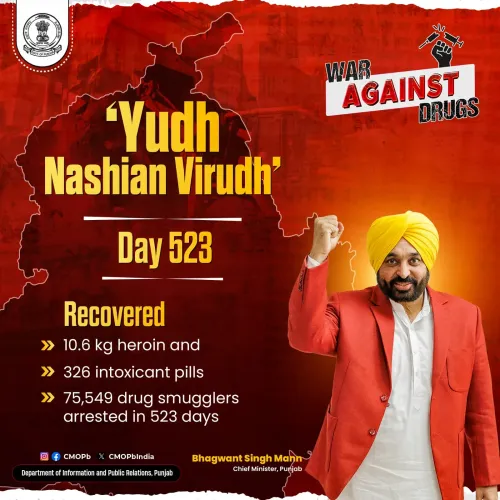
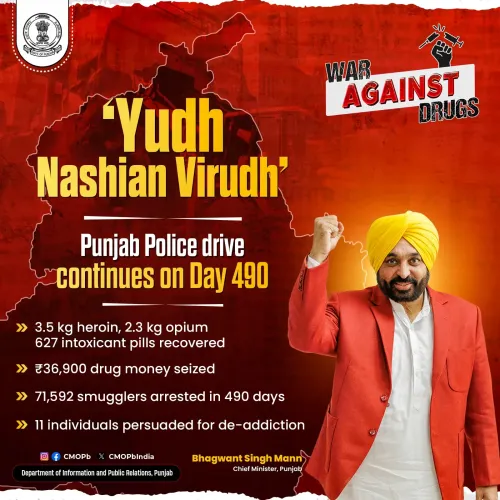
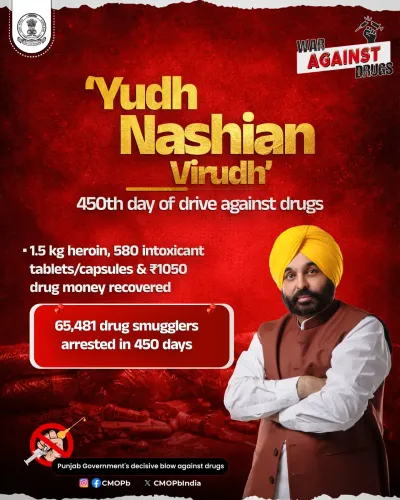
Punjab's 'Yudh Nashian Virudh' hits Day 606, nets 20.2 kg heroin
Synopsis
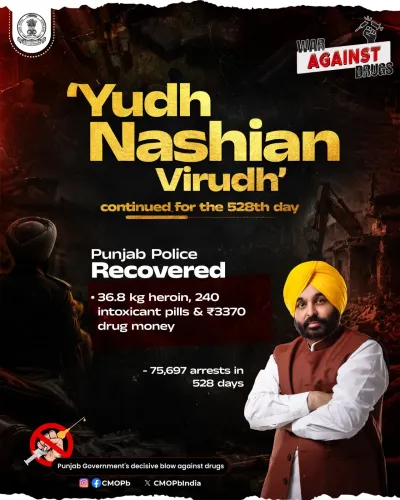
On Day 606 of the continuous 'Yudh Nashian Virudh' drive, Punjab Police seized 20.2 kg heroin, 565 intoxicant pills and Rs 6,550 in drug money. Cumulative arrests since the campaign began now stand at 88,979 smugglers, per the Chief Minister's Office.
Key Takeaways
Day 606 of the unbroken 'Yudh Nashian Virudh' anti-narcotics campaign was reported on 29 October 2026 .
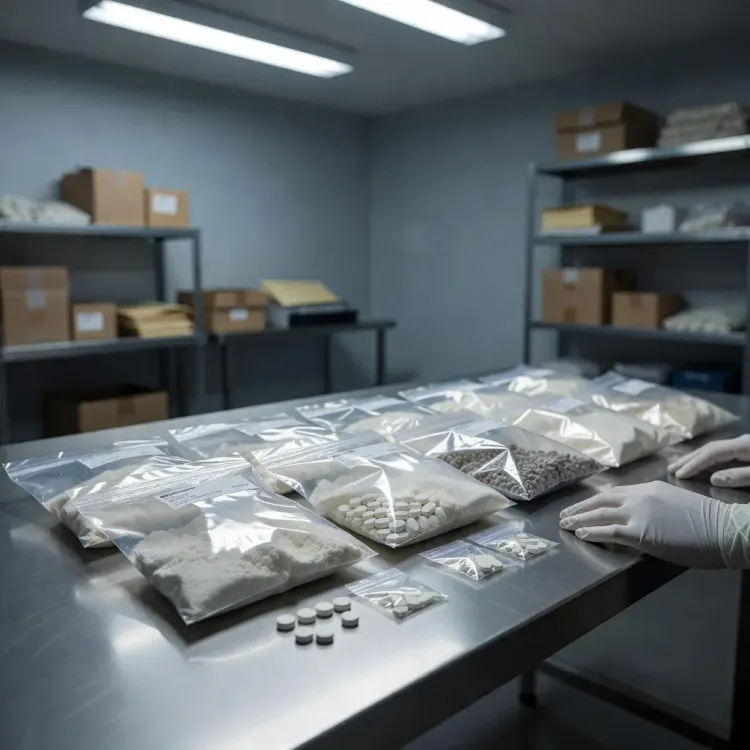
Punjab Police seized 20.2 kg heroin , 565 intoxicant pills , and Rs 6,550 in drug money in the latest operation.
Cumulative drug smuggler arrests since the drive launched have reached 88,979 over 606 days .
The campaign was initiated under Chief Minister Bhagwant Mann following the AAP's 2022 election pledge to dismantle Punjab's narcotics supply chain.
Punjab's proximity to international drug trafficking corridors makes sustained enforcement a long-term structural challenge.
Observers continue to watch for parallel investment in rehabilitation infrastructure to address the demand side of the crisis.
Six hundred and six consecutive days. That is how long Punjab Police has kept its anti-narcotics campaign, Yudh Nashian Virudh ('War Against Drugs'), running without pause — and on Thursday, 29 October 2026, the Chief Minister's Office of Punjab reported another day of seizures: 20.2 kg heroin, 565 intoxicant pills, and Rs 6,550 in drug money recovered, with fresh drug smugglers arrested and added to a cumulative tally that has now crossed 88,979.
What Day 606 looked like on the ground
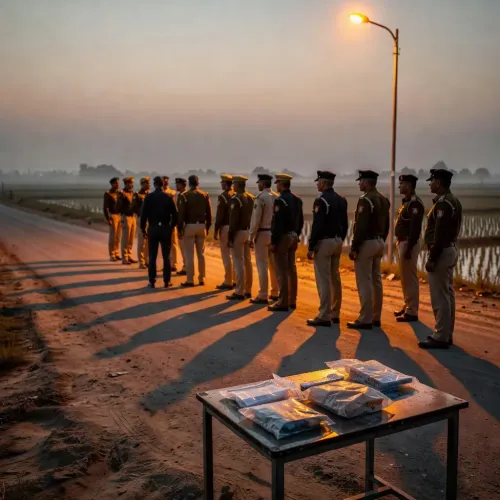
The day's haul was anchored by the heroin seizure — at 20.2 kg, a significant single-day recovery for a state where contraband often moves in small, dispersed consignments to evade detection. The 565 intoxicant pills recovered alongside point to the parallel trade in pharmaceutical drugs that enforcement agencies have flagged as a growing vector in Punjab's narcotics ecosystem. The Rs 6,550 in drug money, modest in absolute terms, reflects the ground-level cash economy that sustains street-level distribution networks.
88,979 arrests in under two years — the scale of the drive
The cumulative arrest figure — 88,979 drug smugglers in 606 days — underlines the sheer operational tempo the AAP government has sought to maintain since Chief Minister Bhagwant Mann took office in March 2022. Anti-drug enforcement was among the most prominent planks of the Aam Aadmi Party's Punjab election campaign that year, with an explicit pledge to break the state's narcotics supply chain. The daily CMO communiqués have become a visibility mechanism for that promise, converting police operations into a public accountability dashboard.
Punjab's drug crisis is rooted in geography as much as governance failure. The state's long borders — shared with Pakistan and abutting international smuggling corridors — have made it a primary entry point for heroin, much of it originating from Afghanistan's poppy belt, for more than two decades. Multiple governments across party lines have launched enforcement waves; what marks the current drive is its insistence on unbroken daily reporting, a cadence that creates both momentum and political scrutiny.
Beyond arrests: the rehabilitation gap
Enforcement numbers, however large, only capture the supply side. Punjab's border districts — and the youth population that bears the heaviest burden of addiction — are watching for the next piece of the policy puzzle: expanded de-addiction and rehabilitation infrastructure. Arrests disrupt supply networks, but sustained recovery requires demand-side investment that the state has signalled but not yet fully scaled. How quickly rehabilitation capacity grows alongside the arrest count will determine whether 'Yudh Nashian Virudh' becomes a transformation story or an endurance statistic.
For now, the campaign grinds forward. Day 607 will bring another report.
Point of View
Converting police work into political capital. The approach carries real risk: an unbroken streak of public reporting raises the stakes of any perceived slowdown or high-profile failure. More broadly, the drive sits within a long pattern of Punjab governments using enforcement surges to signal intent on drugs; what will distinguish this one is whether the arrest numbers are matched by measurable reductions in addiction prevalence and by credible rehabilitation scale-up — neither of which a daily arrest count can demonstrate on its own.
NationPress
29 Oct 2026
Frequently Asked Questions
What is 'Yudh Nashian Virudh' in Punjab?
'Yudh Nashian Virudh' — meaning 'War Against Drugs' — is a continuous anti-narcotics enforcement drive by Punjab Police launched under Chief Minister Bhagwant Mann's AAP government. It involves daily raids, arrests of drug smugglers, and seizures of contraband across the state, with results reported publicly every day.
How many drug smugglers have been arrested in Punjab's drug drive so far?
As of Day 606 of the campaign on 29 October 2026, the Chief Minister's Office of Punjab reported that the total number of drug smugglers arrested under 'Yudh Nashian Virudh' has reached 88,979.
How much heroin was seized by Punjab Police on Day 606?
On Day 606 of the drive, Punjab Police recovered 20.2 kg of heroin, along with 565 intoxicant pills and Rs 6,550 in drug money.
Why does Punjab have such a serious drug problem?
Punjab's drug crisis is closely linked to its geography — the state shares a border with Pakistan and lies along major international narcotics trafficking routes, making it a significant entry point for heroin. This, combined with socioeconomic factors, has fuelled addiction and smuggling networks for over two decades.
What did Bhagwant Mann promise about drugs in Punjab?
During the 2022 Punjab assembly election campaign, the Aam Aadmi Party under Bhagwant Mann made eliminating the drug menace a central pledge. After winning, his government launched the 'Yudh Nashian Virudh' drive as the primary enforcement mechanism to deliver on that promise.