Is Delhi's Air Quality Still Very Poor with AQI at 377?
Click to start listening
Synopsis
Delhi is still facing hazardous air quality with AQI recorded at a troubling 377. This situation continues to threaten public health and daily life, as authorities implement measures to curb pollution. Could this be the wake-up call needed for systemic change?
Key Takeaways
- The AQI in Delhi is currently at 377, indicating 'very poor' air quality.
- The Delhi government is doubling parking fees during severe pollution periods.
- High pollution levels are reported across multiple hotspots in the city.
- Weather conditions, such as fog, exacerbate air quality issues.
- Public health is at risk due to ongoing air pollution.
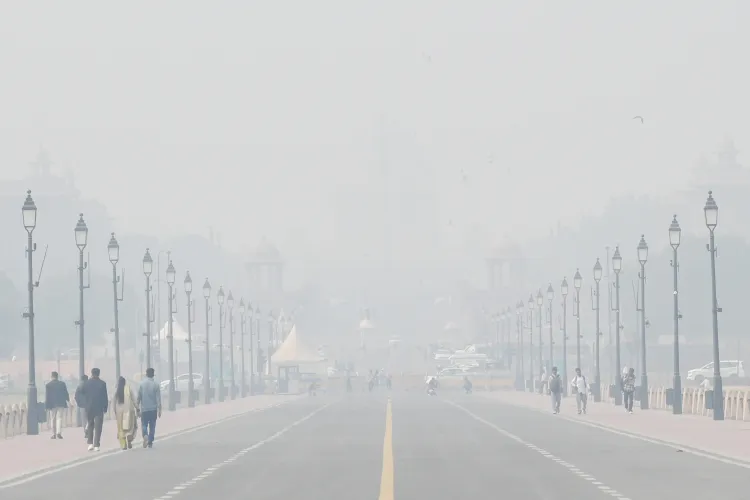
New Delhi, Jan 22 (NationPress) The capital city is grappling with unhealthy air pollution levels on Thursday, as the overall Air Quality Index (AQI) remains in the ‘very poor’ category, even after a slight improvement compared to earlier days. Official data indicates that Delhi's AQI was recorded at 377, raising significant concerns regarding public health and everyday life.
According to the Central Pollution Control Board (CPCB), pollution levels continue to be alarmingly elevated in various regions of the city. The area surrounding the Swaminarayan Akshardham temple reported an AQI of 377, firmly categorizing it as ‘very poor’. Other notable locations also recorded high AQI readings, with ITO at 331 and the AIIMS area at 359.
Multiple pollution hotspots are reporting concerning AQI levels, with Anand Vihar at 379, Ashok Vihar at 333, and Wazirpur at 336. Additional areas such as Punjabi Bagh (338), RK Puram (359), Bawana (323), Chandni Chowk (361), and Dwarka Sector 8 (342) are also classified under the ‘very poor’ category, as per CPCB data.
The CPCB’s Sameer app reported on Wednesday that 29 monitoring stations across Delhi registered ‘very poor’ air quality, while nine stations fell into the ‘poor’ category. This widespread pollution underscores the ongoing challenges the city faces during the winter months.
In light of the fluctuating air quality, the Delhi government announced on Wednesday that parking fees at authorized sites will be doubled during periods of severe pollution. This initiative will be implemented when the AQI reaches the ‘severe’ range (401-450) under the Graded Response Action Plan (GRAP) Stage III and ‘severe plus’ levels (above 450) under GRAP Stage IV. The objective is to discourage the use of private vehicles and reduce vehicular emissions.
Previously, the Commission for Air Quality Management (CAQM) lifted GRAP Stage IV restrictions in Delhi-NCR on Tuesday, following a marginal improvement in air quality. Nonetheless, authorities are closely monitoring pollution levels due to changing weather conditions.
Meanwhile, the India Meteorological Department (IMD) announced moderate to dense fog in several parts of Delhi, exacerbating the situation. At 7 a.m., the city’s temperature was approximately 7.4 degrees Celsius, adding to the discomfort experienced by residents.
Additionally, the IMD forecasts generally cloudy skies for January 22, with light rain anticipated over Delhi and the adjoining National Capital Region. These showers may come with thunderstorms, lightning, and gusty winds reaching speeds of 30-40 kmph. A second round of light rain is likely later in the afternoon and evening.
Cold wave and dense fog conditions persist across parts of North India, including Punjab, Haryana, Rajasthan, and Uttar Pradesh. Adampur has emerged as the coldest location in the plains, registering a minimum temperature of 2.6 degrees Celsius. Reduced visibility due to fog has heightened the risk of road accidents, while cold wave conditions continue in parts of Himachal Pradesh.
Point of View
It's imperative to highlight that the ongoing air quality crisis in Delhi not only poses immediate health risks but also reflects broader environmental challenges. While the government is taking steps to address these issues, sustained efforts and public awareness are crucial for long-term solutions. This situation calls for collective responsibility from both authorities and citizens.
NationPress
22/01/2026
Frequently Asked Questions
What is the current AQI in Delhi?
The current AQI in Delhi is recorded at 377, which falls into the 'very poor' category.
What measures is the Delhi government taking to improve air quality?
The Delhi government has announced that parking fees will be doubled during severe pollution periods to discourage the use of private vehicles.
How does the weather affect air quality in Delhi?
Weather conditions like fog and low temperatures can trap pollutants, worsening air quality and increasing health risks.
What are some pollution hotspots in Delhi?
Pollution hotspots include Anand Vihar, Ashok Vihar, Wazirpur, Punjabi Bagh, and several others, all reporting high AQI levels.
Are there any health risks associated with high AQI levels?
Yes, prolonged exposure to high AQI levels can lead to serious health issues, including respiratory problems and cardiovascular diseases.