Delhi Zoo's Asiatic lion pair breeds twice in one year, three new cubs born
Synopsis
Delhi Zoo's lioness Mahagauri has given birth to three Asiatic lion cubs — her second litter with lion Maheshwar in the same year. Repeat breeding by the same pair within months is rare in zoo conservation, and with just six Asiatic lions now at the NZP, each birth carries outsized significance for a species whose wild population is almost entirely confined to Gujarat's Gir Forest.
Key Takeaways
Delhi Zoo welcomed three Asiatic lion cubs from lioness Mahagauri and lion Maheshwar , confirmed on 10 July .
This is the pair's second successful breeding event in 2025 — a rare occurrence in zoo conservation settings.
Their first litter, born on 27 April , produced two cubs: male Kartik and female Karni , both growing well.
The National Zoological Park now houses six Asiatic lions — three males and three females.
The Asiatic lion is listed as endangered , with its wild population almost entirely restricted to Gir Forest, Gujarat .
The zoo recently launched the 'NZP Saathi App' and self-ticketing kiosks to modernise visitor experience.
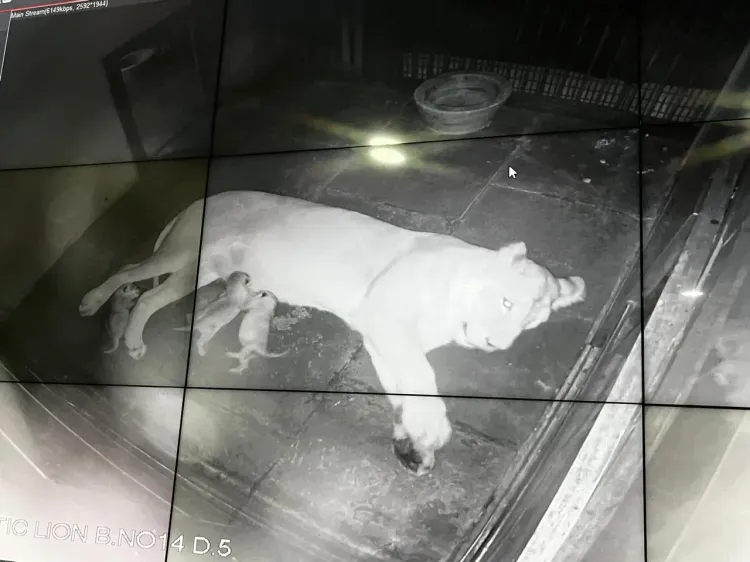
Delhi Zoo has recorded a rare conservation milestone: lioness Mahagauri and lion Maheshwar have produced three Asiatic lion cubs in a second successful breeding event within the same calendar year, zoo officials confirmed on Friday, 10 July. The achievement is being hailed as a significant breakthrough in the National Zoological Park's (NZP) conservation breeding programme for the endangered Asiatic lion.
Cubs Under Close Watch in Maternity Enclosure
The three newborn cubs and their mother Mahagauri are currently housed in a dedicated, secure maternity enclosure designed to provide a calm and undisturbed environment critical to early-stage development. The zoo's veterinary and animal care teams are monitoring the cubs around the clock via a CCTV surveillance system, according to an official statement.
A Second Litter in the Same Year
The pair's first litter this year arrived on 27 April, when Maheshwar and Mahagauri produced two healthy cubs — a male named Kartik and a female named Karni — both of whom are reportedly growing well at the zoo. A second successful breeding by the same pair within months is described by officials as rare in zoo conservation settings, underlining the health and compatibility of the breeding pair.
Delhi Zoo's Asiatic Lion Population
With the arrival of the three new cubs, the National Zoological Park now houses six Asiatic lions in total — three males (Sundaram, Maheshwar, and Kartik) and three females (Mahagauri, Shailja, and Karni). The Asiatic lion (Panthera leo persica) is listed as endangered, with its wild population confined almost entirely to the Gir Forest National Park in Gujarat. Captive breeding programmes at accredited zoos play a supplementary role in species preservation and genetic diversity management.
NZP's Recent Conservation and Visitor Upgrades
The breeding success comes alongside recent infrastructure improvements at the zoo. Last month, Union Minister of State for Environment, Forest and Climate Change Kirti Vardhan Singh launched the 'NZP Saathi App' — a smart digital guide available on both Android and iOS platforms. The app features an interactive digital map, smart navigation to locate animal enclosures, washrooms, buggy points, and exits, as well as thematic tour options including an Express Tour, Family Tour, Grand Zoo Tour, and a personalised 'My Tour' mode.
The minister also inaugurated self-ticketing kiosks at the zoo, enabling visitors to book tickets on-site via UPI-based digital payments with complimentary Wi-Fi connectivity. The dual rollout signals a broader push by the NZP to modernise visitor experience alongside its core conservation mandate.
What This Means for Asiatic Lion Conservation
Repeat breeding success within a single year by the same pair is considered a strong indicator of animal welfare standards and programme effectiveness. This comes amid ongoing national efforts to expand the Asiatic lion's range beyond Gir — a proposal that has faced political and logistical hurdles for over a decade. Breeding achievements at facilities like the NZP contribute to the studbook records maintained for the species, which inform reintroduction and genetic management decisions across Indian zoos.
Point of View
Not just a feel-good story. Asiatic lion numbers in the wild remain perilously concentrated in a single forest, making captive genetic diversity a real insurance policy — not a sideshow. What the NZP has not yet detailed is how these cubs will be integrated into the broader national studbook and whether any are candidates for inter-zoo transfer to widen the gene pool. The 'NZP Saathi App' rollout, announced in the same breath, risks burying the conservation headline under a visitor-experience story. The cubs deserve the sharper focus.
NationPress
10 Oct 2026
Frequently Asked Questions
How many Asiatic lion cubs were born at Delhi Zoo in July 2025?
Three Asiatic lion cubs were born at the National Zoological Park (Delhi Zoo) in the latest breeding event, confirmed on 10 July 2025. They are the offspring of lioness Mahagauri and lion Maheshwar.
Why is repeat breeding by the same lion pair in one year considered rare?
Repeat successful breeding by the same pair within the same calendar year is uncommon in zoo conservation settings, reflecting strong animal health, welfare conditions, and pair compatibility. The same pair, Mahagauri and Maheshwar, had already produced two cubs on 27 April 2025.
How many Asiatic lions does Delhi Zoo currently have?
The National Zoological Park currently houses six Asiatic lions — three males (Sundaram, Maheshwar, and Kartik) and three females (Mahagauri, Shailja, and Karni).
Why does captive breeding of Asiatic lions matter?
The Asiatic lion is an endangered species whose wild population is almost entirely confined to Gir Forest National Park in Gujarat. Captive breeding programmes at accredited zoos help maintain genetic diversity and serve as a conservation safety net for the species.
What is the NZP Saathi App launched at Delhi Zoo?
The NZP Saathi App is a smart digital guide for visitors to the National Zoological Park, available on Android and iOS. It offers an interactive map, smart navigation, and thematic tour options, and was launched by Union Minister of State for Environment Kirti Vardhan Singh last month.