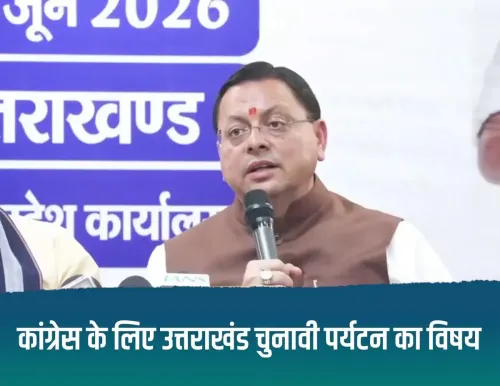
CM Dhami accuses Congress of plotting to change Uttarakhand's demographics

Synopsis
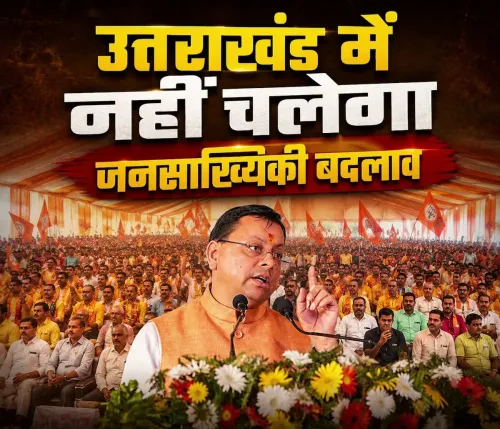
Uttarakhand CM Pushkar Singh Dhami accused Congress of conspiring to alter the demographic character of Devbhoomi on October 31, intensifying the BJP-Congress political battle ahead of the 2027 state assembly election.
Key Takeaways
CM Pushkar Singh Dhami posted on October 31, 2026 accusing Congress of plotting to change Uttarakhand 's demography.
The post invokes Devbhoomi — the sacred identity of Uttarakhand as home to Char Dham pilgrimages — to amplify the charge.
Similar BJP accusations of Congress-driven demographic engineering have previously surfaced in Assam and Himachal Pradesh .
Uttarakhand 's next assembly election is due in 2027 , and this charge appears designed to seed the electoral narrative early.
CM Dhami 's tenure has already been defined by identity-forward policies including India's first state-level Uniform Civil Code .
No formal response from Congress leadership has emerged yet; their counter-narrative will shape the next phase of this debate.
A sharp political charge landed on Saturday, October 31, 2026, when Uttarakhand Chief Minister Pushkar Singh Dhami took to X to accuse the Indian National Congress of engineering a conspiracy to alter the demographic character of the state — invoking the sacred identity of Devbhoomi (the Land of Gods) to frame the stakes as nothing less than civilisational.
In his post, CM Dhami wrote: 'Congress ne racha Devbhoomi ki demography badalne ka shadyantra!' — 'Congress has hatched a conspiracy to change the demography of Devbhoomi!' The language is deliberate and loaded: Devbhoomi is not just a tourism tagline for Uttarakhand. It is the spiritual shorthand for a state that hosts Char Dham — Badrinath, Kedarnath, Gangotri, and Yamunotri — among the most revered pilgrimage sites in Hinduism. To invoke its demographic integrity is to pitch the argument at a frequency well beyond routine electoral sparring.
A recurring BJP script — and why Uttarakhand is a charged setting
This is not the first time a BJP-governed state has raised the spectre of Congress-engineered demographic change. Similar accusations have surfaced in Assam over migration from Bangladesh and in Himachal Pradesh over land-use patterns — but Uttarakhand carries a particular political weight. The state shares a sensitive border with China and Nepal, has a significant proportion of pilgrimage-dependent economy, and has repeatedly seen BJP deploy religious identity as a primary electoral mobiliser. CM Dhami himself rose to prominence partly on the promise of a Uniform Civil Code — a first for any Indian state — framing Uttarakhand as a laboratory for cultural conservatism.
The accusation carries an implicit policy signal as well. When sitting chief ministers raise demographic concerns publicly, it typically precedes or accompanies regulatory moves — tighter land-ownership rules for non-domiciles, scrutiny of migration patterns, or anti-encroachment drives in ecologically sensitive zones. Uttarakhand has in recent years debated restrictions on land purchase by non-residents, a debate with both economic and identity dimensions.
Congress in the crosshairs — and the counter-narrative to watch
The timing matters. With no immediate election on the calendar in Uttarakhand — the state last voted in February 2022 and the next assembly election is due in 2027 — such a charge now seeds the electoral ground well in advance. It also keeps Congress on the defensive, forcing the opposition to either rebut the conspiracy framing (which legitimises the debate) or ignore it (which lets the charge settle into public consciousness). Neither is a comfortable position. A formal response from Congress leadership in Uttarakhand or at the national level would be the next move worth watching.
Whether this post is the opening salvo of a focused legislative or policy campaign, or a standalone political statement ahead of a local event, will become clear in the days that follow. What is already clear is the temperature CM Dhami intends to run the conversation at — and the sacred ground he has chosen to fight it on.
Point of View
He makes it structurally difficult for Congress to rebut without engaging on BJP's chosen terrain. The pattern mirrors similar demographic-anxiety rhetoric deployed successfully in Assam and the Hindi heartland. With the 2027 Uttarakhand assembly election approaching, expect this to evolve into a concrete legislative or regulatory push — giving the charge both political and administrative momentum.
NationPress
31 Oct 2026
Frequently Asked Questions
What did Uttarakhand CM Dhami say about Congress and demographics?
CM Pushkar Singh Dhami accused Congress of hatching a conspiracy to change the demographic character of Uttarakhand, which he described using the term 'Devbhoomi' — the Land of Gods.
What does Devbhoomi mean and why is it politically significant?
'Devbhoomi' literally means 'Land of the Gods' and is the common religious identity of Uttarakhand, home to the Char Dham pilgrimage circuit. Invoking it in a political charge elevates the argument from policy to cultural and religious identity.
Has BJP made similar demographic change accusations in other states?
Yes. Accusations that Congress-era policies enabled demographic shifts through migration or settlement patterns have recurred in BJP-governed states including Assam and Himachal Pradesh.
When is the next Uttarakhand assembly election?
The next Uttarakhand assembly election is due in 2027. The last election was held in February 2022, which the BJP won under CM Dhami's leadership.
What policies has CM Dhami pushed that relate to Uttarakhand's identity?
CM Dhami's government enacted India's first state-level Uniform Civil Code and has debated land-ownership restrictions for non-domicile residents, both framed around protecting Uttarakhand's cultural and demographic character.