CM Dhami Warns Strictest Action to Protect Uttarakhand's Faith
Synopsis
Chief Minister Pushkar Singh Dhami on 22 July 2026 issued a public warning that anyone who dares to challenge the faith and culture of Devbhoomi — Uttarakhand — will face the harshest legal action, backed by the state's 2022 anti-conversion law and 2024 Uniform Civil Code.
Key Takeaways
CM Pushkar Singh Dhami issued a stern warning on 22 July 2026 against any challenge to Uttarakhand's faith and culture.
The Chief Minister pledged 'strictest action as per law' against those who 'dare to cast an eye' against Devbhoomi's religious identity.
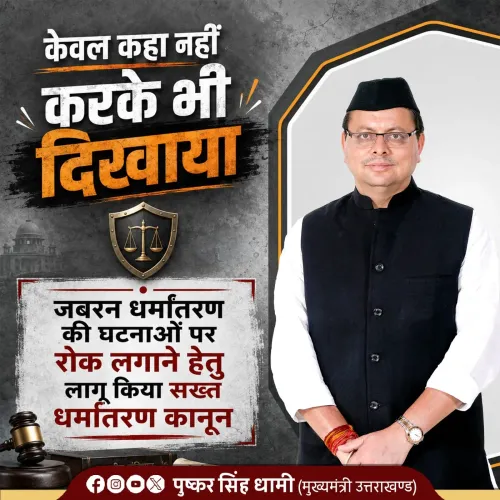
Uttarakhand enacted the Prohibition of Unlawful Conversion of Religion Act in 2022 , providing a legal basis for such action.
In 2024 , Uttarakhand became the first Indian state to implement the Uniform Civil Code .
The statement aligns with a broader pattern of BJP -governed states issuing public commitments on religious protection since 2020 .
The specific trigger for the 22 July 2026 statement has not been independently confirmed.
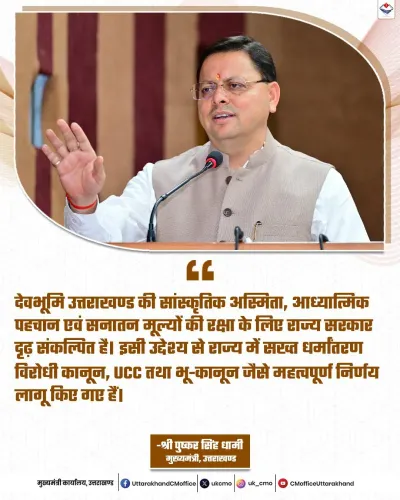
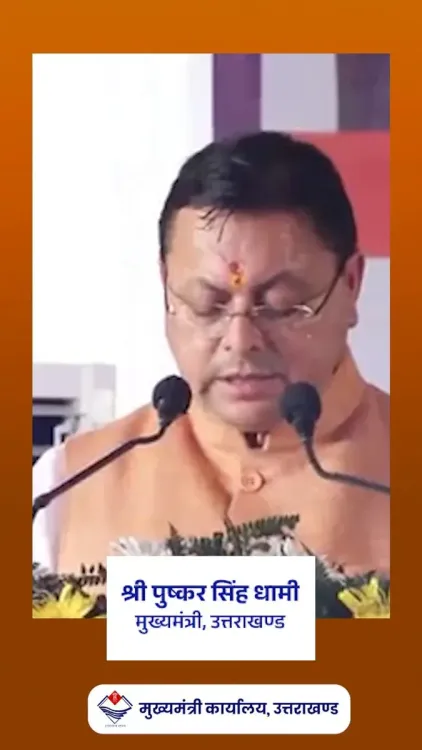
The Chief Minister's Office of Uttarakhand, on Wednesday, 22 July 2026, quoted Chief Minister Pushkar Singh Dhami issuing a stern public warning that anyone who dares to challenge the faith and culture of Devbhoomi — the sacred land of Uttarakhand — will face the harshest possible legal action.
Context
The statement, shared through the official Chief Minister's Office account, reads in Hindi: 'Agar Devbhoomi ki aastha aur mahan sanskriti par koi bhi aankh uthane ka dussahas karega to uske viruddh kanoon ke anusaar kathoratum karvai ki jayegi' — translated: 'If anyone dares to cast an eye against the faith and great culture of Devbhoomi, the strictest action as per law will be taken against them.' The statement was accompanied by a video and carries the direct attribution to CM Dhami.
The research notes that the specific incident or development that triggered this particular warning on 22 July 2026 could not be independently verified. The statement stands as a direct public commitment by the Chief Minister to the protection of the state's religious and cultural identity.
Policy Backdrop
The warning is consistent with a legislative framework Uttarakhand has built over recent years. In 2022, the state enacted the Uttarakhand Prohibition of Unlawful Conversion of Religion Act, which introduced enhanced punishments for forced or fraudulent religious conversions — one of the strictest such statutes in the country at the time of its passage.
In 2024, Uttarakhand became the first Indian state to implement the Uniform Civil Code (UCC), a landmark move that placed the state at the forefront of social legislation debates nationally. Together, these measures form the legal architecture that CM Dhami appears to be referencing when he speaks of action 'as per law.'
Comparable public commitments and anti-conversion statutes have been issued by BJP-led administrations in Uttar Pradesh, Madhya Pradesh, and Haryana since 2020, reflecting a broader pattern of state-level governance responses to concerns about religious demographics in pilgrimage and border regions.
Stakeholders and Impact
The statement is directed at multiple audiences: local communities who reside in and around pilgrimage towns, the millions of pilgrims who visit sites such as Badrinath and Kedarnath annually, and any actor — individual or organised — perceived as threatening the region's religious character. For local communities, the message reinforces the government's stated protective posture.
Civil liberties observers and minority community representatives have in the past raised concerns about the broad scope of anti-conversion laws, arguing that vaguely worded statutes can be misused. The government's position, as articulated by CM Dhami, is that the laws serve as a necessary deterrent to protect the sanctity of a region whose identity is inseparable from its Hindu pilgrimage heritage.
What's Next
Attention will now turn to whether the statement is followed by specific enforcement action under the 2022 Conversion Act or any new legislative proposals in the Uttarakhand assembly concerning religious institutions or land use near pilgrimage corridors. Any such follow-through would signal whether the 22 July 2026 warning marks a policy escalation or remains a reaffirmation of existing commitments.
As Uttarakhand continues to position itself as a model state for cultural and religious governance within the BJP's national framework, CM Dhami's statements carry weight beyond the state's borders — feeding into a national conversation on the legal protection of majority religious spaces that is likely to intensify ahead of future electoral cycles.
Point of View
Making any perceived cultural affront a matter of state security rather than mere law-and-order. The warning lands against the backdrop of a legislative architecture — the 2022 anti-conversion law and the 2024 UCC — that gives the rhetoric concrete legal teeth, distinguishing it from purely symbolic posturing. It also feeds into a national BJP playbook of using pilgrimage-state governance as a laboratory for policies that can be advocated at the Centre. The absence of a named trigger is itself notable: the open-ended framing maximises deterrent effect while avoiding the constraints of responding to a specific, verifiable incident.
NationPress
21 Oct 2026
Frequently Asked Questions
What did CM Dhami say about protecting Devbhoomi?
On 22 July 2026, CM Pushkar Singh Dhami stated that anyone who dares to challenge the faith and great culture of Devbhoomi — Uttarakhand — will face the strictest possible action as per law.
What is Devbhoomi and why is it significant?
Devbhoomi, meaning 'Land of the Gods,' is the official and popular identity of Uttarakhand, home to major Hindu pilgrimage sites including Badrinath, Kedarnath, Gangotri, and Yamunotri. The state government actively promotes this identity in its cultural and governance policies.
What laws does Uttarakhand have to protect its religious culture?
Uttarakhand enacted the Prohibition of Unlawful Conversion of Religion Act in 2022, introducing strict penalties for forced or fraudulent conversions. In 2024, it also became the first Indian state to implement the Uniform Civil Code.
Has Uttarakhand taken action against religious conversions before?
Yes. The 2022 Uttarakhand Prohibition of Unlawful Conversion of Religion Act established a legal framework for prosecuting forced or fraudulent religious conversions, and the government has publicly committed to its enforcement multiple times since.
How does Dhami's warning fit into the broader BJP governance pattern?
BJP-led state governments in Uttar Pradesh, Madhya Pradesh, and Haryana have issued similar public commitments and enacted anti-conversion statutes since 2020. Uttarakhand's statements and legislation are part of this wider pattern of state-level religious protection measures.