CM Assam: Dibrugarh Achieves 100% Institutional Deliveries

Synopsis
Dibrugarh district in Assam has maintained 100% institutional deliveries for two consecutive financial years, the Chief Minister's Office announced on September 24, 2026, marking a significant milestone in maternal and newborn health under the National Health Mission framework.
Key Takeaways
Dibrugarh has achieved 100% institutional deliveries sustained across two consecutive financial years .
The announcement was made by the Chief Minister's Office of Assam on September 24, 2026 , tagging NHM Assam .
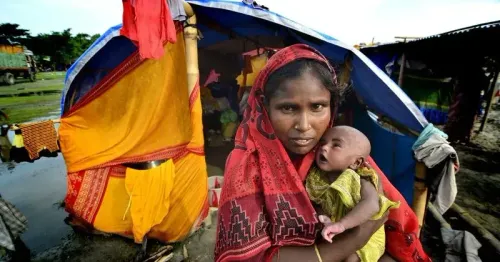
Dibrugarh serves diverse populations including urban residents and tea-garden communities in Upper Assam.
The achievement builds on India's Janani Suraksha Yojana incentive scheme, launched under the National Rural Health Mission in 2005 .
Sustaining 100% over two consecutive years is a more demanding benchmark than a single-year peak, requiring continuous facility readiness and community outreach.
Whether Assam extends this target to other districts and releases updated maternal mortality data for Upper Assam is the next indicator to watch.
Every single baby born in Dibrugarh over two consecutive financial years arrived in a health facility — not at home, not in transit. That is the milestone the Chief Minister's Office of Assam announced on Thursday, September 24, 2026, crediting the district's sustained push for safe childbirth and quality maternal care.
The post, addressed to @nhm_assam — the state arm of India's National Health Mission — declared that Dibrugarh has maintained 100% institutional deliveries across two back-to-back financial years, a benchmark few Indian districts have managed to hold, let alone sustain consecutively.
Why 100% is harder to hold than to hit
Reaching full institutional delivery in a single year is one thing. Holding it for two consecutive years — across a district that blends urban populations with remote tea-garden communities — is a different discipline entirely. It demands consistent facility readiness, round-the-clock staffing, ambulance connectivity, and community trust built one household at a time. Dibrugarh, as a key administrative and medical hub of Upper Assam, carries that responsibility for populations that include some of the state's most economically vulnerable workers.The NHM backbone behind the number
The architecture enabling this result stretches back to 2005, when the National Rural Health Mission — later expanded into the National Health Mission — introduced the Janani Suraksha Yojana, a cash-incentive scheme designed to pull women away from home deliveries and into government facilities. Over two decades, Assam has used NHM frameworks to steadily improve institutional delivery rates across districts, though inter-district variation has remained a persistent challenge. Dibrugarh's two-year run signals that the gains here have moved beyond a statistical spike into something more structural.What the state watches next
The question now is whether this benchmark travels. Assam has multiple districts with more difficult terrain and thinner health infrastructure than Dibrugarh. Whether the state government can replicate this model — and whether updated maternal mortality data for Upper Assam will reflect the on-ground improvement — will be the real measure of how deep this progress runs. For the women of Dibrugarh, the statistic is personal: two years of births, every one of them safer by design.Point of View
Particularly in districts with tea-garden worker populations historically underserved by public health infrastructure. The Chief Minister's Office amplifying the achievement through NHM Assam is also a deliberate political framing — positioning the state government as a credible executor of national health mandates ahead of any performance reviews. The real test is replicability: if the model cannot be transferred to more remote Upper and Lower Assam districts, the milestone remains locally significant rather than a state-wide turning point. Maternal mortality data, not delivery rates alone, will ultimately validate whether the structural investment has reached its intended outcome.
NationPress
24 Sept 2026
Frequently Asked Questions
What does 100% institutional delivery mean in Assam?
It means every recorded birth in the district took place inside a government or accredited health facility — not at home — ensuring access to skilled attendants, emergency obstetric care, and clean conditions for both mother and newborn.
Which district in Assam achieved 100% institutional deliveries?
Dibrugarh , a key administrative and medical hub in Upper Assam , achieved and sustained 100% institutional deliveries for two consecutive financial years as announced by the Chief Minister's Office of Assam in September 2026.
What is the Janani Suraksha Yojana and how does it help?
Janani Suraksha Yojana is a cash-incentive scheme launched under India's National Rural Health Mission in 2005 that encourages pregnant women, especially from low-income households, to deliver in government health facilities by providing a direct financial benefit after an institutional birth.
What is NHM Assam's role in maternal health?
NHM Assam is the state-level body that implements India's National Health Mission programmes, including reproductive, maternal, newborn, and child health initiatives, by strengthening facilities, training health workers, and running community outreach across all districts.
Can other Assam districts achieve the same 100% institutional delivery milestone?
The government has not officially announced a state-wide 100% target, but Dibrugarh's sustained performance is expected to serve as a model. Inter-district variation in infrastructure and terrain remains a challenge, and analysts will watch whether updated maternal mortality data for Upper Assam validates the impact of higher delivery rates.