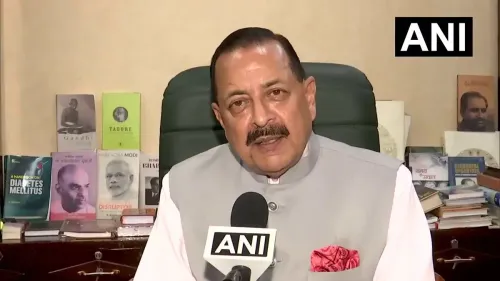
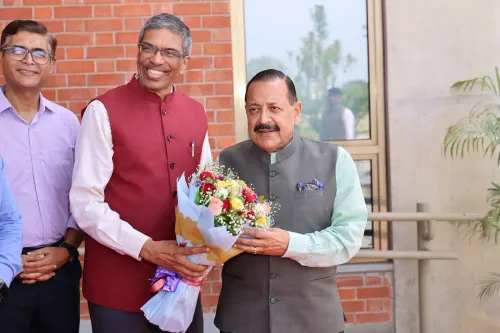
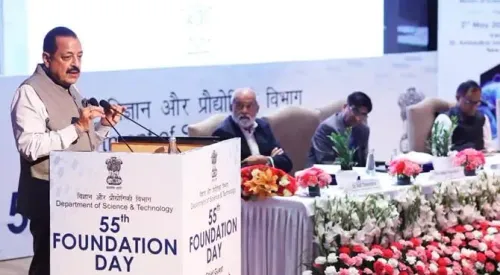
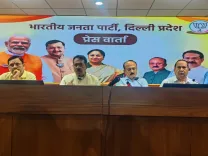
Dr. Jitendra Singh addresses DST matters in Rajya Sabha
Synopsis
Union Science and Technology Minister Dr. Jitendra Singh participated in Rajya Sabha proceedings on DST matters on 23 July 2026, reinforcing parliamentary accountability over India's science and technology policy agenda.
Key Takeaways
Jitendra Singh , Union MoS (Independent Charge) for Science and Technology, engaged with Rajya Sabha on 23 July 2026 on DST-related matters.
The Department of Science and Technology was established in May 1971 and serves as India's nodal S&T policy body.
Rajya Sabha proceedings are a key mechanism for legislative oversight of DST's budget, schemes, and institutional performance.
Jitendra Singh also holds charge of Earth Sciences and is MoS in the Prime Minister's Office .
Future session statements may signal government priorities on R&D spending and science missions.
Union Minister of State (Independent Charge) for Science and Technology Dr. Jitendra Singh engaged with the Rajya Sabha on matters relating to the Department of Science and Technology (DST) on Thursday, 23 July 2026, marking another instance of parliamentary accountability on India's science policy agenda.
Context
The minister's post, tagged with #DST and #RajyaSabha, signals his participation in the upper house's proceedings concerning the Department of Science and Technology. Rajya Sabha sessions routinely serve as a formal forum where ministers respond to questions, make statements, and table data on departmental performance and funding.
Dr. Jitendra Singh holds independent charge of both the Ministry of Science and Technology and the Ministry of Earth Sciences, in addition to serving as Minister of State in the Prime Minister's Office and the Ministry of Personnel.
Policy Backdrop
The Department of Science and Technology was established in May 1971 as the nodal agency for formulating and implementing India's national science policy, coordinating R&D efforts across institutions, and channelling funding to research bodies. Over five decades, it has grown into a central pillar of India's innovation ecosystem, overseeing autonomous bodies, fellowships, and technology missions.
Parliamentary oversight through question hours and ministerial statements has been a consistent mechanism linking the DST's functioning with legislative scrutiny. Budget allocations, scheme performance metrics, and institutional mandates are among the subjects that routinely come before the house.
Stakeholders and Impact
The DST's parliamentary appearances directly concern research scientists, academic institutions, and S&T bodies funded or regulated by the department. Statements made in Rajya Sabha carry weight as official government positions and can signal shifts in funding priorities or policy direction.
For the broader scientific community, ministerial engagement in Parliament offers a window into the government's commitments on R&D spending, institutional reforms, and India's science diplomacy goals.
What's Next
Observers will watch for any written or starred questions tabled in this Rajya Sabha session that probe DST budget allocations, scheme utilisation rates, or the performance of flagship science missions. Ministerial responses during question hour often foreshadow departmental priorities for the coming fiscal cycle.
Future sessions are also expected to address India's broader ambition of raising gross expenditure on R&D as a share of GDP, a target that has drawn sustained attention from the scientific community and policymakers alike.
Frequently Asked Questions
What did Dr. Jitendra Singh say in Rajya Sabha about DST?
The minister's post referenced his engagement with Rajya Sabha on DST matters on 23 July 2026, though the specific content of his statement or responses was not detailed in the available information.
What is the Department of Science and Technology (DST)?
The Department of Science and Technology is a central government body established in May 1971 to formulate national science policy, coordinate R&D, and fund scientific institutions across India.
Who is Dr. Jitendra Singh?
Dr. Jitendra Singh is the Union Minister of State (Independent Charge) for Science and Technology and Earth Sciences, and also serves as MoS in the Prime Minister's Office and the Ministry of Personnel.
Why does the Science Minister appear in Rajya Sabha?
Ministers appear in Rajya Sabha to answer questions, make statements, and table data on departmental performance — a constitutional mechanism for parliamentary oversight of executive functioning.
What topics are typically raised in Rajya Sabha on DST?
Common subjects include DST budget allocations, utilisation of science schemes, institutional performance, research fellowships, and India's overall R&D expenditure as a share of GDP.