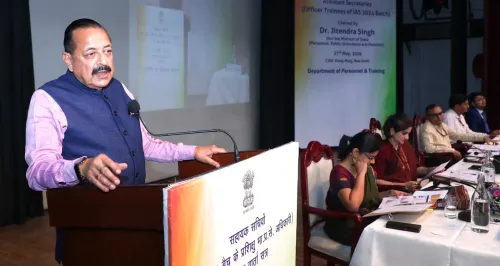
Dr. Jitendra Singh Inaugurates 52nd APPPA at IIPA New Delhi
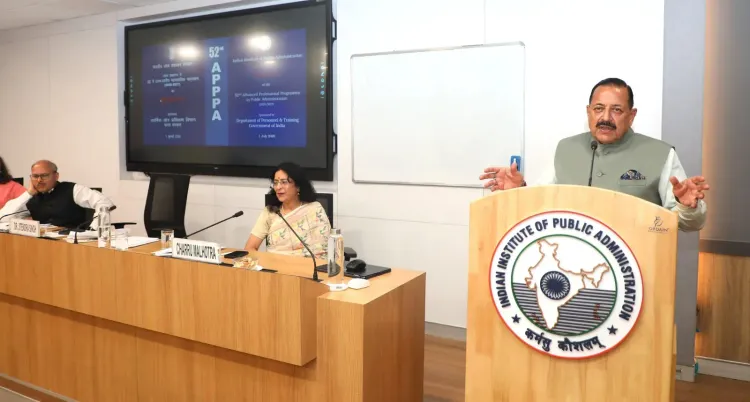
Synopsis
Union Minister Dr. Jitendra Singh inaugurated the 52nd APPPA at IIPA New Delhi on 1 July 2026, urging curriculum reform, technology integration, and citizen-centric governance training to build administrative leaders for Viksit Bharat @2047.
Key Takeaways
Jitendra Singh inaugurated the 52nd APPPA at IIPA, New Delhi on 1 July 2026 .
The minister called for 'continuous revamping' of APPPA curriculum through faculty diversity, institutional collaboration, and interactive learning.
He stressed an 'agile, technology-driven and citizen-centric governance model' as the framework for training senior civil servants.
The ten-month APPPA brings together senior officers from diverse All India and Central Services to prepare policy leaders for Viksit Bharat @2047 .
IIPA was established in 1954 and has trained generations of civil servants since Independence.
Future administrators must be 'lifelong learners equipped with technology, communication skills and interdisciplinary thinking,' according to the minister.
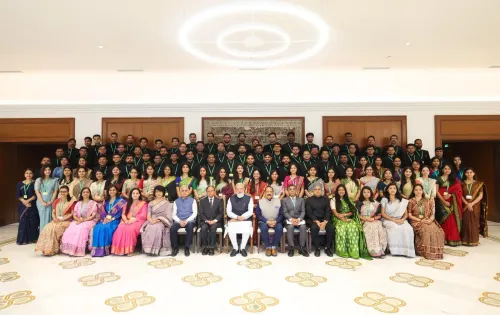
Union Minister of State (Independent Charge) for Science and Technology Dr. Jitendra Singh on Wednesday, 1 July 2026 inaugurated and addressed the 52nd Advanced Professional Programme in Public Administration (APPPA) at the Indian Institute of Public Administration (IIPA), New Delhi, calling for a fundamental overhaul of how India trains its senior civil servants.
Context
Speaking at the inauguration, Dr. Singh stressed the need for 'continuous revamping of teaching curriculum' through faculty diversity, institutional collaboration, interactive learning, and regular content updates. He underscored the importance of an 'agile, technology-driven and citizen-centric governance model' as the guiding philosophy for training future administrators. The minister also emphasised that future administrators 'ought to be lifelong learners equipped with technology, communication skills and interdisciplinary thinking.'
The ten-month APPPA brings together senior officers from diverse All India and Central Services and is explicitly designed to prepare policy leaders and administrators aligned with the government's Viksit Bharat @2047 vision — the national goal of transforming India into a developed nation by the centenary of Independence.
Policy Backdrop
IIPA was established in March 1954 as an autonomous society, making it one of India's oldest institutions dedicated to professionalising public administration. Dr. Singh acknowledged its 'distinguished legacy since its establishment soon after Independence,' noting that it has 'over the decades, played a defining role in nurturing generations of civil servants who contributed significantly to nation-building.'
The minister's call for curriculum reform echoes recommendations of the Second Administrative Reforms Commission (2005–2009), which had urged periodic revamping, faculty diversity, and technology integration at civil service training institutes. More recently, Mission Karmayogi — the National Programme for Civil Services Capacity Building approved in 2020 and launched in 2021 — institutionalised a shift from rule-based to competency-based training across the civil services.
The Viksit Bharat @2047 vision, articulated by the Prime Minister in 2022–23, has explicitly linked administrative capacity building to long-term national development, making programmes like APPPA central to the government's governance reform strategy.
Stakeholders and Impact
The APPPA cohort comprises senior officers who are positioned to take on leadership roles across central ministries and state governments. Their mid-career training at IIPA is widely regarded as a feeder pipeline for the administrative capacity needed to operationalise Viksit Bharat targets across sectors ranging from digital infrastructure to social welfare delivery.
Dr. Singh's emphasis on interdisciplinary thinking and communication skills signals a broader expectation that tomorrow's administrators must navigate complex, cross-cutting policy challenges — not merely implement rules. The call for institutional collaboration also points toward potential partnerships between IIPA and technical or academic institutions to diversify the faculty and knowledge base available to APPPA participants.
What's Next
The 52nd APPPA batch will undergo the full ten-month programme at IIPA, New Delhi, with outcomes typically reviewed at annual events such as Civil Services Day and IIPA Foundation Day. Observers will watch for any formal notifications from the Department of Personnel and Training (DoPT) or IIPA on revised curriculum modules reflecting the priorities outlined by Dr. Singh.
As India's administrative machinery is increasingly expected to deliver on ambitious national targets, the direction set at the 52nd APPPA suggests that competency-based, technology-oriented training will remain a defining feature of how the government prepares its next generation of policy leaders.
Point of View
Not merely for completing training hours. The emphasis on agility and technology aligns squarely with the Mission Karmayogi framework, suggesting a push to accelerate competency-based reform at one of India's oldest training institutions. By invoking IIPA's post-Independence legacy while demanding curriculum modernisation, the minister is threading a political needle — honouring institutional history while pressing for structural change. Whether this translates into concrete DoPT directives or revised APPPA modules will determine if the speech marks a genuine policy inflection or remains an aspirational address.
NationPress
1 Jul 2026
Frequently Asked Questions
What is the APPPA at IIPA?
The Advanced Professional Programme in Public Administration (APPPA) is a ten-month mid-career training programme conducted at the Indian Institute of Public Administration (IIPA) in New Delhi, bringing together senior officers from All India and Central Services to prepare them for leadership and policy roles.
What did Dr. Jitendra Singh say at the 52nd APPPA inauguration?
Dr. Jitendra Singh called for continuous revamping of the APPPA teaching curriculum with faculty diversity, institutional collaboration, and interactive learning. He stressed the need for an agile, technology-driven, and citizen-centric governance model and said future administrators must be lifelong learners with technology, communication, and interdisciplinary skills.
What is Viksit Bharat @2047?
Viksit Bharat @2047 is the Government of India's vision to transform the country into a fully developed nation by 2047, the centenary of Independence. Administrative capacity building and governance reforms are central pillars of this vision.
When was IIPA established?
The Indian Institute of Public Administration (IIPA) was established in March 1954 as an autonomous society to professionalise public administration training in India, shortly after Independence.
What is Mission Karmayogi?
Mission Karmayogi is the National Programme for Civil Services Capacity Building, approved in 2020 and launched in 2021, which institutionalised a shift from rule-based to competency-based training for civil servants across India.