Dr. Jitendra Singh pays tribute to Lokmanya Tilak on Jayanti
Synopsis
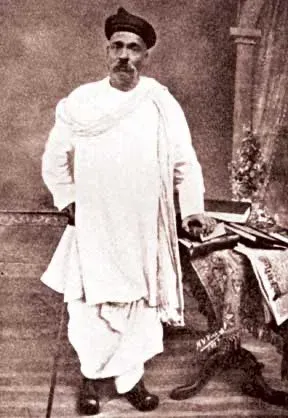
Union Science and Technology Minister Dr. Jitendra Singh marked Tilak Jayanti on 23 July 2026 by paying tribute to Lokmanya Bal Gangadhar Tilak, calling the nationalist icon a great social reformer, thinker, and freedom fighter. Tilak, born in 1856, championed Swaraj and remains a towering figure of India's independence movement.
Key Takeaways
Jitendra Singh posted a tribute to Lokmanya Bal Gangadhar Tilak on 23 July 2026 , Tilak's birth anniversary.
Bal Gangadhar Tilak was born on 23 July 1856 in Ratnagiri, Maharashtra , and died on 1 August 1920 .
Tilak was a nationalist journalist who founded Kesari and Mahratta newspapers to advance the independence cause.
His declaration 'Swaraj is my birthright, and I shall have it' is among the most celebrated lines in Indian political history.
Tilak Jayanti is observed annually with cultural and educational programmes, especially in Maharashtra .
Tributes from central government ministers are part of a broader official practice of commemorating freedom-struggle figures on their anniversaries.
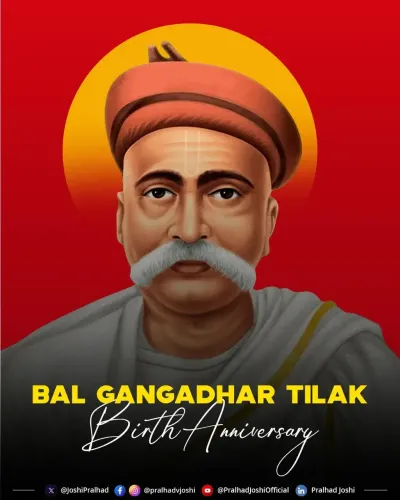
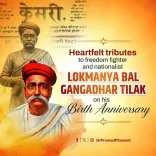
Union Science and Technology Minister Dr. Jitendra Singh on Thursday, 23 July 2026, paid tribute to freedom fighter and social reformer Bal Gangadhar Tilak on his birth anniversary, honouring the nationalist leader with a post on X.
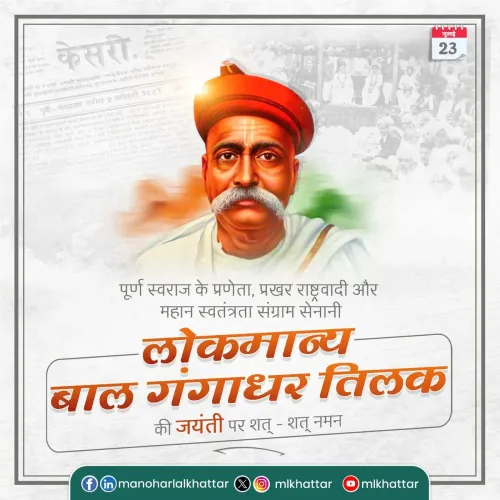
In his post, Dr. Singh wrote in Hindi: 'महान समाज सुधारक, विचारक और स्वतंत्रता सेनानी लोकमान्य बाल गंगाधर तिलक की जयंती पर शत्-शत् नमन' — translated as 'Hundreds of salutations on the birth anniversary of the great social reformer, thinker, and freedom fighter Lokmanya Bal Gangadhar Tilak.'
Context
Bal Gangadhar Tilak, born on 23 July 1856 in Ratnagiri, Maharashtra, was one of the foremost architects of India's independence movement. Popularly addressed as Lokmanya — meaning 'accepted by the people as their leader' — he championed the causes of Swaraj and Swadeshi at a time when assertive nationalism was taking shape. He passed away on 1 August 1920.
Tilak used journalism as a political weapon, founding and editing newspapers Kesari (Marathi) and Mahratta (English) to mobilise public opinion against British rule. His declaration 'Swaraj is my birthright, and I shall have it' remains among the most quoted lines in Indian political history.
Policy Backdrop
Commemorating pre-independence leaders on their birth and death anniversaries is a well-established practice across Indian government and political accounts. These digital tributes form part of the broader official outreach that successive administrations have maintained to underscore continuity with the national freedom struggle.
Tilak Jayanti on 23 July is observed annually with events at state and central government levels, particularly in Maharashtra, where cultural and educational programmes are organised in his memory. Such commemorations carry symbolic weight in reinforcing national heritage narratives.
Stakeholders and Impact
The tribute resonates with a wide cross-section of Indian citizens, historians, and cultural organisations who regard Tilak as a foundational figure of the independence movement. His legacy is especially significant in Maharashtra, where he organised the public Ganesh Chaturthi celebrations as a platform for nationalist mobilisation.
Tilak's intellectual contributions — including his commentaries on the Bhagavad Gita and the Vedas — continue to be studied in academic and political circles. Tributes from sitting ministers keep his legacy visible in contemporary public discourse.
What's Next
State governments, cultural bodies, and educational institutions across India are expected to mark Tilak Jayanti with seminars, exhibitions, and public programmes through the day. Annual observances are likely to grow in scale as governments continue to integrate freedom-struggle heritage into civic education and public diplomacy.
Point of View
Reinforcing the government's self-positioning as a custodian of national heritage. The regularity of these tributes signals an institutionalised communication strategy rather than a one-off gesture.
NationPress
23 Jul 2026
Frequently Asked Questions
When is Lokmanya Tilak Jayanti celebrated?
Lokmanya Tilak Jayanti is celebrated on 23 July every year, marking the birth anniversary of Bal Gangadhar Tilak, who was born on 23 July 1856 in Ratnagiri, Maharashtra.
Who is Lokmanya Bal Gangadhar Tilak?
Bal Gangadhar Tilak (1856-1920), known as Lokmanya, was a leading Indian nationalist, journalist, social reformer, and independence activist. He founded newspapers Kesari and Mahratta and is famous for the declaration 'Swaraj is my birthright, and I shall have it.'
What did Dr. Jitendra Singh post on Tilak Jayanti 2026?
Dr. Jitendra Singh posted a tribute in Hindi on X on 23 July 2026 , offering 'hundreds of salutations' to Lokmanya Bal Gangadhar Tilak on his birth anniversary, describing him as a great social reformer, thinker, and freedom fighter.
Why is Lokmanya Tilak important in Indian history?
Tilak is important because he was one of the first and most prominent advocates of complete independence (Swaraj) from British rule, used journalism and mass cultural events like Ganesh Chaturthi to mobilise public opinion, and shaped the early Indian National Congress movement.
What newspapers did Bal Gangadhar Tilak found?
Bal Gangadhar Tilak founded Kesari (in Marathi) and Mahratta (in English), both of which he used as platforms to advance the cause of Indian independence and nationalist thought.