Dr. Jitendra Singh Remembers C.V. Raman on Death Anniversary
Synopsis
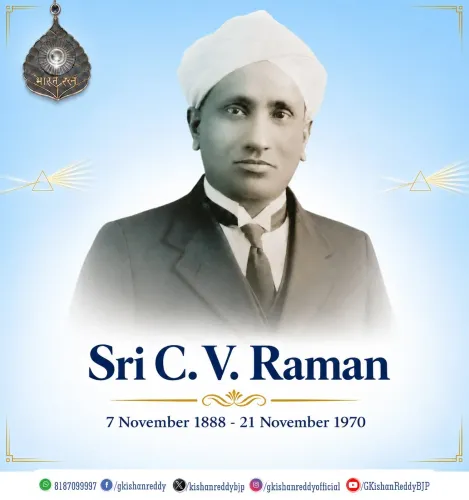
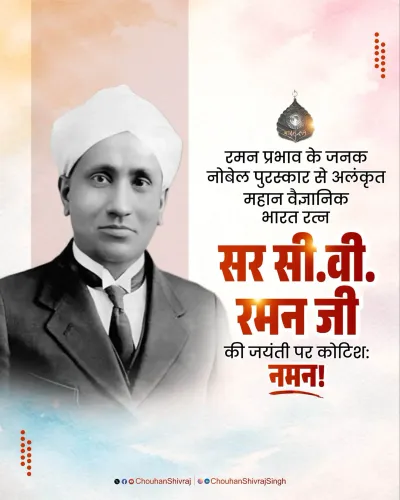
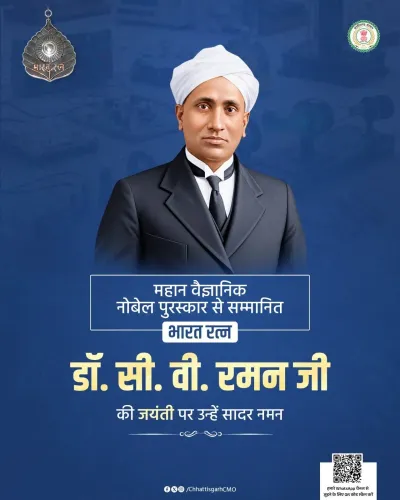
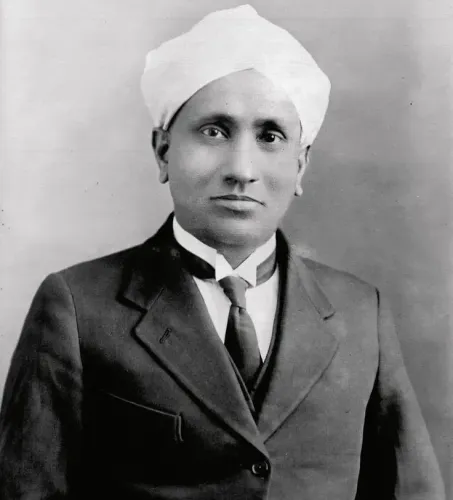
On the death anniversary of Bharat Ratna Sir C.V. Raman, Union Science Minister Dr. Jitendra Singh paid tribute to the physicist whose 1930 Nobel Prize in Physics for the Raman Effect made history as Asia's first science Nobel.
Key Takeaways
Union Science and Technology Minister Dr.
Jitendra Singh paid tribute to Sir C.V.
Raman on his death anniversary, 21 November .
Raman discovered the Raman Effect in 1928 , describing the inelastic scattering of photons by matter.
He was awarded the Nobel Prize in Physics in 1930 — the first Nobel in any science stream for a scientist based in Asia .
India honoured Raman with the Bharat Ratna in 1954 , among the first recipients of the country's highest civilian honour.
National Science Day is observed every 28 February to commemorate the 1928 announcement of the Raman Effect.
Raman founded the Raman Research Institute in Bengaluru in 1948 , which continues as an active scientific institution.
A century after his work rewrote how humanity understands light, Bharat Ratna Sir C.V. Raman is remembered today — on his death anniversary — by Union Science and Technology Minister Dr. Jitendra Singh, who paid tribute to the physicist whose discovery made Asia's first science Nobel a reality.
The discovery that crossed a continent's scientific horizon
In 1928, working at the Indian Association for the Cultivation of Science in Calcutta, Sir Chandrasekhara Venkata Raman observed that when light passes through a transparent material, a small fraction of it scatters at a different wavelength — a phenomenon that now bears his name: the Raman Effect. The finding was elegant, the implications immense, cutting across physics, chemistry, and materials science in ways researchers still mine today.
Two years later, the Nobel Committee in Stockholm awarded Raman the 1930 Nobel Prize in Physics — the first time the prize for any science stream had gone to a scientist based in Asia. Dr. Jitendra Singh underscored that historic dimension in his post, calling it 'the first Nobel Prize for Physics in Asia for any science stream.'
Bharat Ratna and the arc of a national icon
India honoured Raman with its highest civilian distinction, the Bharat Ratna, in 1954 — recognition that placed him alongside the republic's most consequential figures in its very first decade. He remained active in research well into his eighties, running the Raman Research Institute in Bengaluru, which he founded in 1948 and which continues to operate as an autonomous research institution.
Raman passed away on 21 November 1970, and every year on that date, scientists, institutions, and public figures across the country pause to recall the quiet, determined brilliance that put India on the global physics map.
Why governments keep invoking Raman
The periodic invocation of Raman by ministers and institutions is not merely ceremonial. India's science ministry uses figures like Raman to anchor a narrative: that the country's scientific ambitions today have deep, Nobel-validated roots. National Science Day, observed every 28 February, already commemorates the 1928 announcement of the Raman Effect — a date that links national pride directly to a peer-reviewed breakthrough. Today's tribute from the Science Minister reinforces that continuum.
For a government that has staked much of its identity on making India a global science and technology power, reminding the public that an Indian physicist won Asia's first science Nobel nearly a century ago is a data point that lands with quiet force.
Point of View
Nobel-validated achievements — lending institutional weight to what might otherwise read as routine social media commemoration. Invoking Raman's 1930 Nobel as Asia's first science prize is a soft but pointed argument: that India was not a late entrant to global science, but a pioneer. As the government pushes investment in deep-tech, space, and research infrastructure, reminders of Raman serve a dual purpose — public inspiration and international credibility. The Science Ministry's consistent use of this narrative signals it views scientific heritage as an active policy asset, not mere nostalgia.
NationPress
21 Nov 2026
Frequently Asked Questions
When did C.V. Raman die?
Sir C.V. Raman died on 21 November 1970 in Bengaluru, India.
What is the Raman Effect?
The Raman Effect is the phenomenon by which light changes wavelength when it scatters off molecules in a transparent medium. Discovered by C.V. Raman in 1928 , it has wide applications in physics, chemistry, and materials science.
Why did C.V. Raman win the Nobel Prize?
C.V. Raman won the Nobel Prize in Physics in 1930 for his discovery of the Raman Effect — the inelastic scattering of photons — making him the first Asian scientist to win a Nobel in any science discipline.
What is National Science Day and why is it celebrated on 28 February?
National Science Day is observed every 28 February to commemorate the date in 1928 when C.V. Raman announced the discovery of the Raman Effect, one of India's most celebrated scientific milestones.
What Bharat Ratna did C.V. Raman receive?
Sir C.V. Raman was awarded the Bharat Ratna , India's highest civilian honour, in 1954 — one of the earliest recipients of the award, established that same year.