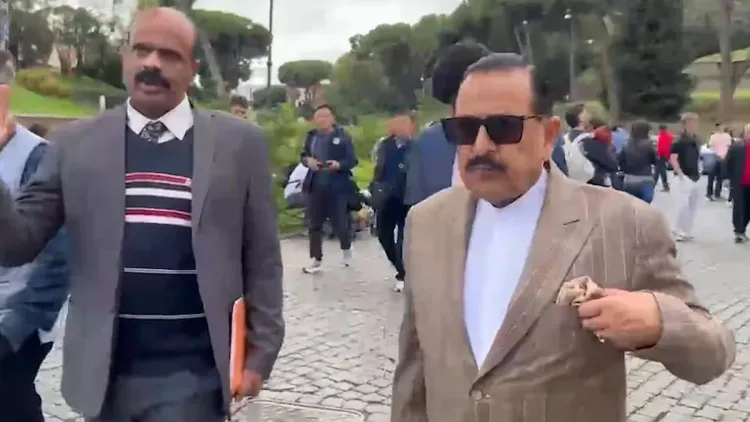
Dr. Jitendra Singh visits Rome's Colosseum before flying home
Synopsis
Union Science and Technology Minister Dr. Jitendra Singh visited the Colosseum in Rome on 16 November 2026, sharing a striking historical note: Julius Caesar, the empire's most iconic figure, was assassinated 125 years before the amphitheatre was built — the two icons never coexisted.
Key Takeaways
Jitendra Singh visited the Colosseum in Rome on 16 November 2026 before returning to New Delhi .
The Colosseum was completed in 80 CE and once hosted gladiatorial contests before tens of thousands of spectators.
Julius Caesar was assassinated in 44 BCE — roughly 125 years before the Colosseum's construction was completed, meaning he never visited the structure.
Singh quoted Caesar's famous last words to Brutus — ' Et tu, Brute? ' — immortalised by Shakespeare.
The post is part of a broader pattern of Indian ministers sharing cultural reflections from overseas trips on social media.
Two thousand years of history, one last stop before the flight home. Union Science and Technology Minister Dr. Jitendra Singh made a cultural detour to the iconic Colosseum in Rome on Monday, 16 November 2026, pausing to reflect on the grandeur — and the ironies — of the ancient Roman Empire before boarding his return flight to New Delhi.
A 2,000-year-old arena, up close
The minister described the visit as 'a majestic journey through the history of the grand Roman Empire.' Completed in 80 CE, the Colosseum once held tens of thousands of spectators who gathered to watch gladiatorial contests and public spectacles — the blockbuster entertainment of its age. Dr. Singh called it 'an extraordinary marvel of Roman engineering' and 'a timeless symbol of ancient Rome's architectural brilliance, cultural heritage and enduring legacy.'
The Julius Caesar paradox
The minister saved his sharpest observation for a historical footnote that stops most visitors cold: Julius Caesar — arguably the most famous name associated with Rome — never once set foot inside the Colosseum. The reason is simple arithmetic. Caesar was assassinated in 44 BCE, nearly 125 years before the amphitheatre was even completed. Dr. Singh noted the poetic contradiction: two of the Roman Empire's most enduring icons never shared the same era.
He capped the observation with Caesar's legendary dying words to his trusted aide Brutus — immortalised by Shakespeare — 'Et tu, Brute?' (You too, Brutus), the line that has echoed through literature and drama for centuries.
When ministers travel with curiosity
Indian ministers sharing personal cultural reflections during overseas visits has become a recognisable genre on social media — a blend of public diplomacy and genuine intellectual engagement that humanises official travel beyond the press-conference frame. Dr. Singh's Rome post fits that pattern: a moment of personal curiosity about history, shared openly before the aircraft door closes.
The Colosseum today receives millions of visitors a year and remains one of the world's most visited heritage sites, a testament to the staying power of the civilisation it once centred.
Point of View
Well-read traveller rather than a bureaucratic functionary. In a media environment saturated with political combat, such posts offer a soft-power dividend: a glimpse of the person behind the portfolio, without straying into controversy.
NationPress
16 Nov 2026
Frequently Asked Questions
Why did Dr. Jitendra Singh visit the Colosseum in Rome?
Dr. Singh made a personal cultural visit to the Colosseum before boarding his return flight to New Delhi on 16 November 2026, describing it as a reflection on the history and legacy of the Roman Empire.
Did Julius Caesar ever visit the Colosseum?
No. Julius Caesar was assassinated in 44 BCE, approximately 125 years before the Colosseum was completed in 80 CE, so the two iconic symbols of Rome never coexisted.
What is the historical significance of the Colosseum?
Built over 2,000 years ago and completed in 80 CE, the Colosseum in Rome is an ancient amphitheatre that once hosted gladiatorial contests and public spectacles for tens of thousands of spectators. It is considered a marvel of Roman engineering.
What does 'Et tu, Brute' mean?
'Et tu, Brute?' is Latin for 'You too, Brutus?' — the legendary dying words attributed to Julius Caesar upon being stabbed by his trusted aide Brutus, later immortalised in Shakespeare's play 'Julius Caesar'.
What was Dr. Jitendra Singh doing in Rome?
The specific official purpose of Dr. Jitendra Singh's Rome trip has not been confirmed; the post describes a cultural visit to the Colosseum made just before his return flight to New Delhi.