Dr. Jitendra Singh Welcomes BJP Chief at Jammu With CSIR Lavender
Synopsis
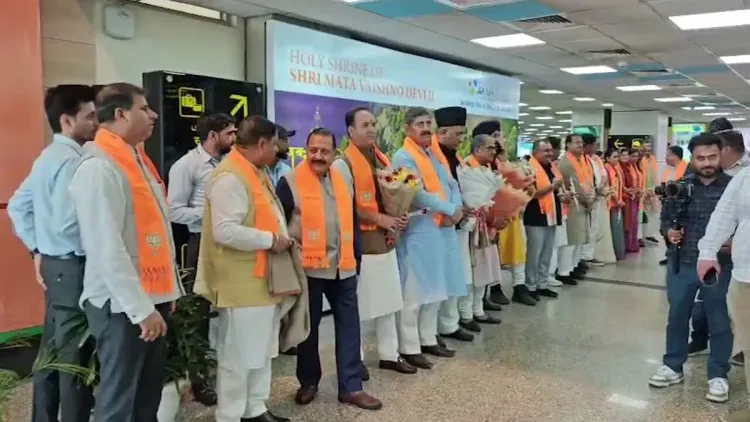
Union Science and Technology Minister Dr. Jitendra Singh welcomed BJP national president Nitin Nabin at Jammu Airport on 7 July 2026 with CSIR Aroma Mission lavender, spotlighting the programme's role in farmer prosperity and Atmanirbhar Bharat.
Key Takeaways
Jitendra Singh welcomed BJP national president Nitin Nabin at Jammu Airport on 7 July 2026 .
The minister presented CSIR-developed lavender flowers as a symbol of the Aroma Mission , not merely as a ceremonial bouquet.
CSIR launched the Aroma Mission in 2016 , targeting over 5,000 hectares of aromatic crops; it was extended to Jammu and Kashmir in 2018-19 .
CSIR-IIIM, Jammu developed the lavender varieties and transferred agro-technologies to local farmers.
Prime Minister Narendra Modi has publicly praised lavender farming and CSIR-IIIM's work in his Mann ki Baat broadcasts.
The gesture reinforces the government's framing of S&T investments as drivers of rural prosperity and import substitution under Atmanirbhar Bharat .
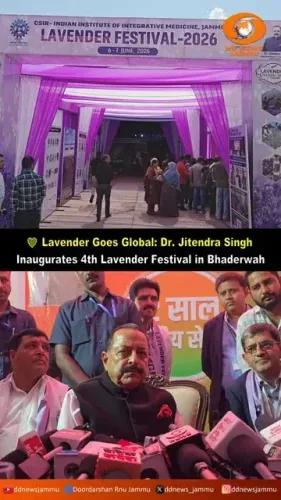
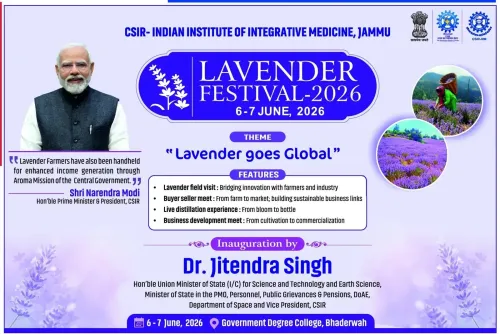
Union Science and Technology Minister Dr. Jitendra Singh on Monday, 7 July 2026, welcomed Bharatiya Janata Party national president Nitin Nabin at Jammu Airport, presenting him with lavender flowers developed by the Council of Scientific and Industrial Research (CSIR) under its flagship Aroma Mission.
Context
The minister posted on X that the lavender bouquet was not merely a floral gesture but a symbol of the Aroma Mission's work in transforming rural livelihoods. In his words, the flowers represent 'kisanon ki samridhi aur Atmanirbhar Bharat ki disha mein ek sashakt pahel' ('a strong initiative towards farmers' prosperity and the direction of a self-reliant India'). Dr. Singh also noted that Prime Minister Narendra Modi has cited lavender farming and the efforts of CSIR-Indian Institute of Integrative Medicine (CSIR-IIIM) in his Mann ki Baat radio address.
Policy Backdrop
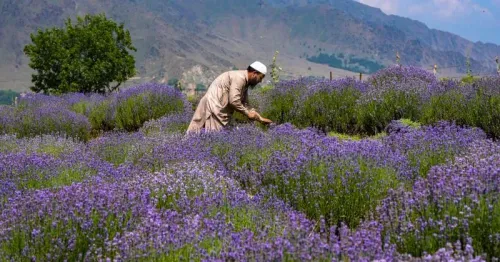
CSIR formally launched the Aroma Mission in 2016 with a target of covering more than 5,000 hectares of aromatic crops across India. The mission was subsequently extended to Jammu and Kashmir in 2018-19, with lavender and other high-value aromatic plants as the primary focus. CSIR-IIIM, Jammu — India's premier integrative medicine research institute — developed the lavender varieties and the agro-technologies that were transferred directly to farmers in the region.
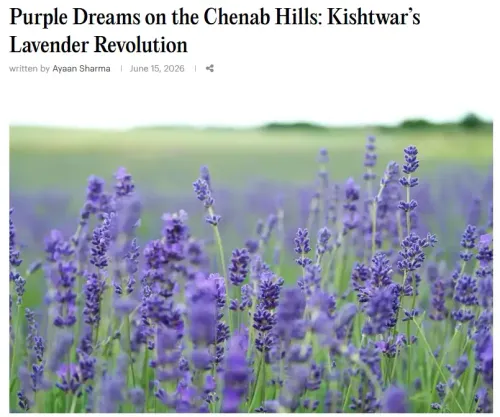
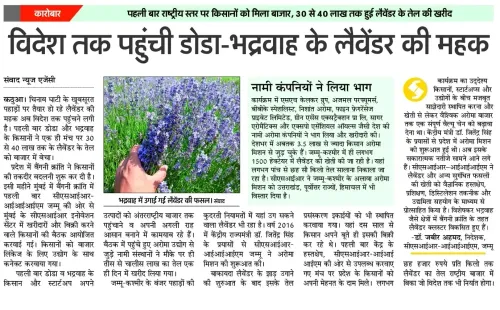
The Aroma Mission sits within the broader Atmanirbhar Bharat framework, aiming to reduce India's dependence on imported aromatic raw materials and essential oils while creating farm-level income diversification. Lavender cultivation in the Jammu hills has emerged as one of the mission's most visible success stories, drawing comparisons to the 'Purple Revolution' that reshaped parts of the Doda and Bhaderwah belt.
Stakeholders and Impact
The primary beneficiaries of the Aroma Mission in Jammu and Kashmir are smallholder farmers who have shifted portions of their land to lavender, earning significantly higher returns than from traditional crops. CSIR-IIIM has facilitated the supply of planting material, training, and market linkages for these growers. The institute's work has also supported the creation of farmer-producer organisations and distillation units in the region.
By presenting lavender at a political reception, Dr. Singh reinforced the government's consistent messaging that scientific research under CSIR has direct, tangible benefits for rural communities. Such gestures recur at senior BJP visits to CSIR field sites, underscoring the linkage between science-and-technology outputs and grassroots outreach in Jammu and Kashmir.
What's Next
Attention will now turn to whether the BJP leadership's visit translates into further policy commitments for expanding Aroma Mission clusters in Jammu and Kashmir. Parliamentary questions on CSIR budget allocations for aromatic crops are expected during the upcoming monsoon session. Any announcement on scaling up distillation infrastructure or new farmer enrolment targets in the Union Territory would be closely watched by growers and agri-researchers alike.
Point of View
Fusing BJP's electoral outreach in Jammu and Kashmir with a tangible CSIR success story. Dr. Singh, who holds charge of both Science and Earth Sciences ministries, has consistently used Aroma Mission imagery to project the Modi government's rural-technology narrative in J&K, a Union Territory that carries outsized political significance. The episode fits a recurring pattern where scientific outputs are deployed as soft-power props at party events, blurring the line between policy communication and political mobilisation. Whether this translates into fresh budgetary commitments or remains symbolic will be the real test of intent.
NationPress
6 Jul 2026
Frequently Asked Questions
What is the CSIR Aroma Mission?
The CSIR Aroma Mission is an initiative launched in 2016 by the Council of Scientific and Industrial Research to promote cultivation and value-addition of aromatic crops such as lavender across India, with a focus on raising farmer incomes and reducing import dependence.
What is CSIR-IIIM Jammu and its role in lavender farming?
CSIR-IIIM (Indian Institute of Integrative Medicine) in Jammu is the lead institute for the Aroma Mission in J&K. It developed lavender varieties suited to the region and transferred agro-technologies and planting material directly to local farmers.
Why did Dr. Jitendra Singh give lavender to the BJP national president?
Dr. Singh presented CSIR Aroma Mission lavender to BJP national president Nitin Nabin at Jammu Airport to highlight the mission's contribution to farmer prosperity and the Atmanirbhar Bharat initiative, framing a political reception as an opportunity for science outreach.
Has PM Modi spoken about lavender farming in Mann ki Baat?
Yes. Prime Minister Narendra Modi has praised lavender cultivation and the efforts of CSIR-IIIM in his Mann ki Baat radio programme, lending high-profile visibility to the Aroma Mission's work in Jammu and Kashmir.
What is the Purple Revolution in Jammu and Kashmir?
The 'Purple Revolution' refers to the transformation of farming in parts of the Doda and Bhaderwah belt of Jammu and Kashmir, where CSIR-IIIM's lavender cultivation programme helped smallholder farmers shift to high-value aromatic crops, significantly improving their incomes.