Kishan Reddy hails DRDO's Pralay missile flight test success

Synopsis
Union Minister G. Kishan Reddy praised DRDO, BDL and RCI Hyderabad for successfully flight-testing the Pralay quasi-ballistic missile, calling it a milestone for India's indigenous defence capabilities and the Atmanirbhar Bharat initiative.
Key Takeaways
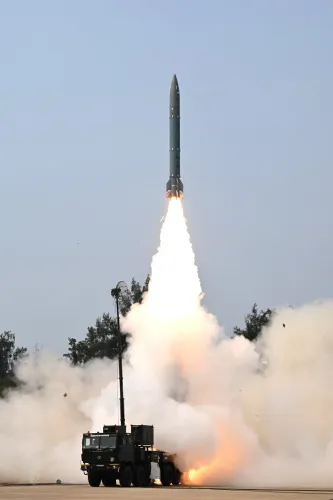
Pralay , India's indigenously developed quasi-ballistic surface-to-surface missile, completed a successful flight test on or before 6 November 2026 .
Three organisations were credited: DRDO , Bharat Dynamics Limited (BDL) , and Research Centre Imarat (RCI), Hyderabad .
Pralay was first flight-tested in December 2021 from Abdul Kalam Island ; this test advances its developmental record.
The missile is designed for tactical battlefield roles, using a quasi-ballistic trajectory and high manoeuvrability to defeat interception.
RCI Hyderabad specialises in missile guidance, avionics and propulsion — the core technologies behind Pralay's precision.
The test reinforces India's Atmanirbhar Bharat push to reduce dependence on foreign defence imports through indigenous design and PSU manufacturing.
India's quasi-ballistic battlefield missile Pralay has cleared another successful flight test — and Union Coal and Mines Minister G. Kishan Reddy was quick to salute the teams behind it on Friday, 6 November 2026, calling the achievement a proud moment for the nation's self-reliance drive.
What Pralay is — and why it matters on the battlefield
Pralay is a surface-to-surface quasi-ballistic missile designed for tactical battlefield roles, combining high manoeuvrability with a depressed trajectory that makes it harder to intercept than a conventional ballistic missile. Unlike the longer-range strategic systems in India's arsenal, Pralay is built for the front line — fast, precise, and punishing at short-to-medium ranges. That combination of speed and in-flight manoeuvre is precisely what modern layered air-defence systems find difficult to handle.
The missile was first flight-tested in December 2021 from Abdul Kalam Island off the Odisha coast. This latest test adds to that developmental record and moves Pralay closer to formal induction into the Indian Army.
The Hyderabad cluster that built the guidance brain
Research Centre Imarat (RCI), located in Hyderabad, is the DRDO laboratory that handles missile guidance, avionics, and propulsion — the most technically demanding elements of any precision strike weapon. RCI has been the nerve centre for several of India's re-entry and guidance technology milestones going back to the original Integrated Guided Missile Development Programme launched in 1983. That programme's legacy runs through every Indian missile that has followed, including Pralay.
Bharat Dynamics Limited (BDL), the defence public-sector undertaking, handles production and system integration — the bridge between a laboratory prototype and a weapon the armed forces can actually field. Kishan Reddy explicitly named all three organisations — DRDO, BDL, and RCI — in his congratulatory post, a signal that credit is being shared across the full design-to-delivery chain.
Atmanirbhar Bharat's missile dividend
The minister's invocation of #AtmanirbharBharat — the policy push to indigenise defence design, development, and manufacturing — is more than a hashtag here. India's defence import bill has historically been among the world's largest, and successive governments have tried to reverse that dependency through public-private and PSU partnerships. DRDO's sustained missile test cadence since the 2010s, anchored in solid-fuel propulsion and advanced guidance, represents the clearest technical dividend of that effort.
Pralay's development sits squarely within that arc — an indigenously conceived, designed, and produced system that did not require a foreign technology transfer to get off the ground. The next milestone to watch: a formal Army induction timeline or user trials announced by the Ministry of Defence.
Point of View
Amplifying such milestones serves a dual purpose: it validates the Atmanirbhar Bharat framework as a defence policy success, and it anchors Hyderabad's RCI cluster — located in Telangana, where Kishan Reddy leads the state unit — in a national security narrative. The Army induction timeline for Pralay will be the real test of whether developmental success converts into operational capability, which is where India's missile programmes have historically faced the longest lag.
NationPress
6 Nov 2026
Frequently Asked Questions
What is the Pralay missile?
Pralay is an indigenously developed Indian quasi-ballistic surface-to-surface missile designed for tactical battlefield roles, offering high manoeuvrability and a depressed flight trajectory to evade interception. It was first tested in December 2021 from Abdul Kalam Island.
Who developed the Pralay missile?
Pralay was developed by DRDO, with guidance and avionics work led by Research Centre Imarat (RCI) in Hyderabad and production handled by Bharat Dynamics Limited (BDL), a defence public-sector undertaking.
What is the difference between a quasi-ballistic and a ballistic missile?
A quasi-ballistic missile follows a low, depressed trajectory and can manoeuvre during flight, unlike a standard ballistic missile that follows a predictable high-arc path. This makes quasi-ballistic missiles significantly harder for air-defence systems to track and intercept.
What is Research Centre Imarat (RCI) in Hyderabad?
RCI is a DRDO laboratory in Hyderabad specialising in missile guidance systems, avionics, and propulsion. It has been central to several of India's key missile guidance and re-entry technology milestones, including work on the Pralay missile.
Will Pralay be inducted into the Indian Army?
Pralay has been developed for tactical Army use, but a formal induction timeline or announcement of user trials by the Ministry of Defence has not yet been confirmed. This latest successful flight test is expected to bring that decision closer.