CM Yogi: Eastern UP gets its first flatted factory for MSMEs
Synopsis
The Chief Minister's Office of Uttar Pradesh announced that CM Yogi Adityanath has inaugurated eastern Uttar Pradesh's first flatted factory, a multi-storey complex designed to host more than 100 MSME units under one roof. The launch advances the state's push to narrow the industrial gap between western and eastern UP through shared, plug-and-play manufacturing infrastructure.
Key Takeaways
Eastern Uttar Pradesh has received its first flatted factory, announced by the Chief Minister's Office of UP on 3 June 2026.
The complex is designed to accommodate over 100 MSME units within a single multi-storey campus.
CM Yogi Adityanath framed the launch as a regional first for Purvanchal's industrial infrastructure.
The project aligns with the UP Industrial Investment and Employment Promotion Policy, 2017, which backed multi-storey MSME facilities.
Beneficiaries include small manufacturers seeking plug-and-play premises with shared utilities and services.
Replication across other eastern UP districts will be a key indicator of the model's success.
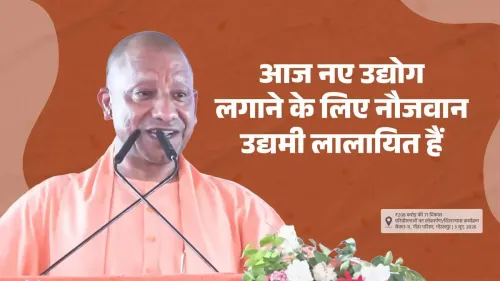
The Chief Minister's Office of Uttar Pradesh on Wednesday, 3 June 2026, announced the inauguration of the first ever flatted factory in eastern Uttar Pradesh, citing Chief Minister Yogi Adityanath. The facility is designed to host over 100 industrial units from the MSME sector within a single multi-storey campus, marking a notable shift in how shared manufacturing infrastructure is being delivered in the region.
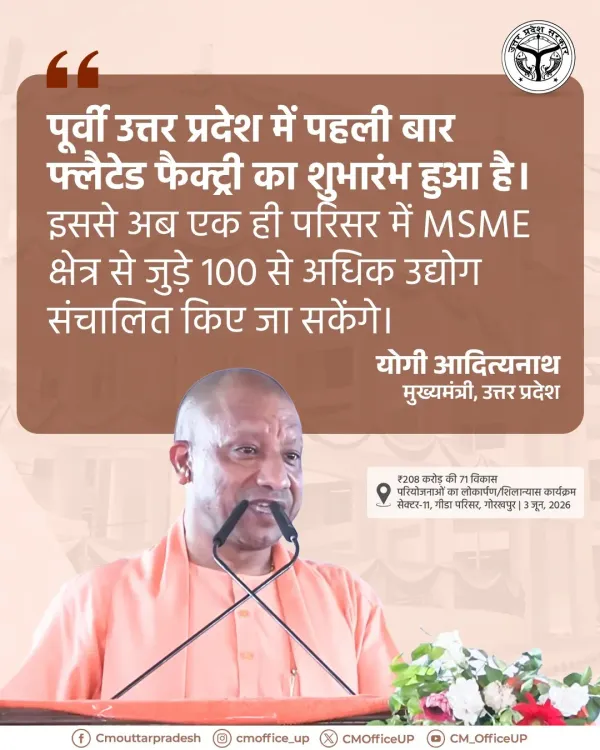
In the post, the Chief Minister stated, in translation, 'A flatted factory has been launched for the first time in eastern Uttar Pradesh. With this, more than 100 industries linked to the MSME sector can now be operated within a single complex.' The original Hindi line — 'पूर्वी उत्तर प्रदेश में पहली बार फ्लैटेड फैक्ट्री का शुभारंभ हुआ है' (the first flatted factory has been launched in eastern UP) — frames the project as a regional first.
Context
A flatted factory is a multi-storey industrial building in which independent small manufacturers occupy ready-to-use floors or units, sharing common services such as power, freight lifts, effluent handling and parking. The model is widely used in land-scarce manufacturing hubs to compress horizontal industrial estates into a vertical footprint, lowering entry costs for micro and small units.
By concentrating more than 100 MSME units in one complex, the eastern UP facility aims to give small entrepreneurs plug-and-play premises without the delays of acquiring land, securing approvals and building standalone sheds. The Chief Minister's announcement positions the launch as a template for shared industrial infrastructure in the Purvanchal belt.
Policy backdrop
The project sits within a longer arc of state industrial policy. The Uttar Pradesh Industrial Investment and Employment Promotion Policy, 2017, articulated under the Yogi Adityanath government, encouraged industrial estates, clusters and multi-storey facilities specifically tailored to MSMEs, alongside incentives for backward districts.
Successive state governments have flagged the industrial gap between western Uttar Pradesh — anchored by Noida, Ghaziabad and Kanpur — and the eastern districts, where manufacturing density has historically been thinner. Flatted factories are part of a broader toolkit, alongside one-district-one-product clusters and dedicated MSME parks, intended to narrow that divide.
Stakeholders and impact
The most immediate beneficiaries are MSME entrepreneurs in eastern Uttar Pradesh, particularly first-generation manufacturers and units currently operating from informal premises. A shared-campus model can reduce capital outlay on land and civil works, while allowing tenants to access common compliance, logistics and utility services.
For the wider economy of the region, clustering small units in one facility can support ancillary services, ease last-mile logistics and create a more visible address for buyers and lenders. The state government has repeatedly linked such infrastructure to employment generation, especially for youth in districts that have seen out-migration for work.
Industry associations and lenders working with MSMEs will likely watch how floor allotments, rental terms and shared-service charges are structured, as these factors determine whether the model is financially viable for the smallest units.
What's next
Attention will turn to whether the state replicates the flatted factory format in other Purvanchal districts, and how the new facility integrates with central schemes for MSME credit, technology upgradation and market access. Tenant onboarding, occupancy levels and the mix of sectors that take up space inside the complex will offer early signals of demand.
If uptake is strong, the eastern UP launch could anchor a wider rollout of vertical industrial estates across the state — and become a reference point for other Indian states pursuing compact, MSME-focused manufacturing infrastructure.
Point of View
Shared infrastructure to nudge MSME activity into districts that have historically lagged the western belt. Flatted factories are a pragmatic answer to land fragmentation and high upfront costs that often keep micro units informal. The real test, however, lies beyond the ribbon-cutting — in tenant occupancy, rental viability for the smallest firms, and linkages to credit and market access. If those align, the model could become a blueprint for Purvanchal's next industrial phase.
NationPress
17 Oct 2026
Frequently Asked Questions
What is a flatted factory?
A flatted factory is a multi-storey industrial building where several small manufacturers occupy independent units or floors and share common facilities such as power, lifts, utilities and parking. The format is used to maximise land use and offer ready-to-use premises to MSMEs.
Where has the first flatted factory in eastern UP been launched?
The Chief Minister's Office of Uttar Pradesh announced the launch as the first such facility in eastern Uttar Pradesh, but the specific district was not stated in the post. The complex is designed to house over 100 MSME units.
How many industries can operate in the new UP flatted factory?
According to the Chief Minister's Office, more than 100 MSME-sector industries can be operated within the single complex. They will share a common campus with integrated facilities.
How does this support MSMEs in Uttar Pradesh?
By offering ready-built, multi-storey premises with shared services, the model reduces land and construction costs for small manufacturers. It also helps cluster ancillary services, logistics and compliance support in one location.
How does this link to UP's industrial policy?
The launch aligns with the Uttar Pradesh Industrial Investment and Employment Promotion Policy, 2017, which encouraged industrial estates, clusters and multi-storey facilities for MSMEs, especially in backward regions of the state.