CM Yogi Pitches Flatted Factory Model for Small Entrepreneurs
Synopsis
Uttar Pradesh Chief Minister Yogi Adityanath highlighted the flatted factory model as a proof point that small entrepreneurs can now establish industry and earn solid returns with limited capital, anchoring the state's MSME-led industrialisation push.
Key Takeaways
CM Yogi Adityanath posted on 3 June 2026 on the flatted factory model.
He said small capital can now yield good profits and enable industry setup.
Flatted factories are multi-storey complexes for micro and small units.
The format aligns with UP Industrial Policy 2017's MSME focus.
Targets small entrepreneurs constrained by land and capital costs.
Watch for more such projects under district-level industrial plans.
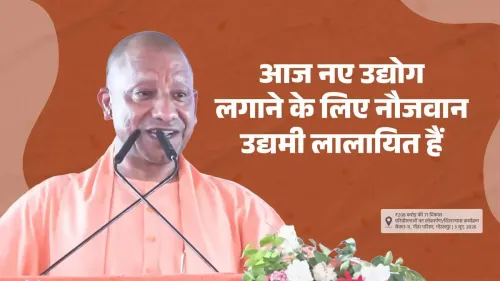
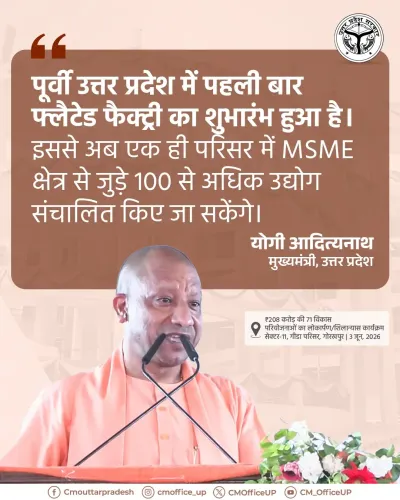
Uttar Pradesh Chief Minister Yogi Adityanath on 3 June 2026 highlighted the flatted factory model as a viable route for small entrepreneurs to set up industrial units with limited capital. In a post on X accompanied by a video, the Chief Minister positioned the multi-storey industrial format as proof that meaningful manufacturing returns are now possible at a smaller scale in the state.
'Now good profits can be earned and industry established even with small capital; the flatted factory has provided one model of that,' the Chief Minister wrote in Hindi (अब छोटी पूंजी में भी अच्छा मुनाफा कमाया जा सकता है और उद्योग स्थापित किया जा सकता है). The message frames shared, vertical industrial infrastructure as a tool for lowering the entry barrier into manufacturing.
Context
A flatted factory is a multi-storey complex where individual floors or units are allotted to micro and small enterprises, allowing them to operate without acquiring standalone land parcels. The format is particularly suited to urban and peri-urban clusters where land is scarce and capital costs deter first-time entrepreneurs.
The Chief Minister's framing — that 'small capital' can now translate into 'good profit' — is consistent with Uttar Pradesh's sustained messaging around MSME-led industrialisation since 2017.
Policy backdrop
The flatted factory concept in Uttar Pradesh draws from the Uttar Pradesh Industrial Investment and Employment Promotion Policy 2017, which prioritised shared MSME infrastructure to reduce entry costs for small manufacturers. The policy lineage emphasises cluster-based industrialisation and Ease of Doing Business reforms as twin levers for expanding the state's manufacturing base.
Similar flatted-factory templates have been deployed in other Indian states to accommodate micro-enterprises in dense urban pockets, but Uttar Pradesh has integrated the format into its broader industrial corridor and district-level industrial planning architecture.
Stakeholders and impact
The most direct beneficiaries are small entrepreneurs and MSME units that have historically struggled with the upfront cost of land, boundary walls, and standalone factory sheds. By offering ready-to-occupy floors with shared utilities, the model compresses the time and capital required to move from idea to production.
For the state, the format supports two parallel objectives: absorbing manufacturing employment closer to towns and cities, and densifying industrial output per unit of land — a critical concern in a state with high population density and competing demand for agricultural land.
What's next
Attention now turns to the rollout of additional flatted factory complexes under district-level industrial plans, and to whether the state will pair the infrastructure with targeted credit, skilling or marketing linkages for the units that occupy them. Any refresh of MSME policy instruments — particularly around plug-and-play industrial infrastructure — will be a key signal of how central the flatted factory format becomes to Uttar Pradesh's next phase of industrial expansion.
If the model scales, it could reshape how India's largest state absorbs first-generation manufacturers, with implications for both employment patterns and the geography of small-scale industry.
Point of View
Where lowering the capital and land threshold for manufacturing has been a recurring policy theme. By singling out flatted factories, the Chief Minister is signalling that shared, vertical industrial infrastructure — not just mega-projects — is central to the state's MSME strategy. The broader arc is one of cluster-based industrialisation aimed at first-generation entrepreneurs in smaller towns. The real test will be whether occupancy, credit access and market linkages keep pace with the built infrastructure.
NationPress
17 Oct 2026
Frequently Asked Questions
What is a flatted factory?
A flatted factory is a multi-storey industrial complex where individual floors or units are allotted to micro and small enterprises. It lets entrepreneurs run manufacturing units without buying standalone land, sharing common utilities and services.
What did CM Yogi Adityanath say about flatted factories?
He said that good profits can now be earned and industry established even with small capital, and that the flatted factory model demonstrates this. His 3 June 2026 post positioned the format as a route for small entrepreneurs.
How does the flatted factory model help MSMEs in Uttar Pradesh?
It reduces the upfront cost of land and construction for small entrepreneurs. MSMEs get ready-to-occupy units with shared infrastructure, cutting the time and capital needed to start production.
Which Uttar Pradesh policy supports flatted factories?
The Uttar Pradesh Industrial Investment and Employment Promotion Policy 2017 promoted MSME infrastructure, including flatted factory complexes. It aimed to lower entry barriers for small manufacturers and support cluster-based industrialisation.
Who benefits most from flatted factories?
Small entrepreneurs and MSME units benefit most, especially those constrained by land costs in urban areas. The format suits micro-enterprises that need modest floor space and shared utilities to begin manufacturing.