CM Yogi: GIDA Flatted Factory to Empower Purvanchal Youth, MSMEs
Synopsis
The Chief Minister's Office of Uttar Pradesh announced that a new flatted factory at the Gorakhpur Industrial Development Authority will host readymade garments, electronics and other small industries under one roof, positioning it as a platform for Purvanchal youth and MSME entrepreneurs to enter formal manufacturing.
Key Takeaways
The GIDA flatted factory in Gorakhpur is pitched as a shared platform for eastern UP youth and MSMEs.
It will house readymade garments, electronic products and other industries in a single complex.
The model lowers entry barriers for small units by offering ready-to-use floor space and common utilities.
It aligns with the UP Industrial Investment and Employment Promotion Policy 2017 and Make in India.
The project is part of a wider push to industrialise Purvanchal alongside western UP clusters.
Next signals: unit allotments, tenant mix and any linkage with central PLI schemes.
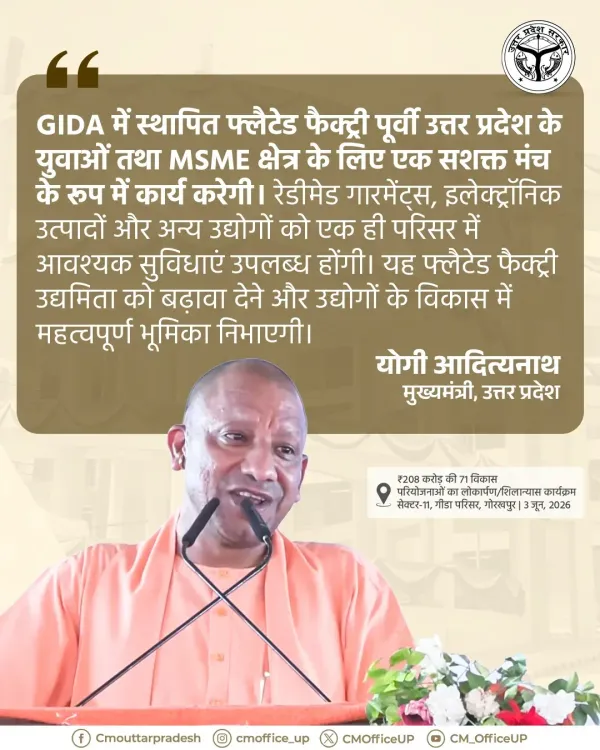
The Chief Minister's Office of Uttar Pradesh on Wednesday, 3 June 2026, said the newly established flatted factory at the Gorakhpur Industrial Development Authority (GIDA) will serve as a strong platform for the youth of eastern Uttar Pradesh and the MSME sector. The post, attributed to Chief Minister Yogi Adityanath, framed the facility as a multi-sector hub offering shared infrastructure to readymade garments, electronics and other small industries under one roof.
In the post, the Chief Minister stated that the flatted factory established in GIDA 'will act as a strong platform for the youth of eastern Uttar Pradesh and the MSME sector'. He added that 'readymade garments, electronic products and other industries will get the necessary facilities in a single complex' and that the facility 'will play an important role in promoting entrepreneurship and the growth of industries'.
Context
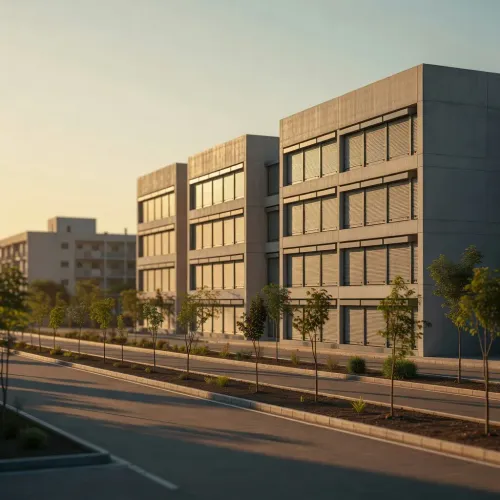
A flatted factory is a multi-storey industrial building that houses several small manufacturing units in compact, ready-to-use floor spaces with shared utilities such as power, water, loading bays and effluent handling. The model is designed to lower the entry barrier for micro and small enterprises, which often struggle to acquire standalone industrial plots in expensive urban-adjacent zones.
GIDA, set up by the state government, is the principal industrial infrastructure body for the Gorakhpur region in Purvanchal, eastern Uttar Pradesh. The authority has been progressively allotting land and developing common facilities in sectors ranging from food processing to apparel and electronics assembly.
Policy backdrop
The flatted factory concept dovetails with the Uttar Pradesh Industrial Investment and Employment Promotion Policy 2017, which offered incentives for shared MSME infrastructure to widen the manufacturing base. It also aligns with the central Make in India initiative launched in 2014, which encouraged states to develop multi-tenant industrial facilities for small units in labour-intensive segments such as garments and electronics.
By bundling readymade garments and electronics within a single complex, the GIDA project mirrors a wider push under Atmanirbhar Bharat (self-reliant India) to localise apparel and electronics production. Both sectors are central to India's export ambitions and to employment generation for first-time industrial workers, particularly women and youth from semi-urban districts.
Stakeholders and impact
The most direct beneficiaries are MSME entrepreneurs in Purvanchal, a region that has historically lagged behind western Uttar Pradesh's industrial clusters around Noida, Ghaziabad and Kanpur. Flatted units typically allow smaller firms to begin operations with lower capital outlay, since they avoid the cost and delay of constructing standalone sheds.
For the youth of eastern Uttar Pradesh, the facility is positioned as a route into formal manufacturing jobs closer to home, potentially easing the migration pressure that has long characterised districts such as Gorakhpur, Basti, Deoria and Kushinagar. Anchor industries in garments and electronics tend to absorb large numbers of semi-skilled and skilled workers, including diploma holders from local ITIs and polytechnics.
For the state government, the project reinforces its narrative of regional industrial balancing — extending infrastructure-led growth into Purvanchal alongside continued investment in the western corridor and the upcoming Defence Industrial Corridor nodes.
What's next
Attention will turn to the pace of unit allotments inside the GIDA flatted factory, the mix of garment versus electronics tenants, and whether the facility is integrated with central Production Linked Incentive (PLI) schemes for electronics and textiles. The state has signalled that more such multi-storey industrial complexes are on the anvil under various industrial authorities.
The broader test will be employment outcomes: how many MSME units occupy the building, how many direct jobs they generate for local youth, and whether the cluster attracts ancillary suppliers. If the Gorakhpur experiment scales, it could become a template for similar interventions in other Purvanchal and Bundelkhand districts seeking to bridge the industrial gap with western Uttar Pradesh.
Point of View
However, will depend on occupancy and visible employment, not on the inauguration itself.
NationPress
18 Oct 2026
Frequently Asked Questions
What is the GIDA flatted factory in Gorakhpur?
It is a multi-storey industrial facility set up by the Gorakhpur Industrial Development Authority to house multiple MSME units — including readymade garments, electronics and other small industries — under one roof with shared infrastructure.
Who will benefit from the GIDA flatted factory?
MSME entrepreneurs and youth in eastern Uttar Pradesh are the primary intended beneficiaries, with the facility designed to lower setup costs for small manufacturers and create local manufacturing jobs in Purvanchal.
Which sectors will operate inside the GIDA flatted factory?
The Chief Minister's Office said readymade garments, electronic products and other industries will be accommodated in the single complex, with necessary common facilities provided.
How does the project fit Uttar Pradesh's industrial policy?
It aligns with the UP Industrial Investment and Employment Promotion Policy 2017, which encouraged shared MSME infrastructure, and with the national Make in India push for multi-tenant industrial facilities in labour-intensive sectors.
Why is Purvanchal a focus for new industrial infrastructure?
Purvanchal has historically lagged western Uttar Pradesh's industrial clusters, and the state government has been steering infrastructure projects eastward to balance regional development and curb out-migration for work.