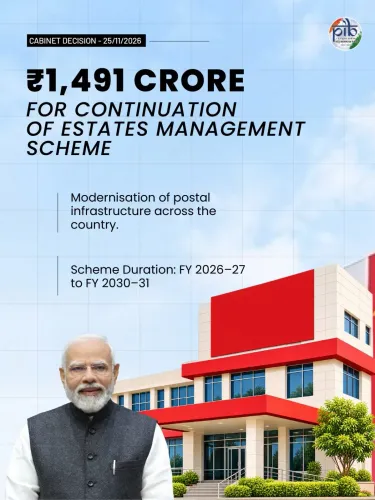
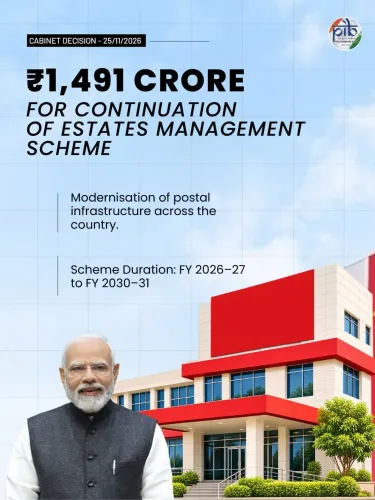
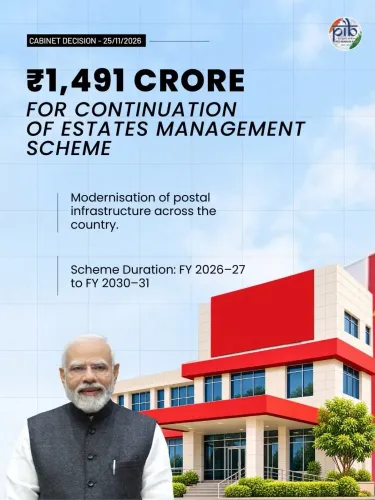
Education Minister Pradhan: Cabinet clears ₹1,141-cr postal scheme
Synopsis
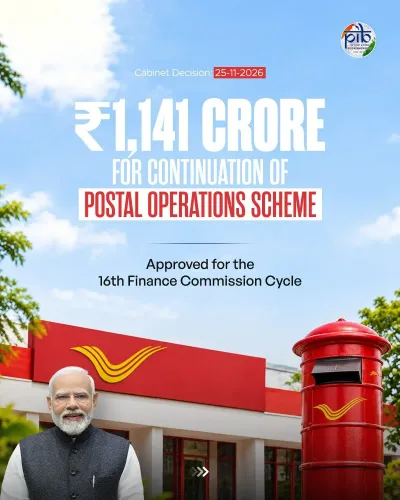
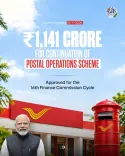
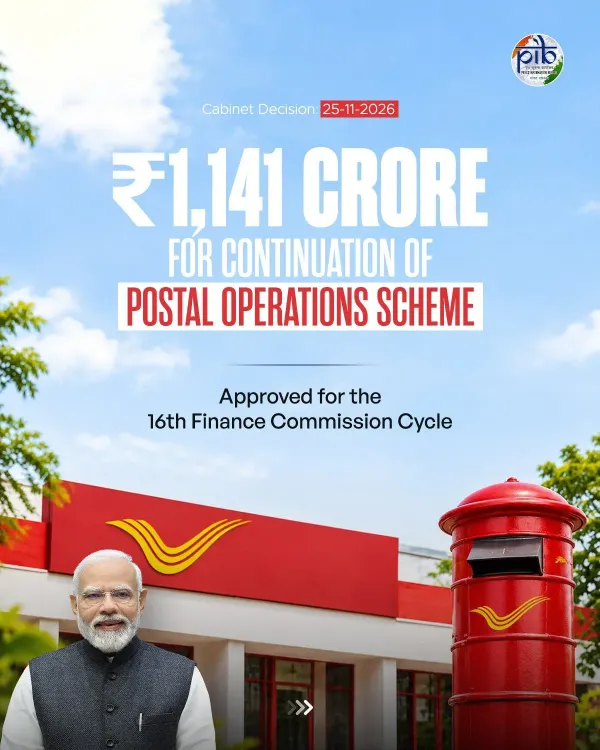
Union Education Minister Dharmendra Pradhan said the Union Cabinet, chaired by PM Narendra Modi, approved continuation of the Postal Operations Scheme with a ₹1,141 crore outlay for 2026–27 to 2030–31, covering rural access, parcels, e-commerce logistics, international mail, service quality and philately.
Key Takeaways
Union Education Minister Dharmendra Pradhan on 25 November 2026 said the Union Cabinet, chaired by PM Narendra Modi, approved continuation of the Postal Operations Scheme.
The announced outlay is ₹1,141 crore for 2026–27 to 2030–31.
Six stated focus areas: rural postal and financial access, faster mail and parcels, e-commerce logistics, international mail, service quality, and philately.
The Department of Posts and India Post are the implementing backbone of the network.
An earlier IT Modernization Project for the Department of Posts was approved in 2012 to computerise and network post offices.
Rural communities and e-commerce businesses are the principal groups highlighted in the announcement.
A five-year cheque just landed on India's oldest public network. On 25 November 2026, Union Education Minister Dharmendra Pradhan said the Union Cabinet in New Delhi, chaired by Prime Minister Narendra Modi, had approved continuation of the Postal Operations Scheme — ₹1,141 crore for 2026–27 to 2030–31. The pitch is blunt: faster mail, better parcels, and counters that still work in the village.
Pradhan described the decision as everyday infrastructure, not a distant reform. From faster mail delivery to better parcel services, he said, continued modernisation of postal operations will make services more efficient and accessible for citizens across India. In his words, the focus is on making essential services more accessible, reliable and responsive to citizens' needs.
Six priorities, from village counters to philately
The minister listed six workstreams. First: better access to postal and financial services in rural areas — the last-mile map the Department of Posts already occupies. Second: faster, more efficient mail and parcel delivery. Third: improved logistics support for e-commerce and rural businesses, the sellers who now ship from small towns, not only from metros.
The other three look outward and backward at once. Smoother processing of international mail and consignments. Improved service quality and customer experience. Greater awareness of India's postal heritage through philately. Letters still matter. Stamps still tell a national story. Parcels and payments now share the same counter.
A network built for inclusion, now asked to move goods
Successive governments have treated India Post as more than a mail carrier. The IT Modernization Project for the Department of Posts, approved in 2012, was meant to computerise and network post offices nationwide. That wave wired the counters. The Cabinet decision Pradhan announced extends an older pattern: keep upgrading a citizen-facing grid so rural banking, digital payments and e-commerce can ride the same rails.
Rural households remain the core constituency. So do small e-commerce firms that need pickup beyond city warehouses. India Post already sits where private logistics still treats the last mile as expensive. The bet in this outlay is that presence can be turned into speed.
The test after the Cabinet note
The announcement is the easy part. Watch rollout milestones for rural post office upgrades, and whether the scheme surfaces again in the next Union Budget or in Parliament. A ₹1,141 crore envelope over five years is a planning signal. Delivery times, parcel volumes and village-level financial access will be the scorecard.
The next test is whether a weaver's parcel from a taluka post office reaches a buyer as reliably as a money order once did. That is the modernisation India Post is being funded to prove.
Point of View
Not merely a letter carrier. That a minister holding the Education portfolio is amplifying a Department of Posts Cabinet note also shows how front-bench messaging now travels in real time across ministries. The policy question is whether ₹1,141 crore over five years can close the gap between a computerised counter and a competitive parcel service. Watch rural upgrade timelines more than the philately line — heritage is garnish; last-mile speed is the meal.
NationPress
25 Nov 2026
Frequently Asked Questions
What did Dharmendra Pradhan say about the Postal Operations Scheme?
Union Education Minister Dharmendra Pradhan said the Union Cabinet, chaired by Prime Minister Narendra Modi, approved continuation of the Postal Operations Scheme with an outlay of ₹1,141 crore for 2026–27 to 2030–31. He framed it as a push for faster mail, better parcels and more accessible services nationwide.
What is the outlay and period of the postal scheme announced on 25 November 2026?
Pradhan said the outlay is ₹1,141 crore covering 2026–27 to 2030–31. He presented the decision as a continuation of postal operations modernisation rather than an entirely new programme.
What are the six focus areas of the Postal Operations Scheme?
According to Pradhan, the six areas are better rural access to postal and financial services; faster mail and parcel delivery; logistics support for e-commerce and rural businesses; smoother international mail and consignments; improved service quality and customer experience; and greater awareness of India's postal heritage through philately.
How does this relate to earlier India Post upgrades?
The Department of Posts has been on a long modernisation path, including the IT Modernization Project approved in 2012 to computerise and network post offices. The Cabinet decision announced by Pradhan extends that pattern of incremental upgrades linking legacy post offices with rural finance and e-commerce logistics.
Who stands to be affected by the postal operations continuation?
Rural populations seeking postal and financial access, and e-commerce as well as rural businesses needing logistics, are the main groups highlighted. Users of ordinary mail, parcels and international consignments are also in the stated scope.