Education Minister Pradhan flags ₹11,000-cr equipment scheme
Synopsis
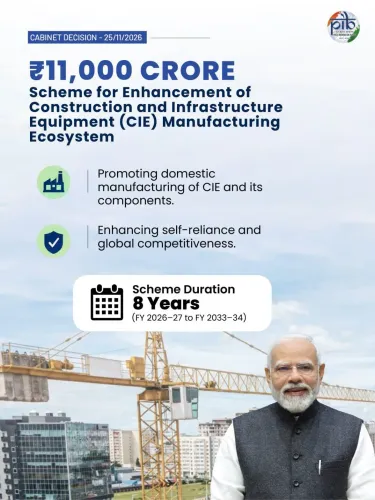
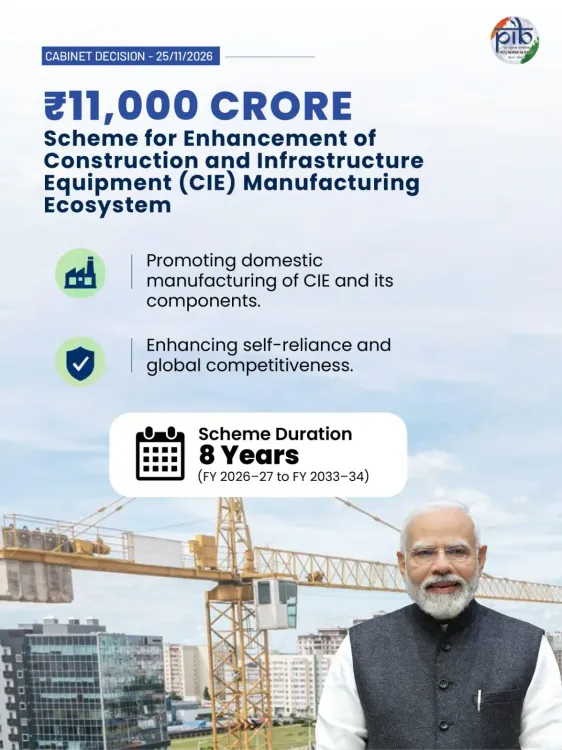
Union Education Minister Dharmendra Pradhan said the Union Cabinet, chaired by Prime Minister Narendra Modi, has approved an ₹11,000 crore scheme for construction and infrastructure equipment. He put the market at ₹97,500 crore in FY 2024–25, projected to reach ₹2.28 lakh crore by FY 2029–30, with incentives and a testing facility to deepen local manufacturing.
Key Takeaways
Union Education Minister Dharmendra Pradhan said the Union Cabinet, chaired by Prime Minister Narendra Modi, approved an ₹11,000 crore scheme for construction and infrastructure equipment manufacturing.
He said the Indian market, already the world's third-largest, was valued at ₹97,500 crore in FY 2024–25 and is projected to reach ₹2.28 lakh crore by FY 2029–30.
The scheme will incentivise production of advanced equipment and components and set up a dedicated testing facility, according to his post.
Stated aims include indigenous capabilities, stronger supply chains, employment and higher global competitiveness.
The move sits in the Make in India (2014), Atmanirbhar Bharat (2020) and Production Linked Incentive lineage.
Next markers: scheme guidelines, testing-facility site selection and first incentive disbursements.
Union Education Minister Dharmendra Pradhan said on 25 November 2026 that India's construction-equipment industry — already the world's third-largest — is being backed by an ₹11,000 crore Cabinet scheme to turn a booming market into a manufacturing hub. The Union Cabinet, he said, was chaired by Prime Minister Narendra Modi. He put the sector at ₹97,500 crore in FY 2024–25 and projected more than a doubling to ₹2.28 lakh crore by FY 2029–30.
Pradhan wrote that the industry is 'entering a phase of significant growth.' Recognising that opportunity, he said, the Cabinet had approved the outlay to strengthen the domestic manufacturing ecosystem — by incentivising advanced equipment and components and by establishing a dedicated testing facility.
Those two instruments, in his telling, will deepen indigenous capabilities, strengthen supply chains, generate employment and enhance India's competitiveness in the global market. He called the decision 'a major push towards making India a global hub for construction and infrastructure equipment manufacturing.'
A ₹97,500 crore market racing toward ₹2.28 lakh crore
Scale is the argument. Third-largest in the world, ₹97,500 crore today, more than double by the end of the decade — if the projection holds. That growth is not abstract. It is excavators on highway packages, cranes over metro viaducts, pavers on expressways.
The risk in a boom like that is familiar: demand is Indian, high-value machines and components often are not. The Cabinet package is framed as a bid to reverse that leak.
Incentives plus a dedicated testing facility
Production incentives for advanced equipment and components are one lever. A dedicated testing facility is the other. Heavy machinery does not clear export markets on slogans. It clears them on certified tests.
The template is older than this outlay. Make in India in 2014 named manufacturing as a national project. Atmanirbhar Bharat in 2020 made self-reliance the organising idea. Production Linked Incentive schemes, rolled out from 2020 for automobiles, electronics and pharmaceuticals, paid firms to produce at home. Construction and infrastructure equipment now sits in that same capital-goods lane, part of a longer effort to raise manufacturing's share of GDP and lock Indian firms into global supply chains.
Localising this stack is harder than assembling phones. Steel, hydraulics, engines, electronics and after-sales networks all have to move together. A test bed is meant to be the missing public good.
Guidelines, a lab site and the first payouts
Manufacturers will not bank an announcement. They will watch three clocks: when scheme guidelines are notified, where the testing facility is sited, and when the first incentives are actually paid to eligible firms.
Until then, ₹11,000 crore is an envelope. Construction-equipment makers and their component suppliers are the first in line. Jobs and export share are the claimed returns.
India wants the machines that build its roads and ports to be made — and certified — at home. The Cabinet has named a price. Factories, labs and invoices will decide whether the hub is real.
Point of View
000 crore package extends the incentive-and-infrastructure model New Delhi has used in electronics, automobiles and pharmaceuticals since 2020. Construction equipment is a harder test because it is capital-intensive and certification-heavy; a testing facility matters as much as the subsidy. Pradhan's post frames the Cabinet as converting India's third-largest market into a manufacturing base rather than an import sink. The political bet is familiar: pay for localisation now, claim jobs and export share later — if guidelines and disbursements follow.
NationPress
25 Nov 2026
Frequently Asked Questions
What scheme did the Union Cabinet approve for construction equipment?
The Union Cabinet, chaired by Prime Minister Narendra Modi, has approved an ₹11,000 crore scheme to strengthen domestic manufacturing of construction and infrastructure equipment, Union Education Minister Dharmendra Pradhan said. The package is meant to incentivise advanced equipment and components and set up a dedicated testing facility.
How large is India's construction and infrastructure equipment market?
Pradhan said the market, already the world's third-largest, was valued at ₹97,500 crore in FY 2024–25. He said it is projected to more than double to ₹2.28 lakh crore by FY 2029–30.
What will the ₹11,000 crore construction equipment scheme fund?
According to Pradhan, the scheme will incentivise production of advanced equipment and components and establish a dedicated testing facility. He said it would deepen indigenous capabilities, strengthen supply chains, generate employment and enhance India's global competitiveness.
How does this fit with Make in India and Atmanirbhar Bharat?
The package follows the Make in India push launched in 2014 and the Atmanirbhar Bharat self-reliance drive announced in 2020. It also echoes Production Linked Incentive schemes introduced from 2020 to raise domestic output in capital goods and cut import dependence.
What happens next after the Cabinet approval?
The next markers are notification of scheme guidelines, selection of a site for the testing facility, and the first incentive disbursements to eligible manufacturers. Those steps will determine how quickly the outlay reaches factories.