Gadkari: Cabinet clears ₹11,000-crore CIE manufacturing scheme
Synopsis
Union Minister Nitin Gadkari said the Cabinet chaired by PM Narendra Modi has approved a ₹11,000-crore scheme to boost domestic CIE manufacturing, including a dedicated testing facility, under the Ministry of Heavy Industries.
Key Takeaways
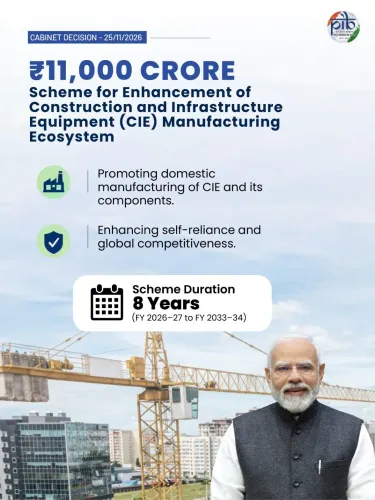
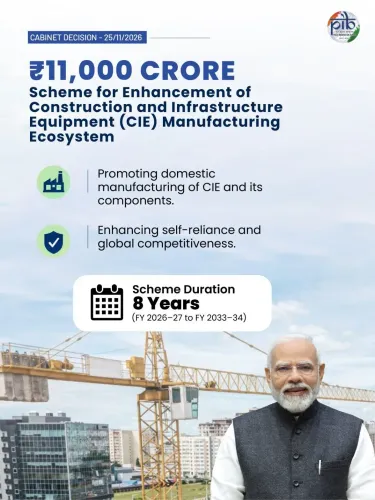
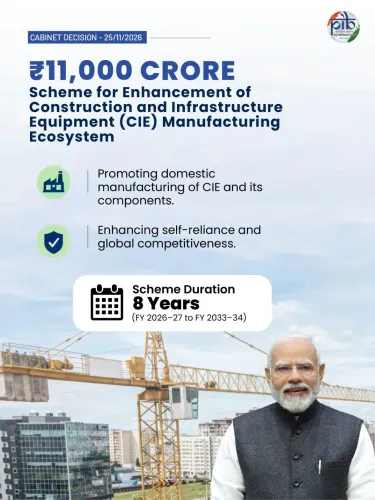
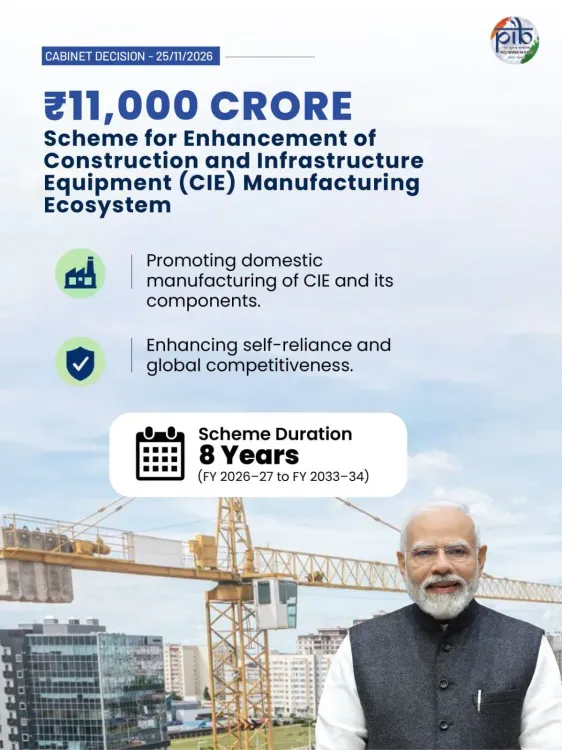
The Union Cabinet, chaired by Prime Minister Narendra Modi, approved the Scheme for Enhancement of Construction and Infrastructure Equipment (CIE) Manufacturing Ecosystem on 25 November 2026.
The financial outlay is ₹11,000 crore, announced by Union Road Transport and Highways Minister Nitin Gadkari.
The Ministry of Heavy Industries will implement the scheme to boost domestic manufacturing of equipment and components.
The scheme includes a dedicated testing facility in India; the site has not been notified.
Gadkari linked the decision to Atmanirbhar Bharat and Viksit Bharat@2047, citing jobs, supply-chain security and global competitiveness.
The move continues the Make in India (2014) and Atmanirbhar Bharat (2020) push to localise capital goods.
Union Road Transport and Highways Minister Nitin Gadkari on 25 November 2026 announced a ₹11,000 crore push to make in India the machines that build the country’s roads and cities. The Union Cabinet, chaired by Prime Minister Narendra Modi, has approved the Scheme for Enhancement of Construction and Infrastructure Equipment (CIE) Manufacturing Ecosystem, to be implemented by the Ministry of Heavy Industries. The package aims to lift domestic manufacturing of equipment and components and to set up a dedicated testing facility on Indian soil.
Posting on X, Gadkari said the Union Cabinet had approved the scheme with a financial outlay of ₹11,000 crore. He wrote: 'This landmark initiative will strengthen indigenous capabilities, secure supply chains, generate employment and enhance India’s competitiveness in the global CIE market, advancing the vision of Atmanirbhar Bharat and Viksit Bharat@2047.'
₹11,000 crore to localise construction machinery
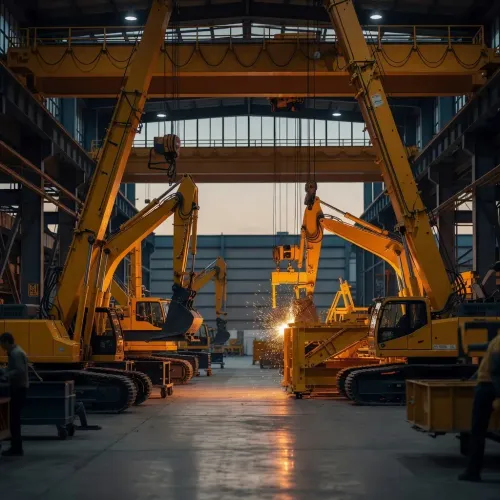
Excavators, pavers, graders and cranes sit at the centre of every highway, rail and housing programme. India has scaled those programmes fast. Production of the machines themselves has not always kept pace, leaving component supply chains exposed and certification often dependent on labs abroad.
The new scheme, implemented by the Ministry of Heavy Industries, puts public money behind domestic manufacturing of construction and infrastructure equipment and components. A dedicated testing facility in India is an explicit part of the design. Selection of the site and detailed operational guidelines have not been notified.
From Make in India to capital-goods self-reliance
Make in India, launched in 2014, sought to position India as a global manufacturing destination, including in heavy equipment. The Atmanirbhar Bharat package announced in 2020 sharpened the drive to cut import dependence in strategic industries. This Cabinet decision continues that lineage: localise capital goods, lock in component supply chains, and raise export competitiveness in the heavy engineering sector.
Tying the scheme to Viksit Bharat@2047 places it inside a long-term industrial modernisation agenda. CIE manufacturers, infrastructure developers and the Indian workforce are the immediate stakeholders. Employment generation and more secure supply chains for public works are stated aims, not side effects.
Heavy Industries Ministry must still notify the testing site
Markets will now watch for scheme guidelines and the location of the testing facility from the Ministry of Heavy Industries, and later for budgetary or parliamentary updates on disbursement and jobs. Until those papers appear, the outlay and the intent are what New Delhi has locked in.
For a country pouring concrete at record pace, the machines that do the pouring may finally be built — and proven — at home.
Point of View
000-crore Cabinet scheme to localise CIE manufacturing and testing continues the Make in India and Atmanirbhar Bharat sequence rather than inventing a new doctrine. Gadkari’s announcement from the roads ministry underlines that the biggest buyer of these machines sits inside government. Delivery will be judged on how quickly the Ministry of Heavy Industries converts an outlay into plants, a test facility and measurable import substitution.
NationPress
25 Nov 2026
Frequently Asked Questions
What scheme did the Union Cabinet approve for construction equipment?
The Cabinet, chaired by Prime Minister Narendra Modi, approved the Scheme for Enhancement of Construction and Infrastructure Equipment (CIE) Manufacturing Ecosystem with an outlay of ₹11,000 crore. Union Minister Nitin Gadkari announced the decision on 25 November 2026.
Who will implement the CIE manufacturing scheme?
The Ministry of Heavy Industries will implement the scheme. It is designed to boost domestic manufacturing of construction and infrastructure equipment and components and to establish a dedicated testing facility in India.
What is the financial outlay of the CIE manufacturing ecosystem scheme?
The Union Cabinet has approved a financial outlay of ₹11,000 crore for the scheme. Nitin Gadkari described it as a landmark initiative for indigenous capabilities and global competitiveness.
How is the CIE scheme linked to Atmanirbhar Bharat?
Gadkari said the initiative will strengthen indigenous capabilities and secure supply chains, advancing Atmanirbhar Bharat and Viksit Bharat@2047. It continues the Make in India push launched in 2014 and the 2020 self-reliance package for strategic industries.
Is the location of the CIE testing facility known?
No. The scheme includes a dedicated testing facility in India, but the exact location and operational guidelines have not been notified. Those details are expected from the Ministry of Heavy Industries.