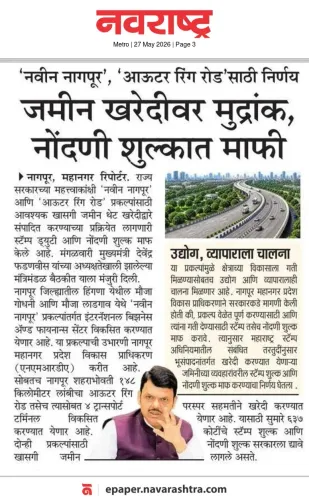
CM Fadnavis Cabinet Decides on Revenue & Stamp Duty Reforms
Synopsis
The Chief Minister's Office of Maharashtra announced a cabinet decision on 26 May 2026 concerning the Revenue and Stamp Duty and Registration Department, with CM Devendra Fadnavis at the helm. The move is expected to impact property transactions and state revenue collection across Maharashtra.
Key Takeaways
The Maharashtra cabinet under CM Devendra Fadnavis took decisions on 26 May 2026 regarding the Revenue and Stamp Duty and Registration Department .
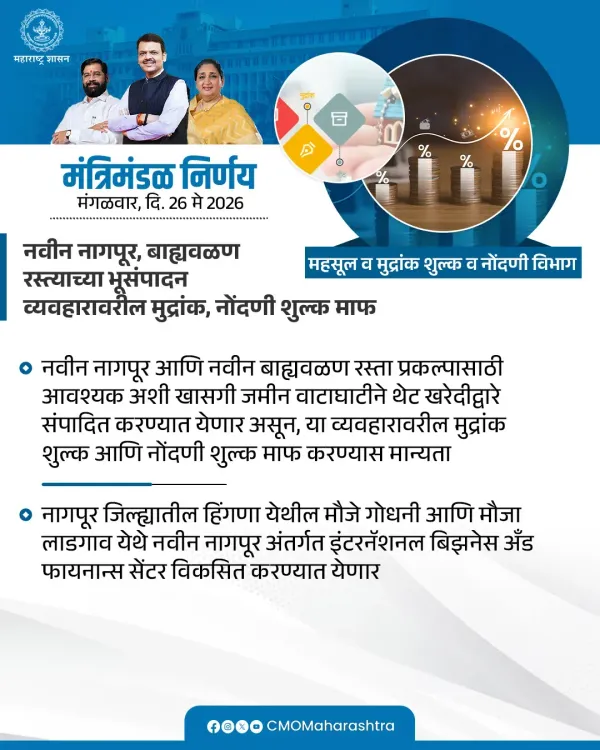
The announcement was made by the Chief Minister's Office of Maharashtra via its official X account.
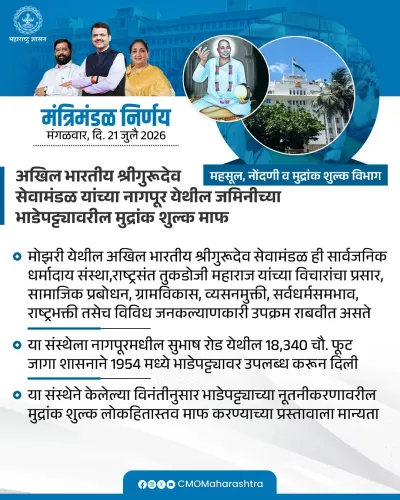
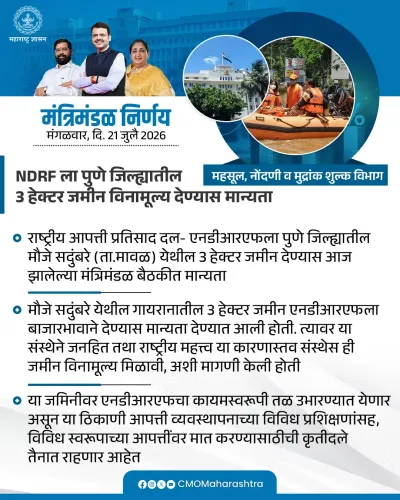
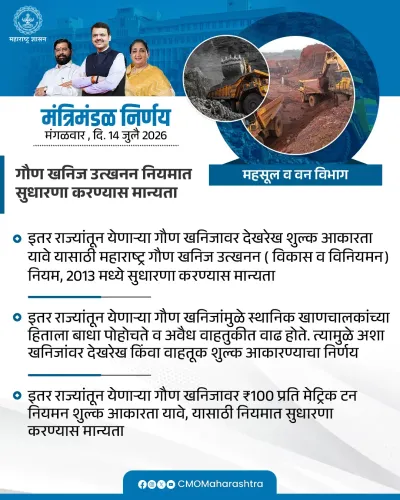
Three official images were shared alongside the post, indicating formal documentation of the decisions.
The Revenue and Stamp Duty and Registration Department governs stamp duty collection, property registration, and land revenue across Maharashtra.
Formal gazette notification detailing the exact decisions — including any rate changes or procedural reforms — is awaited.
The decisions are expected to have direct implications for property buyers , real estate developers , and land revenue stakeholders statewide.
The Chief Minister's Office of Maharashtra announced on Tuesday, 26 May 2026 that the state cabinet, led by Chief Minister Devendra Fadnavis, has taken decisions concerning the Revenue and Stamp Duty and Registration Department — a key body overseeing property transactions, stamp duty collection, and land revenue across the state.
Context
The official post, shared by @CMOMaharashtra, announced a मंत्रिमंडळ निर्णय (cabinet decision) specifically pertaining to the Revenue and Stamp Duty and Registration Department. The announcement was accompanied by three images, suggesting official documentation or visual summaries of the decisions were released alongside the post. Detailed specifics of the decisions are expected to be formally notified through official government channels.
The Revenue and Stamp Duty and Registration Department is among Maharashtra's most consequential administrative arms, directly affecting millions of property buyers, sellers, and real estate stakeholders across the state every year.
Policy Backdrop
Maharashtra's cabinet regularly revisits rules governing stamp duty and property registration as part of its broader effort to balance state revenue mobilisation with ease of doing business in real estate. The state has, over successive governments, periodically revised stamp duty rates, introduced concessions for specific buyer categories, and modernised land record systems to reduce transaction friction.
Chief Minister Devendra Fadnavis, heading a BJP-led coalition government, has positioned administrative efficiency and revenue optimisation as central planks of his governance agenda. Decisions from the Revenue and Stamp Duty Department feed directly into the state's fiscal health, given that stamp duty collections consistently rank among Maharashtra's largest own-tax revenue sources.
Stakeholders and Impact
Any revision to stamp duty rates or registration procedures has an immediate and widespread impact on property buyers, sellers, developers, and the broader real estate sector — particularly in high-value markets such as Mumbai, Pune, and Nagpur. Changes to land revenue rules can also affect farmers, rural landowners, and urban local bodies that depend on accurate land records for planning and taxation.
Procedural reforms in registration, such as digitisation of documents or streamlining of processes at sub-registrar offices, directly affect the ease and cost of completing property transactions for ordinary citizens.
What's Next
An official government notification is expected to detail the precise nature of the cabinet decisions — whether they involve changes to stamp duty rates, new exemptions, procedural reforms, or amendments to land revenue regulations. Stakeholders in the real estate and legal sectors will closely track the gazette notification for actionable details.
These decisions, once formally notified, could shape property market sentiment in Maharashtra in the near term, with particular attention from developers and institutional investors active in the state's urban centres.
Point of View
Any stamp duty rationalisation would serve the dual purpose of boosting homebuyer sentiment and reinforcing the government's pro-growth credentials ahead of urban local body cycles. The absence of specific rate details in the initial announcement is standard practice; the real signal will come in the gazette notification. Observers should watch whether this decision tilts toward revenue augmentation or buyer relief.
NationPress
11 Oct 2026
Frequently Asked Questions
What did the Maharashtra cabinet decide on 26 May 2026 regarding stamp duty?
The Maharashtra cabinet under CM Devendra Fadnavis took decisions concerning the Revenue and Stamp Duty and Registration Department on 26 May 2026. The exact details — including any rate changes or procedural reforms — are expected to be released via an official government notification.
What is the Revenue and Stamp Duty and Registration Department in Maharashtra?
It is a Maharashtra state government department responsible for collecting stamp duty on property transactions, overseeing property registration at sub-registrar offices, and managing land revenue records across the state.
How does a change in stamp duty affect property buyers in Maharashtra?
Stamp duty is a mandatory tax paid when registering a property. Any revision — upward or downward — directly changes the total cost of a property transaction for buyers and sellers, and can significantly influence demand in the real estate market.
Who is Devendra Fadnavis and what is his role?
Devendra Fadnavis is the Chief Minister of Maharashtra, heading a BJP-led coalition government. He chairs the state cabinet and is responsible for all major policy decisions, including those affecting revenue, stamp duty, and property registration.
Where can I find the official details of the Maharashtra cabinet's stamp duty decision?
Official details will be published in the Maharashtra Government Gazette and on the state government's official portals after formal notification. The Chief Minister's Office X account (@CMOMaharashtra) also shares updates on cabinet decisions.