CM Fadnavis Chairs Meet on Maharashtra Labour Law Reforms
Synopsis
Chief Minister Devendra Fadnavis chaired a meeting on 13 July 2026 at Varsha, Mumbai, directing amendments to the Maharashtra Mathadi Act 1969 and Private Security Guards Act 1981 to align them with central labour codes, while prioritising workers' welfare, eliminating dual board membership, and extending coverage to domestic workers.
Key Takeaways
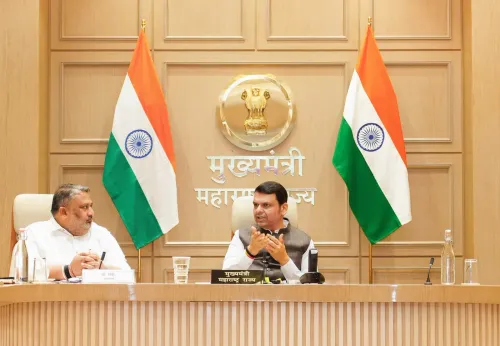
CM Devendra Fadnavis chaired a meeting at Varsha residence, Mumbai on 13 July 2026 on labour law amendments.
Two Acts under review: Maharashtra Mathadi, Hamal and Other Manual Workers Act, 1969 and Maharashtra Private Security Guards Act, 1981 .
Amendments will align state laws with India's four central labour codes (2019-20) and the Bharatiya Nyaya Sanhita .
Dual membership in construction and Mathadi welfare boards is to be eliminated for construction-sector workers.
Domestic workers are to be included in new sector-specific welfare schemes under the central codes.
Amendment proposals are to be placed before the state cabinet ; district-wise CJM reports on pending labour cases are also directed.
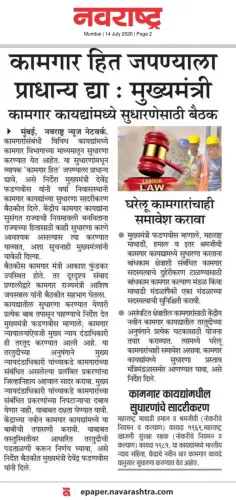
The Chief Minister's Office of Maharashtra announced on Monday, 13 July 2026 that Chief Minister Devendra Fadnavis chaired a high-level meeting at Varsha residence, Mumbai, to deliberate on amendments to two key state labour statutes — the Maharashtra Mathadi, Hamal and Other Manual Workers (Regulation of Employment and Welfare) Act, 1969 and the Maharashtra Private Security Guards (Regulation of Employment and Welfare) Act, 1981.
What the Meeting Decided
CM Fadnavis directed officials to prioritise broad kaamgarhit (workers' welfare) in every proposed amendment. He instructed that while aligning state rules with central labour codes, any modifications necessary to protect state interests should also be incorporated. The Chief Minister emphasised that every clause of the proposed changes must be scrutinised carefully before being finalised.
On judicial arrangements, Fadnavis noted that the provision of Chief Judicial Magistrates (CJMs) has been introduced in place of dedicated labour courts. He directed that a district-wise report of pending labour-related cases before CJMs be prepared, and that care be taken to ensure CJMs are not overburdened with the additional caseload arising from labour disputes.
Context
India consolidated 29 central labour laws into four labour codes — covering wages, industrial relations, social security, and occupational safety — passed between 2019 and 2020. States are required to frame their own rules under these codes, making alignment of legacy state statutes a pressing administrative task. Maharashtra's two Acts under review date back to 1969 and 1981 respectively, and have not seen comprehensive revision to match the new central framework.
The amendments are also being aligned with the Bharatiya Nyaya Sanhita, which replaced the Indian Penal Code, requiring corresponding updates to penal provisions referenced in older labour statutes.
Policy Backdrop
A significant operational concern flagged at the meeting was the problem of dual membership in welfare boards. Fadnavis directed that construction-sector workers should be enrolled in either the Construction Workers Welfare Board or the Mathadi Board — not both — to eliminate duplication of benefits and administrative overlap.
On unorganised sector coverage, the Chief Minister instructed that sector-specific welfare schemes be formulated for each category of worker under the new central codes. He specifically named domestic workers as a category that must be included in these schemes, signalling an intent to extend formal welfare cover to one of the most vulnerable and historically excluded segments of the workforce.
Stakeholders and Impact
Mathadi workers, hamals, private security guards, and domestic workers across Maharashtra stand to be directly affected by the proposed amendments. The Mathadi Act alone covers a large number of unorganised manual labourers engaged in loading, unloading, and carrying work across markets, warehouses, and construction sites in the state.
The meeting was attended by Minister Akash Fundkar, Minister of State Adv. Ashish Jaiswal, and senior officials from the Labour Department.
What's Next
CM Fadnavis directed that the amendment proposals be placed before the state cabinet for approval. Simultaneously, district-wise reporting by Chief Judicial Magistrates on pending labour cases is to be initiated. Officials have also been tasked with fact-based verification of each proposed provision before a final decision is taken. The outcome of the cabinet deliberation will determine the legislative timeline for updating Maharashtra's labour welfare architecture.
Point of View
As states that delay framing rules under the four central labour codes risk legal and operational inconsistencies in welfare delivery. Fadnavis's specific direction to include domestic workers in new welfare schemes is politically notable — this category has long been excluded from formal protections and represents a large, predominantly female workforce. The instruction to avoid overburdening Chief Judicial Magistrates with labour caseloads signals awareness that institutional capacity, not just legislative text, will determine whether the reforms deliver on the ground. The cabinet approval step will be the real test of how quickly Maharashtra can translate these directives into enforceable law.
NationPress
12 Oct 2026
Frequently Asked Questions
What labour laws is Maharashtra planning to amend in 2026?
Maharashtra is amending the Maharashtra Mathadi, Hamal and Other Manual Workers (Regulation of Employment and Welfare) Act, 1969 and the Maharashtra Private Security Guards (Regulation of Employment and Welfare) Act, 1981 to align them with India's four new central labour codes and the Bharatiya Nyaya Sanhita.
Why is Maharashtra updating its labour laws now?
India consolidated 29 central labour laws into four codes between 2019 and 2020. States must align their own rules with these codes, making it necessary for Maharashtra to update legacy statutes like the 1969 Mathadi Act and the 1981 Private Security Guards Act.
Will domestic workers be covered under Maharashtra's new labour welfare schemes?
Yes. CM Devendra Fadnavis specifically directed that domestic workers be included in the sector-specific welfare schemes to be formulated under the new central labour codes, extending formal welfare coverage to this previously excluded category.
What is the Mathadi Board and who does it cover?
The Mathadi Board, established under the Maharashtra Mathadi, Hamal and Other Manual Workers Act, 1969 , regulates employment and provides welfare benefits to unorganised manual labourers — including hamals and mathadis — engaged in loading, unloading, and carrying work across markets, warehouses, and construction sites in Maharashtra.
What happens next after the labour law reform meeting chaired by Fadnavis?
CM Fadnavis directed that the amendment proposals be placed before the Maharashtra state cabinet for approval. District-wise reports on pending labour cases before Chief Judicial Magistrates are also to be prepared, and officials must verify each proposed provision on factual grounds before a final decision is taken.